Introduction
Does *67 still work in 2026? Mostly yes — and this guide covers exactly where it does, where it quietly fails, and what to use instead.
If you have ever needed to call a stranger, a marketplace seller, or a business without exposing your personal number, the answer to "does *67 still work" decides whether your privacy holds or leaks.
You will learn how the code behaves on today's carriers, why hidden calls increasingly go unanswered, the legal lines you should not cross, and a smarter way to hide your caller ID without looking like a spam call. Two minutes of reading here beats one awkward callback from a number you never meant to share.
Key Takeaways
- Does *67 still work in 2026? Yes — on most US and Canadian mobile and landline networks, dialing it before the full number shows your caller ID as "Private."
- It never works on 911, toll-free numbers, or text messages, and unmasking services can reveal blocked numbers anyway.
- Modern spam filters increasingly send anonymous calls straight to voicemail, so a hidden number often means an unanswered call.
- A virtual second number protects your real number while still showing a normal, callable ID — the modern replacement for star codes.
What *67 Does — and How to Dial It
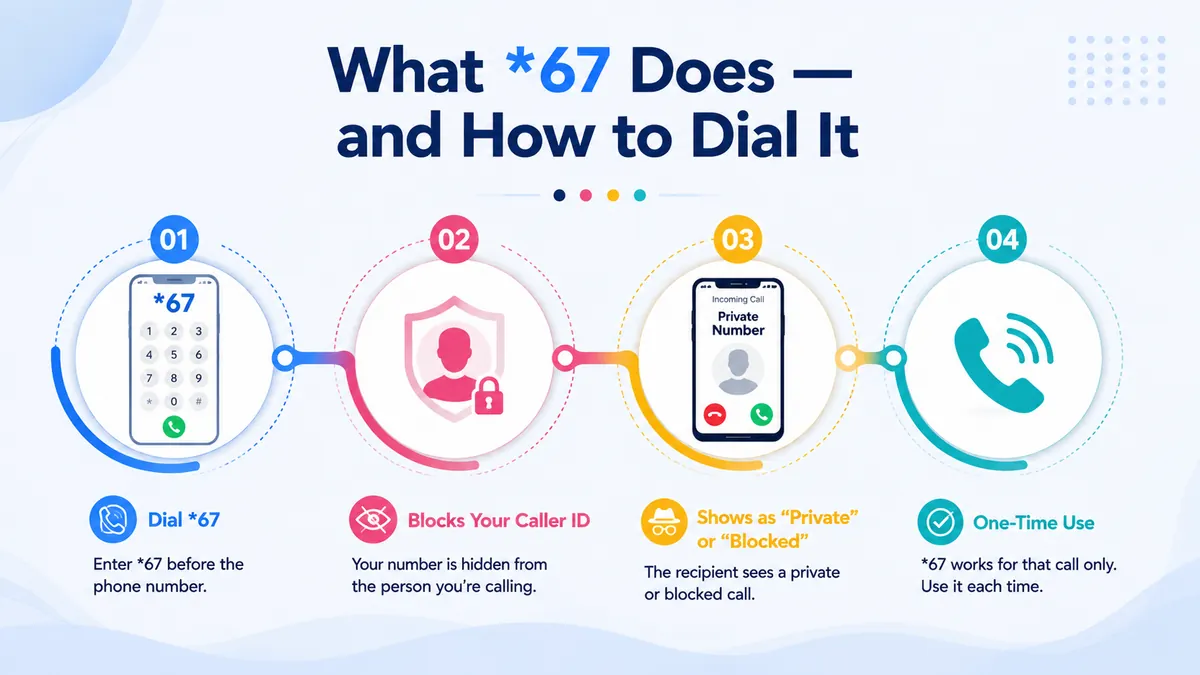
*67 is a vertical service code from the North American Numbering Plan — the same family of star codes that includes *69 (call return) and *82 (unblock). Dial *67 followed by the full ten-digit number, and the network strips your caller ID for that one call. The person you dial sees "Private," "Blocked," "Anonymous," or "Unknown" instead of your name and number.
The key word is one. *67 is strictly per-call — hang up, and your very next call shows your normal caller ID again. There is nothing to install, nothing to enable, and no charge on any major US carrier.
It works the same whether you dial from an iPhone, an Android phone, or a forty-year-old landline in the hallway. The reason "does *67 still work" keeps getting searched is simple: the code is so old that every generation rediscovers it and wonders if the smartphone era finally killed it.
To hide your caller ID on every call instead, skip the star code: iPhones offer Settings → Phone → Show My Caller ID, Androids bury a Caller ID option in call settings, and every carrier can apply a permanent line block on request. With a permanent block active, *82 does the reverse job — revealing your number for a single call when a callee refuses anonymous ones.
Does *67 Still Work in 2026? Carrier-by-Carrier Reality
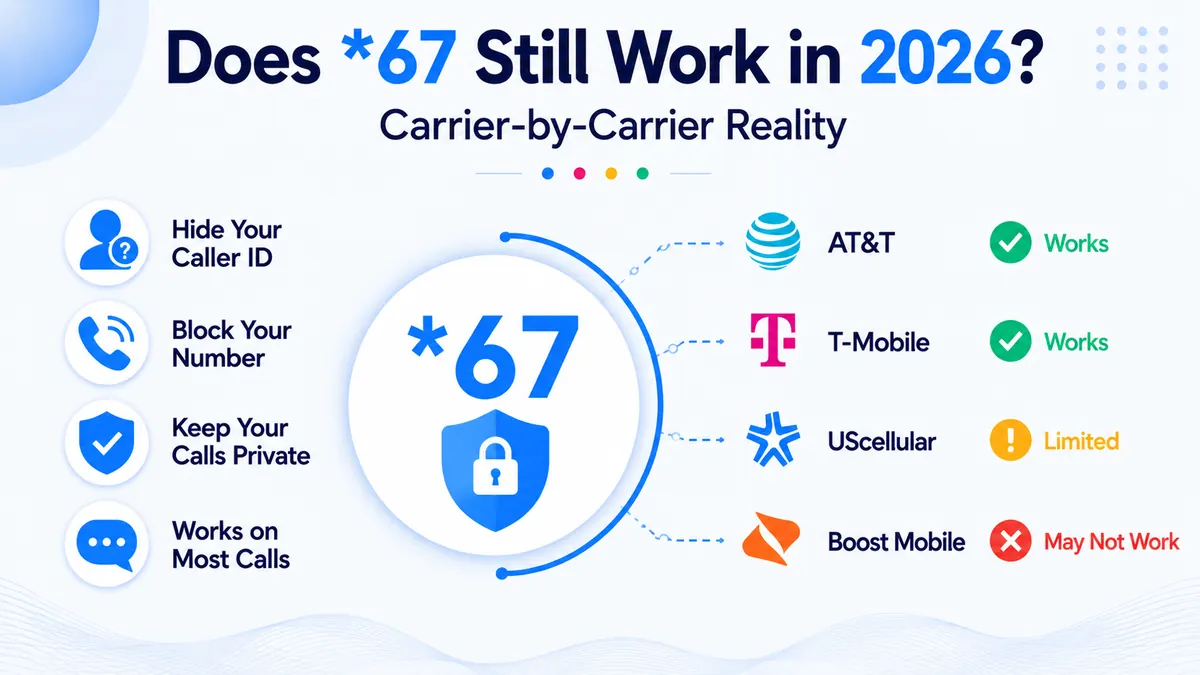
So, does *67 still work after decades of network changes? On the big three US carriers — AT&T, Verizon, and T-Mobile — yes, reliably, on both postpaid and most prepaid plans. Traditional landlines support it universally, and Canadian carriers honor it the same way since both countries share the numbering plan behind +1 dialing.
| Network | *67 Support | Notes |
|---|---|---|
| AT&T / Verizon / T-Mobile | Yes | Free, per-call, all modern plans |
| US & Canadian landlines | Yes | The original home of the code |
| Prepaid / MVNO carriers | Usually | A few budget plans disable it — test first |
| VoIP apps (Wi-Fi calling apps) | Varies | Many ignore star codes; use in-app settings |
| UK / Ireland | Use 141 | Different code, same idea |
| Most GSM countries | Use #31# | The international equivalent |
Still asking "does *67 still work" on your specific plan? One test call settles it: dial *67 plus a friend's number — or your own second line — and check what appears on the screen. If it shows "Private" or "Unknown," you are set; if your number appears, your carrier or plan has the feature disabled.
The catch in 2026 is not whether the code works — it is whether the person answers. Carriers now flag unidentified calls aggressively, which is exactly why the sections below matter more than the star code itself.
Where *67 Fails: 911, Toll-Free Lines, Texts, and Unmasking Apps
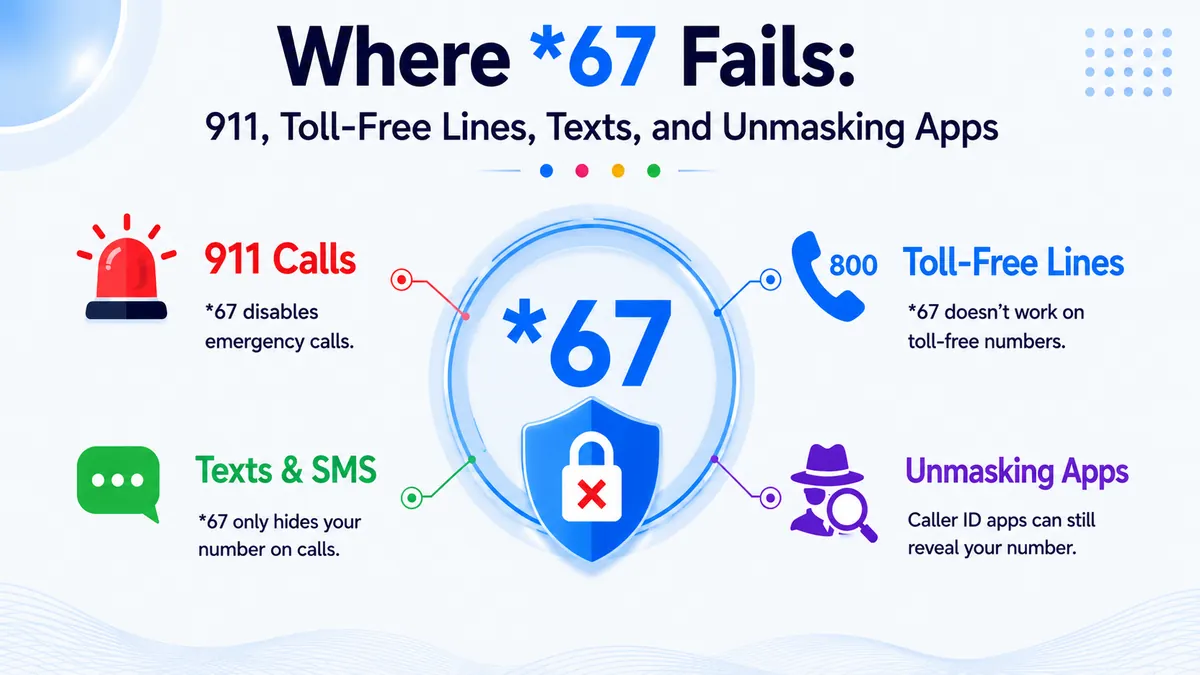
So does *67 still work against every kind of number? No — it has hard limits that no carrier setting changes. Emergency services always see your real number, because 911 systems are legally exempt from caller ID blocking.
Toll-free numbers see through it too: since the business pays for the call, billing systems capture your number through ANI data no matter what the display says. Our 866 guide explains how those toll-free systems work behind the scenes.
Text messages are the other blind spot — no star code hides your number on SMS, ever. And even on regular calls, unmasking services such as TrapCall can reveal a blocked number to their subscribers, while your carrier logs every call in full. *67 hides your number from a person's screen, not from the phone network itself.
*67 hides your number — a second number protects it.
Get a virtual number for marketplace deals, dating, and business calls, and keep your real number out of circulation entirely.
The Spam-Filter Problem: Why Private Calls Get Ignored
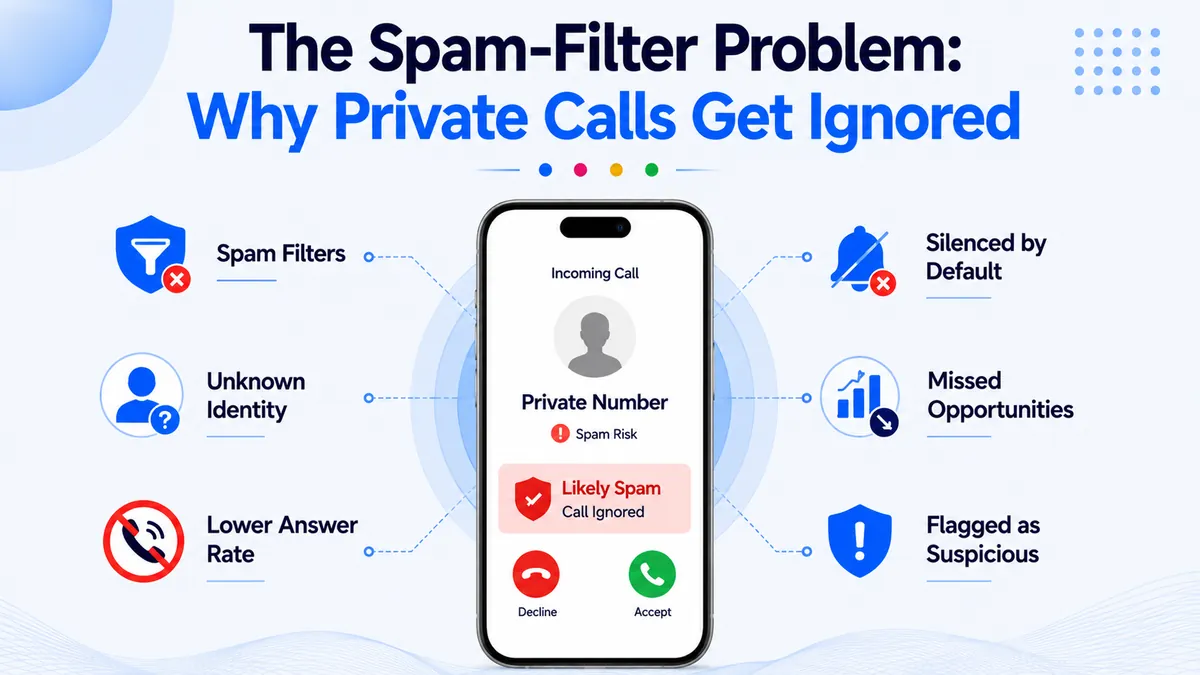
Here is what most guides skip: in 2026, blocking your caller ID often defeats the purpose of calling. Anonymous call rejection (*77) lets any subscriber bounce private calls automatically, iPhones silence unknown callers with one toggle, and carrier spam filters score identity-free calls as high risk. Your carefully hidden call frequently lands in voicemail — or nowhere at all.
The shift is structural. US carriers now authenticate calls with STIR/SHAKEN digital signatures, and calls that arrive without verifiable identity get treated the way email treats messages with no sender.
So while the technical answer to "does *67 still work" is yes, the social answer is increasingly no — choosing to hide your caller ID made you look cautious in 2005, and today it can make you look like a robocall.
Is It Legal to Hide Your Caller ID?
Using *67 for ordinary privacy is completely legal across the US. The line sits at deception and harm: under the Truth in Caller ID Act, transmitting misleading caller ID with intent to defraud, cause harm, or wrongly obtain anything of value is illegal, with penalties reaching tens of thousands of dollars per violation. The FCC spoofing rules draw that boundary in detail.
Blocking your ID also does not license harassment — repeated unwanted anonymous calls remain punishable, and courts can compel carriers to hand over the records behind any "Private" call. Use the code for privacy, never for cover.
A Second Number Beats a Hidden One
Think about what you actually want when you dial *67: to keep your personal number out of a stranger's hands. A virtual second number achieves that better. It shows a real, normal caller ID — so people answer — while your true number stays private. Sellers, clients, and dates can call or text you back without ever learning the number your family uses.
A second line also covers everything *67 cannot: it works for texting, it works when calling toll-free lines, and it never trips anonymous-call rejection. When a relationship or transaction ends, you simply retire the number — a cleaner break than any blocked call could offer. In other words, the best answer to "does *67 still work for my situation" is often a number where the question never comes up.
How to Get a Virtual Phone Number from CallMama
CallMama provides virtual numbers built for exactly this kind of privacy — a separate line for calls and texts that keeps your personal number personal, with no second SIM or second phone required. Your number activates in minutes and works worldwide.
Visit the Website or Download the App
Go to callmama.com or get the app from the App Store or Google Play.
Create Your Free Account
Register with your email address — it takes under a minute.
Choose Your Plan
Pick monthly or pay-as-you-go pricing that matches how often you call.
Select Your Private Number
Choose your country and area code — the number strangers will see instead of yours.
Activate Instantly
Complete payment and your second line goes live immediately.
Configure Your Settings
Set up call forwarding, voicemail, and SMS to fit how you use the line.
Start Calling Right Away
Make and receive calls and texts on any device, with your real number hidden.
Conclusion
So, does *67 still work? Yes — on nearly every US and Canadian carrier, it still hides your number for one call at a time, exactly as it has for decades.
You now also know its blind spots: 911 and toll-free lines see through it, texts ignore it entirely, unmasking apps can defeat it, and spam filters punish it. Used with those limits in mind, it remains a handy free tool for the occasional private call.
Phone privacy is moving past star codes toward numbers you control. A dedicated second line lets you hide your caller ID where it counts — by never exposing your real number in the first place — while still looking like a call worth answering. Setting one up takes less time than reading this article did. Claim your private number below and keep your personal line truly personal.
Your real number deserves better than a 'Private' label.
Download the CallMama app and run a second line for calls and texts — private, answerable, and yours in minutes.