Introduction
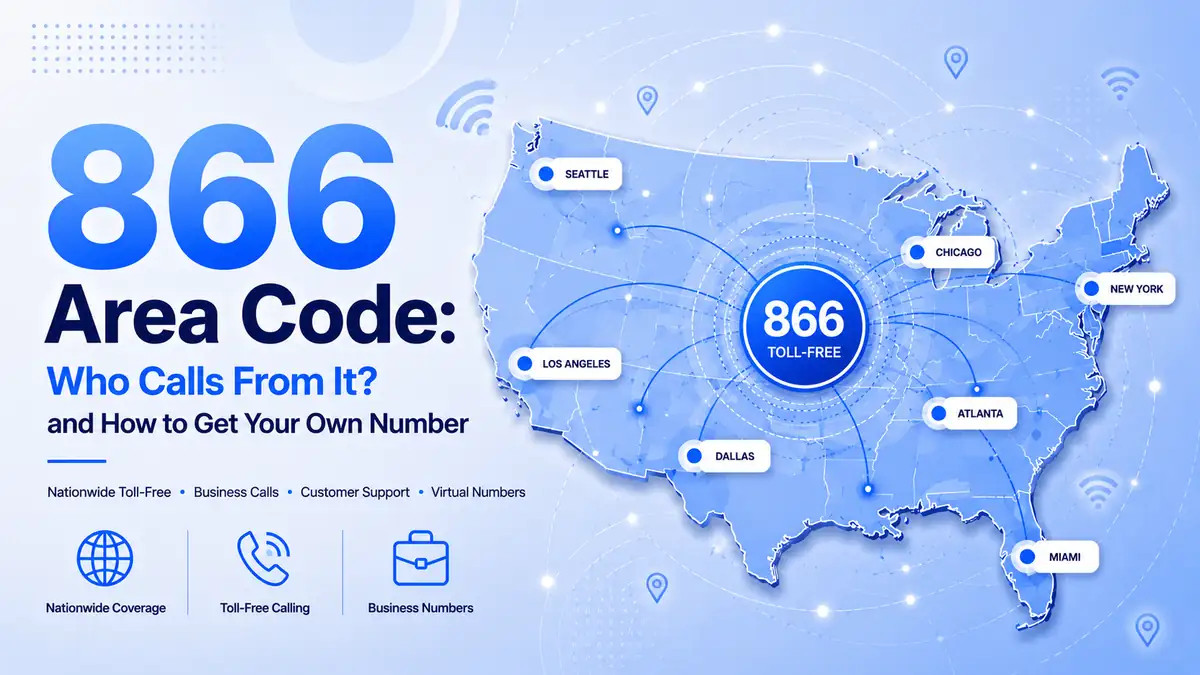
The 866 area code is a toll-free prefix that has connected callers to businesses across the United States and Canada — at zero cost to the caller — since July 2000. Because the 866 area code appears on everything from bank support lines to scam robocalls, knowing how it works protects your wallet and your privacy.
In this guide, you will learn who really dials from these numbers, how toll-free routing works, how to separate genuine support lines from fakes, and how to claim an 866 phone number of your own. By the end, one of North America's most misunderstood prefixes will hold no surprises.
Key Takeaways
- The 866 area code is toll-free — calls are free for US and Canadian callers, with the number's owner paying all inbound charges.
- 866 went live on July 29, 2000 — the fourth toll-free prefix and the only one launched during the dot-com boom.
- Toll-free numbers are fully portable under FCC rules — an 866 number belongs to the business, not the phone company.
- Scammers plant fake 866 "support" numbers in search results and run one-ring tricks — verifying numbers on the company's official site defeats both.
Inside the 866 Area Code: A Toll-Free Prefix, Not a Place
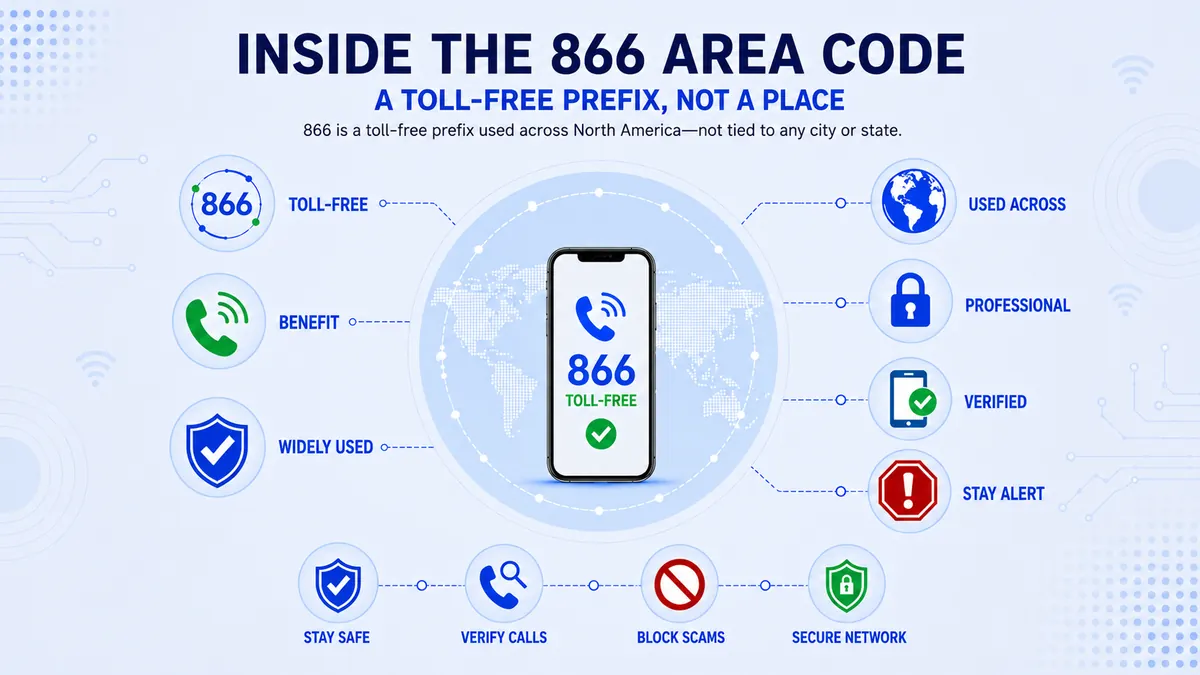
Most area codes point to a map: 212 means Manhattan, 305 means Miami. The 866 area code points to a billing rule instead. It is one of seven prefixes the FCC designates as toll-free — 800, 833, 844, 855, 866, 877, and 888 — and the organization holding the number pays the full cost of every inbound call.
That non-geographic design means an 866 number reaches across the entire North American Numbering Plan: all fifty US states, Canada, Bermuda, and much of the Caribbean. Callers in Vancouver and Miami dial the same ten digits and reach the same line, free of charge, with no long-distance fees involved.
One caution: only those seven prefixes are toll-free. Lookalike codes such as 876 (Jamaica) are geographic and carry real charges — a detail one-ring scammers exploit — so confirm the exact 866 code before returning a missed call.
Who Calls From an 866 Number — and Should You Pick Up?
If an 866 number lights up your screen, the odds strongly favor a legitimate organization. Banks and card issuers use the 866 area code for fraud alerts and account services, while insurers, pharmacies, hospitals, airlines, and utilities run 866 lines because the prefix is easy to publish nationally and free for customers to dial.
Collections agencies and survey firms favor toll-free lines too, which explains why some 866 calls feel less welcome. The rule: any unexpected call asking for money or personal details deserves a callback through the number on your statement or the company's website — never the number that just called you.
Texts follow the same logic. Businesses increasingly send order updates and two-factor codes from an 866 phone number, and US carriers require every toll-free texting line to pass verification first — making 866 texts harder to spoof than ordinary numbers.
Behind Every 866 Call: Registry Routing and Number Portability
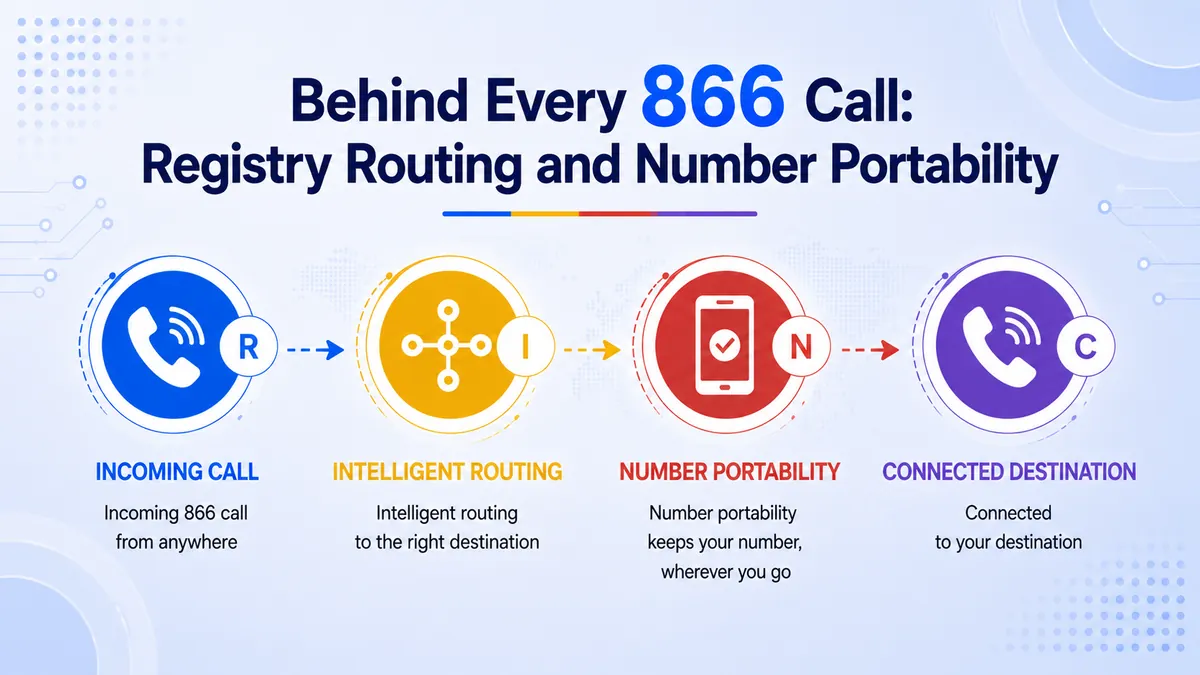
Dial an 866 area code number and your carrier queries a central database run by Somos, Inc., the FCC-appointed administrator of every toll-free number in North America. The registry returns routing instructions set by the number's owner, and the call lands wherever they choose — a cell phone, a VoIP app, or a call center.
That central registry powers a benefit many owners overlook: full portability. Under FCC rules, a toll-free number belongs to the subscriber, not the carrier, so you can move your 866 number to any provider and keep every digit. Business cards and ad campaigns stay intact when your phone service changes.
A number customers can call for free is a number they actually call.
Activate a professional 866 line in minutes — forwarding, voicemail, and verified SMS included from day one.
The Millennium Code: How 866 Joined the Toll-Free Family
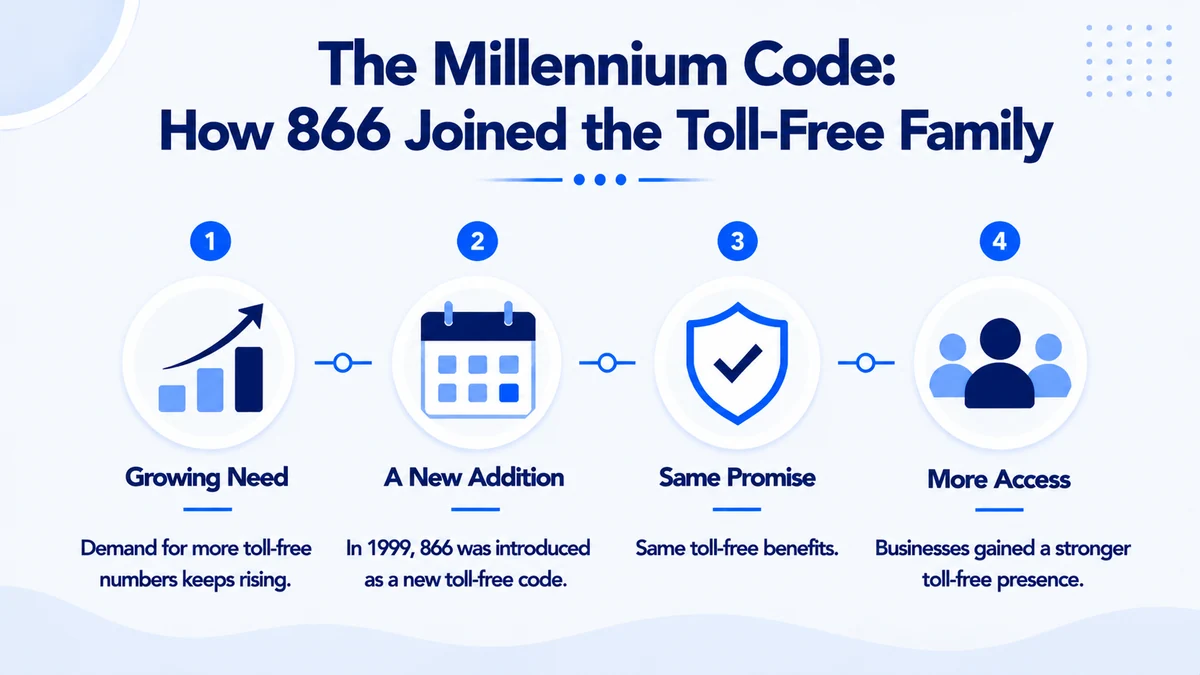
Toll-free service began in 1966, when AT&T's 800 prefix changed how America shopped and complained. Demand ate through the supply for decades, and regulators opened new codes one at a time. The 866 area code arrived on July 29, 2000 — the 280th area code placed in service and the only toll-free prefix born during the dot-com boom, just as websites began printing support numbers.
- 800 — 1966: The original, nearly exhausted and priced at a premium.
- 888 — 1996: The first relief code, released as 800 ran dry.
- 877 — 1998: Added as internet-era demand kept climbing.
- 866 — July 29, 2000: The millennium code — a quarter century of caller recognition and counting.
- 855 — 2010: The fifth prefix, covered in our 855 guide.
- 844 — 2013: A modern option with strong inventory launched three years later.
- 833 — 2017: The newest code with the widest selection.
Twenty-six years of service puts 866 in a sweet spot: recognized since dial-up days, yet never so depleted that good numbers became scarce the way 800 inventory did.
Choosing Between 866 and the Other Toll-Free Prefixes
Every toll-free prefix behaves identically for the caller, so the choice comes down to how established the code feels, how much inventory remains, and what your preferred digits cost.
| Prefix | Launched | Availability | Best For |
|---|---|---|---|
| 800 | 1966 | Very scarce | Maximum prestige, premium budget |
| 888 | 1996 | Limited | Strong recognition at lower cost |
| 877 | 1998 | Moderate | Established professional lines |
| 866 | 2000 | Moderate | Trusted feel with realistic pricing |
| 855 | 2010 | Good | Growing brands wanting choice |
| 844 | 2013 | Very good | Startups picking exact digits |
| 833 | 2017 | Best | Vanity numbers and new launches |
The 866 code wins for businesses that want a line customers instinctively recognize as toll-free without paying 800-level premiums — established rather than new, a quiet credibility signal against bigger competitors. Businesses that want the widest selection of digits instead should read the 844 breakdown.
What an 866 Phone Number Does for a Growing Business
A toll-free line removes the quietest objection in sales: the caller's cost. Businesses that publish an 866 phone number consistently receive more inbound calls than local-only competitors, because a free call is an easy call — and the prefix shows every customer one national brand.
Virtual 866 service turns one number into a complete toolkit: calls forward to any device, an auto-attendant routes callers, voicemails arrive transcribed, and verified SMS handles reminders. Assign a dedicated 866 toll-free number to each ad campaign and the call log becomes attribution data.
How to Get a Virtual Phone Number from CallMama
CallMama provides virtual toll-free and local numbers with forwarding, voicemail, and SMS managed from one simple app — no hardware, no contracts, no technical setup. Your 866 phone number activates within minutes and starts taking calls immediately.
Visit the Website or Download the App
Go to callmama.com or get the app from the App Store or Google Play.
Create Your Free Account
Register with your email address to unlock the number dashboard.
Choose Your Plan
Pick monthly or pay-as-you-go pricing that fits your call volume.
Select Your 866 Number
Browse live inventory by digit pattern or memorable sequence and pick your favorite.
Activate Instantly
Complete payment and your number goes live immediately, with no waiting period.
Configure Your Settings
Set up call forwarding, voicemail, and SMS to match how you work.
Start Calling Right Away
Make and receive calls on any smartphone, tablet, or computer.
866 Scam Calls: Fake Support Lines and One-Ring Tricks
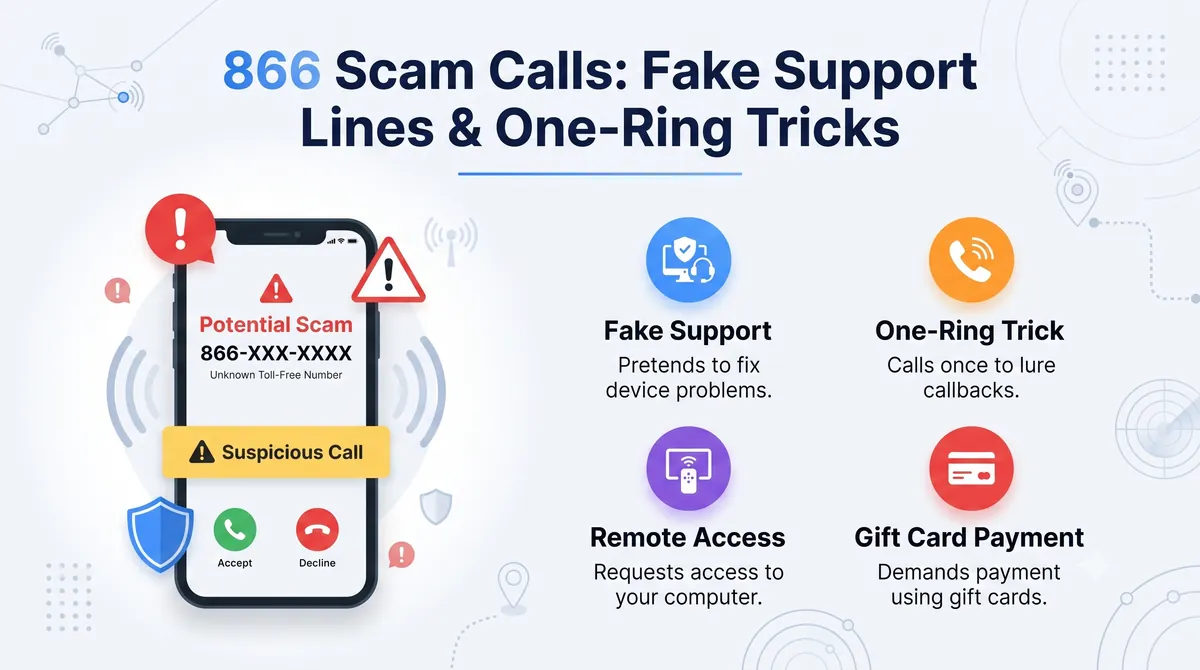
The 866 area code itself is fully legitimate, but its built-in credibility is exactly why fraudsters borrow it. The classic scripts all appear here: fake IRS agents, tech support claiming your computer is infected, bank impersonators, and prize notifications requiring a fee.
The tell is behavioral — urgency, threats, and payment by gift card or wire — no genuine organization operates that way. The FCC guidelines on unwanted calls is the authoritative reference for reporting and stopping them.
The Fake Support Line Trap
The most dangerous 866 scam reverses the usual direction: you place the call. Fraudsters buy search ads and seed fake "airline reservations," "printer support," and "crypto wallet help" listings topped with a toll-free number they control. Take support numbers only from the company's official website or app — never from a search ad or forum post.
One-Ring Callbacks and How to Block the Rest
One-ring scams hang up fast, hoping curiosity makes you call back a premium-rate lookalike number. If you don't recognize a missed call, let it go — anyone real leaves a voicemail. Block repeat offenders on your phone, enable your carrier's free spam filter, register at DoNotCall.gov, and report fraud at ReportFraud.ftc.gov.
Conclusion
The 866 area code has spent twenty-six years doing one job well: connecting callers to organizations for free across the US, Canada, and beyond. You now know the prefix belongs to no city, that Somos routes every call, and that FCC portability rules keep the number yours for life.
You can also read an incoming 866 call the smart way — trusting verified businesses while spotting urgency and payment-pressure tactics instantly. That knowledge turns a mystery prefix into a practical tool you control.
Toll-free numbers keep gaining ground as businesses of every size compete on accessibility. Securing an 866 phone number today locks in a prefix customers have trusted for a generation, while inventory still allows real choice. Setup takes minutes, costs little each month, and starts working the moment it activates. Pick your digits below and give every customer a free, professional way to reach you.
Claim a trusted 866 number before someone else takes your digits.
Your toll-free line activates instantly — with forwarding, voicemail, and SMS ready in one simple app.