Key Takeaways
- 22395 is a shared short code used by multiple businesses for high-volume SMS messaging, including marketing campaigns and two-factor authentication.
- Short codes have significantly higher message throughput than regular long codes, making them ideal for mass alerts, promotions, and OTPs.
- Obtaining proper opt-in consent and providing a clear opt-out mechanism are legal requirements when using short codes for marketing.
- SMS 2FA via short codes like 22395 adds a valuable layer of security, though alternatives such as authenticator apps offer stronger protection.
- Dedicated and vanity short codes offer more control and branding potential but come at a higher cost than shared short codes.
What Is a Short Code and Why Does 22395 Matter?
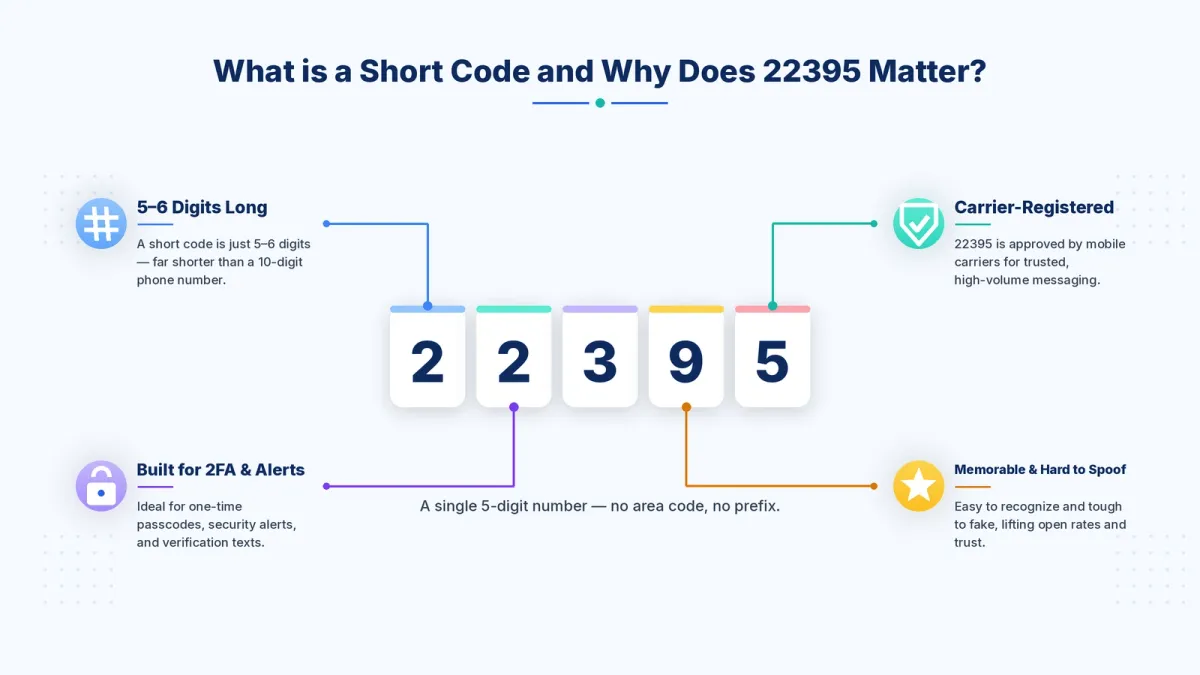
A short code is a special, abbreviated phone number designed for high-volume SMS messaging. Unlike traditional 10-digit phone numbers (known as long codes), SMS short codes are typically five or six digits long, making them easier to remember and type. The 22395 short code is one such number — widely used by businesses and organisations for text marketing, notifications, and security.
| Feature | Short Code (e.g., 22395) | Long Code (10-digit number) |
|---|---|---|
| Memorability | High | Low |
| Message Volume | High (thousands per minute) | Low (typically 1 per second) |
| Cost | Higher | Lower |
| Use Cases | Marketing, alerts, 2FA | Person-to-person, small businesses |
| Approval | Pre-approved by carriers | Limited carrier approval |
| Opt-In | Strictly required | Required |
22395 is a shared short code, meaning it is used by multiple businesses and organisations — as opposed to a dedicated short code, which is exclusive to a single entity. Shared short codes like 22395 are generally more affordable, making them accessible to smaller businesses.
For businesses that also run international SMS campaigns, the 62 country code guide explains how to reach Indonesian contacts — one of the largest SMS markets in Asia.
Why Short Codes Are Effective
- High open rates: SMS messages have significantly higher open rates than emails.
- Instant delivery: Messages are delivered almost instantaneously.
- Wide reach: Virtually everyone has a mobile phone with SMS capabilities.
- Cost-effective: SMS marketing can be very cost-effective compared to other channels.
- Easy to remember: The short format makes the code easy for customers to recall and use.
Using 22395 for Marketing and Customer Engagement
SMS marketing is a direct and personal way to connect with your audience. It allows you to deliver targeted messages, promotions, and updates straight to customers' mobile phones. The 22395 short code can support a wide range of marketing activities.
Common Marketing Use Cases with 22395
- Promotional offers — Send exclusive discounts, coupons, and special deals to subscribers.
Example: "Text SAVE to 22395 to get 20% off your next order!" - Contests and giveaways — Run engaging contests to increase brand awareness and generate leads.
Example: "Text WIN to 22395 to enter our draw for a free product!" - Polls and surveys — Gather customer feedback quickly and easily.
Example: "Text YES or NO to 22395 to tell us if you like our new feature." - Appointment reminders — Reduce no-shows by sending automated reminders.
Example: "Your appointment with Dr. Smith is tomorrow at 2 PM. Reply C to confirm or R to reschedule." - Event notifications — Keep attendees informed about event details, updates, and schedule changes.
- Loyalty programmes — Reward loyal customers with exclusive offers and perks.
- Customer service updates — Proactively update customers on order status, shipping information, or support ticket resolution.
Example: "Your order #12345 has shipped! Track your delivery by replying to this message."
Measuring Success
To get the most out of your SMS campaigns with 22395, monitor these key metrics:
- Delivery rate: The percentage of messages successfully delivered.
- Open rate: The percentage of messages opened by recipients.
- Click-through rate (CTR): The percentage of recipients who clicked a link in your message.
- Conversion rate: The percentage of recipients who completed a desired action.
- Opt-out rate: The percentage of subscribers who unsubscribed.
Security and the 22395 Short Code: Two-Factor Authentication
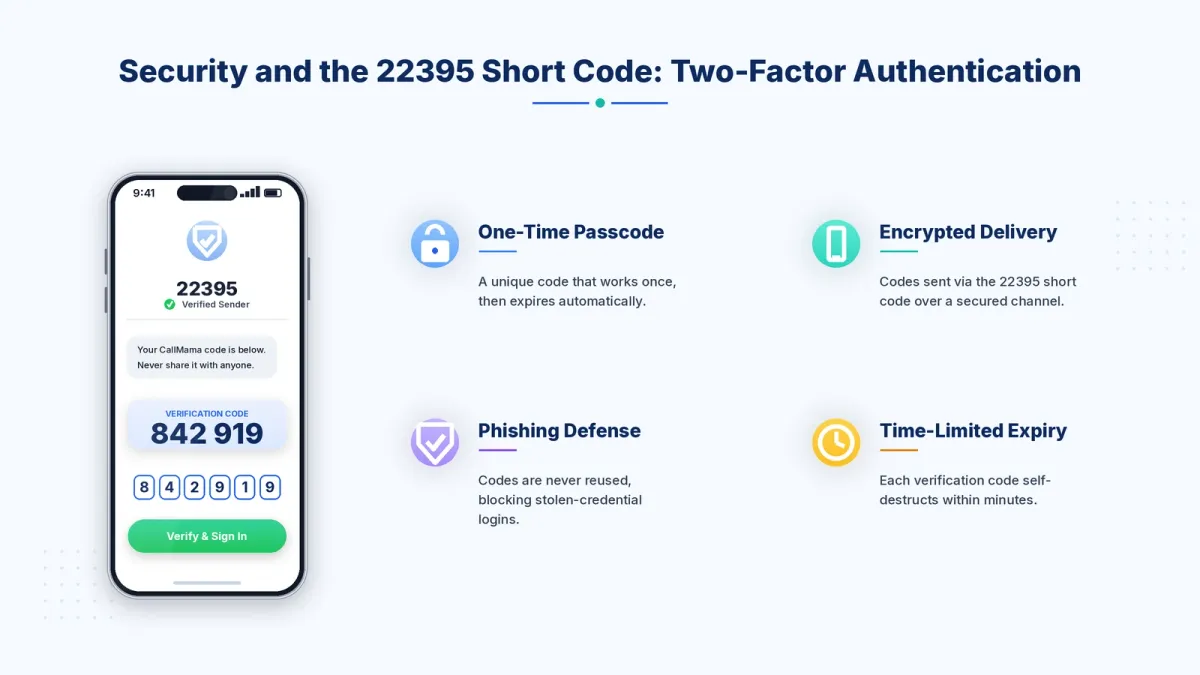
In today's digital landscape, security is paramount. Passwords alone are often not enough to protect accounts from unauthorised access. Two-factor authentication (2FA) adds an extra layer of security by requiring users to provide two forms of identification: something they know (their password) and something they have (their mobile phone).
How 22395 Is Used for 2FA
The process typically works as follows:
- User login: A user attempts to log in to an account.
- Password entry: The user enters their username and password.
- OTP request: The service triggers a request to send a one-time password (OTP) to the user's registered mobile number.
- SMS delivery via 22395: The service provider uses an SMS gateway associated with the 22395 short code to deliver a unique, time-sensitive code.
- Code entry: The user receives the OTP on their phone and enters it on the login screen.
- Access granted: If the OTP is correct, the user is granted access to their account.
Benefits of SMS-Based 2FA
SMS 2FA is also used heavily in messaging contexts — for a related texting topic, see our guide on ML in texting for how abbreviations and SMS culture intertwine.
- Convenience: Most people already have a mobile phone and are familiar with receiving text messages.
- Accessibility: SMS works on virtually all mobile phones, regardless of operating system or internet connectivity.
- Cost-effective: SMS is a relatively inexpensive way to implement 2FA.
- Improved security: Significantly reduces the risk of unauthorised access, even if a password is compromised.
Potential Drawbacks of SMS 2FA
- SIM swapping: Attackers can sometimes trick mobile carriers into transferring a victim's phone number to a SIM card they control, allowing them to intercept OTPs.
- Phishing: Users can be tricked into revealing OTPs through phishing scams.
- Network vulnerabilities: SMS messages can be intercepted in transit, though this is relatively rare.
- Phone loss or theft: If a user's phone is lost or stolen, an attacker could potentially access OTPs.
Alternatives to SMS 2FA
- Authenticator apps: Apps like Google Authenticator and Authy generate time-based OTPs on the user's device without relying on SMS.
- Security keys: Physical devices such as YubiKeys that provide a highly secure form of 2FA.
- Biometric authentication: Fingerprint scanning, facial recognition, or other biometric methods.
Despite its drawbacks, SMS 2FA remains a widely used and valuable security measure, particularly for services where convenience and accessibility are priorities.
Emerging Trends in SMS Communication
The SMS landscape continues to evolve rapidly. Here are the key trends shaping how short codes like 22395 are used today. For the regulatory baseline behind all of this messaging, see the FCC texting guidance.
Personalisation
Businesses are leveraging data to craft personalised SMS messages, increasing relevance and engagement. Instead of a generic message, a personalised version might say: "Hi [Name], there is a special offer just for you! Enjoy 20% off — do not miss out!"
Omnichannel Integration
SMS is being integrated with email, social media, and chat apps to deliver a seamless customer experience. This omnichannel approach helps businesses reach customers through their preferred channels at the right moment.
The Rise of RCS (Rich Communication Services)
- High-quality images and videos: Share multimedia directly within the messaging app.
- Interactive buttons: Create more engaging, interactive messages.
- Branded messaging: Customise with logos and brand elements.
RCS offers advanced features, but SMS remains reliable and essential due to its universal compatibility across all mobile devices.
AI's Impact on SMS Marketing
- Personalisation and automation: AI personalises messages at scale and automates routine tasks.
- Optimisation: AI helps improve campaign performance by analysing data and identifying patterns.
- Chatbots: AI-powered bots provide instant customer service via SMS.
Looking ahead, SMS will remain vital for transactional and time-sensitive messages, RCS will continue to grow alongside it, and AI will make SMS marketing increasingly automated and effective.
22395 Short Code vs. Long Codes: A Deeper Dive
| Factor | Short Codes | Long Codes |
|---|---|---|
| Cost structure | Typically involve setup fees, monthly leasing fees, and per-message charges. | Usually lower per-message costs but may have volume limitations. |
| Affordability | Shared short codes like 22395 are more affordable than dedicated short codes. | Generally cheaper for sending high volumes of messages. |
| Carrier approval | Requires a rigorous approval process (several weeks) to ensure legitimate use. | Less stringent approval, but higher risk of being flagged as spam for high-volume messaging. |
| International reach | Country-specific; may require different short codes for each country. | Can be used for international messaging, though delivery rates may vary. |
Use Case Suitability
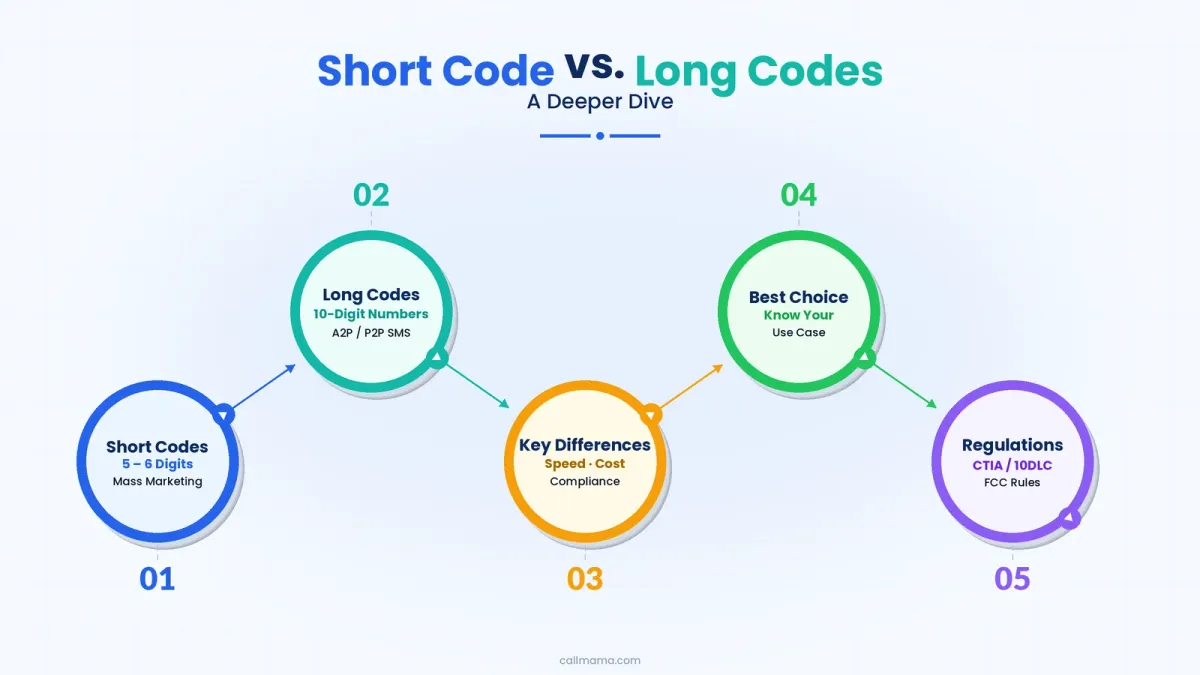
Short codes (22395) are ideal for marketing campaigns, mass alerts, two-factor authentication, voting and polling, and any scenario requiring high throughput and a memorable number.
Long codes are best for one-to-one conversations, low-volume customer service interactions, appointment reminders for small businesses, and situations where a personal touch is preferred.
Making the Right Choice
If you need to send a large volume of messages, require high reliability and deliverability, and want a memorable number for marketing, a short code — likely a shared one like 22395 — is the better choice. If you are primarily engaging in individual conversations or sending low volumes of messages, a long code may be sufficient.
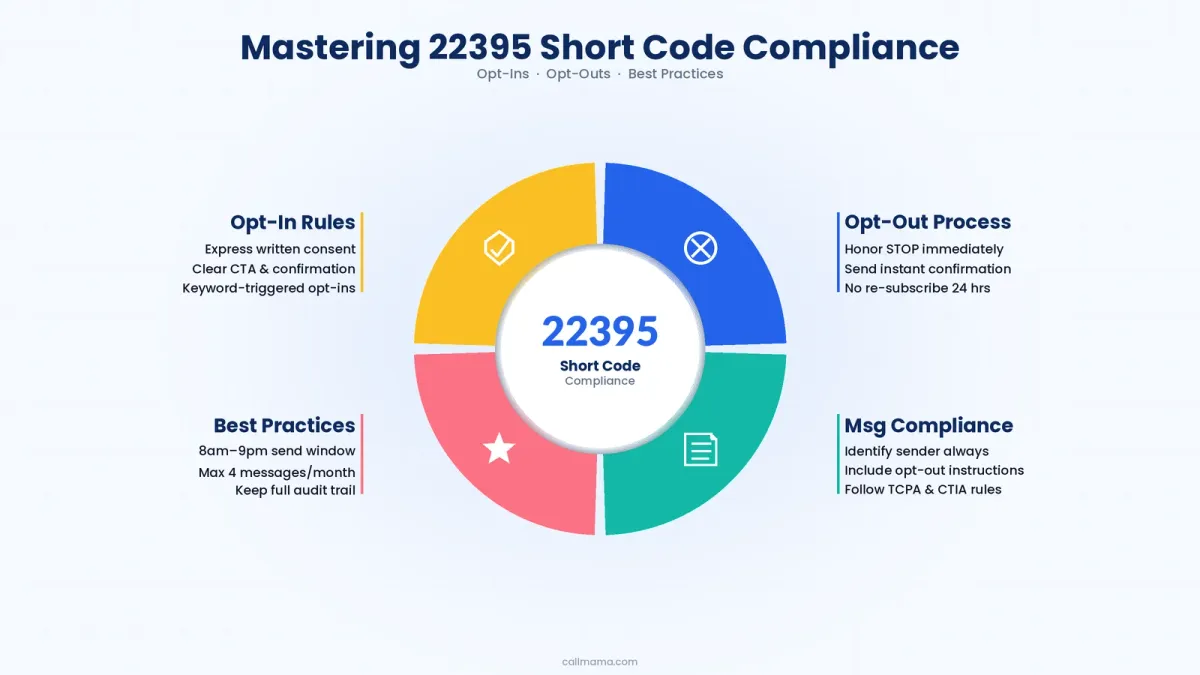
Mastering 22395 Short Code Compliance: Opt-Ins, Opt-Outs, and Best Practices
Sending unsolicited text messages is not only annoying to recipients — it is also illegal in many regions. SMS marketing and communication are governed by strict regulations designed to protect consumers from spam and unwanted messages.
Key Regulations
- Telephone Consumer Protection Act (TCPA) — USA: The primary US law regulating telemarketing and SMS marketing. It mandates that businesses obtain prior express written consent before sending marketing messages.
- CTIA Short Code Monitoring Handbook — USA: Provides guidelines on the proper usage of short codes like 22395, focusing on consumer protection and best practices.
- General Data Protection Regulation (GDPR) — EU: Although primarily focused on data privacy, GDPR has specific implications for SMS marketing, requiring businesses to obtain clear and informed consent.
- Canada's Anti-Spam Legislation (CASL) — Canada: Requires businesses to obtain express consent before sending marketing messages via SMS.
Opt-In Requirements
Obtaining proper consent is crucial for compliant SMS marketing. Key methods include:
- Clear and conspicuous disclosure: You must clearly inform users that by opting in, they are subscribing to receive text messages.
- Keyword opt-in: Users text a keyword (e.g., "JOIN") to 22395. This is the most common method of obtaining opt-in consent.
- Confirmation message: After users opt in, send them a confirmation message that includes your business name, the purpose of the messages, message frequency, opt-out instructions, and a link to your terms and conditions and privacy policy.
- Online forms: Include a checkbox on your website or app where users can explicitly agree to receive SMS messages.
- Point-of-sale (POS) systems: If you collect phone numbers at physical locations, always obtain explicit consent from users.
Opt-Out Mechanisms (STOP)
Providing a clear and easy way for users to opt out is equally important. Users must be able to unsubscribe at any time by texting "STOP," "END," "QUIT," "CANCEL," or "UNSUBSCRIBE" to 22395. You must honour all opt-out requests promptly.
Best Practices for SMS Content
- Identify yourself: Always clearly state your business name in your messages.
- Provide value: Offer something genuinely useful to your subscribers.
- Be respectful: Avoid sending messages at inappropriate times, such as late at night or early in the morning.
- Avoid deceptive practices: Never mislead users or make false promises.
- Keep it concise: Get to the point — text messages are not meant for lengthy content.
- Use proper grammar: Use correct spelling, grammar, and punctuation in all messages.
- Honour opt-out requests: Remove unsubscribers from your list immediately.
Consequences of Non-Compliance
- Fines: The TCPA allows for fines of up to $1,500 per message sent in violation of the law.
- Lawsuits: Consumers can sue businesses for violating their rights under the TCPA.
- Reputational damage: Non-compliance can damage your brand's reputation and erode customer trust.
- Short code suspension: Mobile carriers can suspend your short code if you violate their terms of service.
Send SMS from a Trusted Virtual Number
Get a real virtual phone number for SMS, MMS, and international calls — no SIM card or contract required. Stay connected with CallMama.
Beyond 22395: Exploring Other Short Code Options
Dedicated Short Codes
A dedicated short code is exclusively assigned to your business.
- Pros: Greater control, branding opportunities, higher throughput, and potentially better deliverability.
- Cons: Significantly more expensive than shared short codes; longer approval process.
Vanity Short Codes
A vanity short code is a custom short code that you can choose (if available), often related to your brand name or a specific campaign.
- Pros: Highly memorable and enhances brand recognition.
- Cons: More expensive than standard short codes; availability may be limited.
Other Common Short Codes
You may encounter other short codes used for specific purposes, such as voting on TV shows, donating to charities, or accessing particular services. Each is registered and approved for its designated use case.
Choosing the Right Option
- Shared short code (like 22395): Best for most small to medium-sized businesses, marketing campaigns, and cost-effective messaging solutions.
- Dedicated short code: Suitable for large enterprises, high-volume messaging, and situations where branding and control are paramount.
- Vanity short code: A good option for brand-focused campaigns where memorability is crucial.
The Application Process
Obtaining a dedicated or vanity short code involves a more complex application process than using a shared short code. You will typically need to work with a short code provider and submit an application to the Common Short Code Administration (CSCA). This process can take several weeks and requires providing detailed information about your intended use case and compliance measures.
Conclusion
The 22395 short code — and short codes in general — offer a direct, effective, and versatile way to engage with your audience via SMS. By understanding the regulations, best practices, and potential applications, from marketing and customer service to security, you can leverage this powerful tool to achieve significant business results.
Whether you use a shared short code like 22395 or explore dedicated and vanity options through providers like CallMama, always prioritise responsible and compliant usage. That is the foundation of a successful, long-term SMS communication strategy.
Download the CallMama App
Make calls, send texts, and stay connected with anyone, anywhere — on iOS, Android, or the web. No SIM card or contract required.