Introduction
The 731 area code covers western Tennessee — a wide, productive region stretching from the Kentucky state line in the north to the Mississippi border in the south, anchored by Jackson and reaching across cotton fields, river bluffs, and small college towns that define one of the mid-South's most distinctive landscapes. Understanding the 731 area code matters whether you received a call from a 731 number and want to verify where it originates, you're planning a business expansion into the western Tennessee market, or you're researching how to get a local number with a Jackson-area presence. This guide covers every major city and county in the 731 footprint, explains Central Time zone calling rules, traces the code's 1999 origins, and shows exactly how to get a 731 number in minutes. Every answer you need about this western Tennessee code is organized and ready below.
Key Takeaways
- The 731 area code was created in 1999 when it was split from the 901 area code, giving western Tennessee outside of Shelby County its own dedicated prefix for the first time.
- Jackson is the largest city in the 731 region, serving as the healthcare, education, and commercial hub for more than a dozen counties across western Tennessee.
- All communities in the 731 footprint operate on Central Time (CT) — UTC-6 standard and UTC-5 daylight saving time from mid-March through early November.
- A virtual 731 phone number can be activated instantly and gives any business a credible western Tennessee presence without requiring a physical office in the state.
What Is the 731 Area Code?
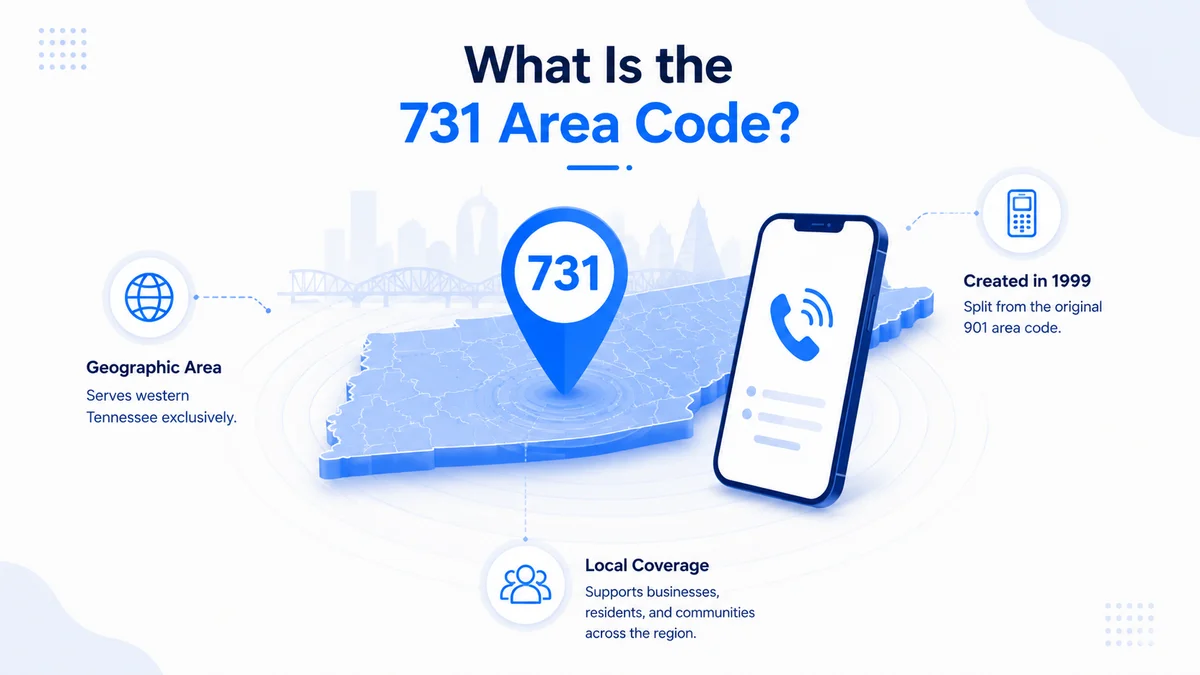
The 731 area code is a North American Numbering Plan (NANP) geographic code assigned exclusively to western Tennessee. It was created in 1999 when the original 901 area code — which had covered the entire western Tennessee region since the 1947 NANP rollout — could no longer provide enough phone number combinations to meet the growing demand from residents, businesses, and mobile users across the Memphis metropolitan area and surrounding communities.
Unlike an overlay code, the 731 is a true geographic split: it took over the western Tennessee territory outside of Shelby County (Memphis), while 901 retained the Memphis metro. This means all phone numbers in the 731 region begin with the 731 prefix and 7-digit local dialing applies within the same area code, though 10-digit dialing is increasingly standard across the US.
Where Is the 731 Area Code Located?
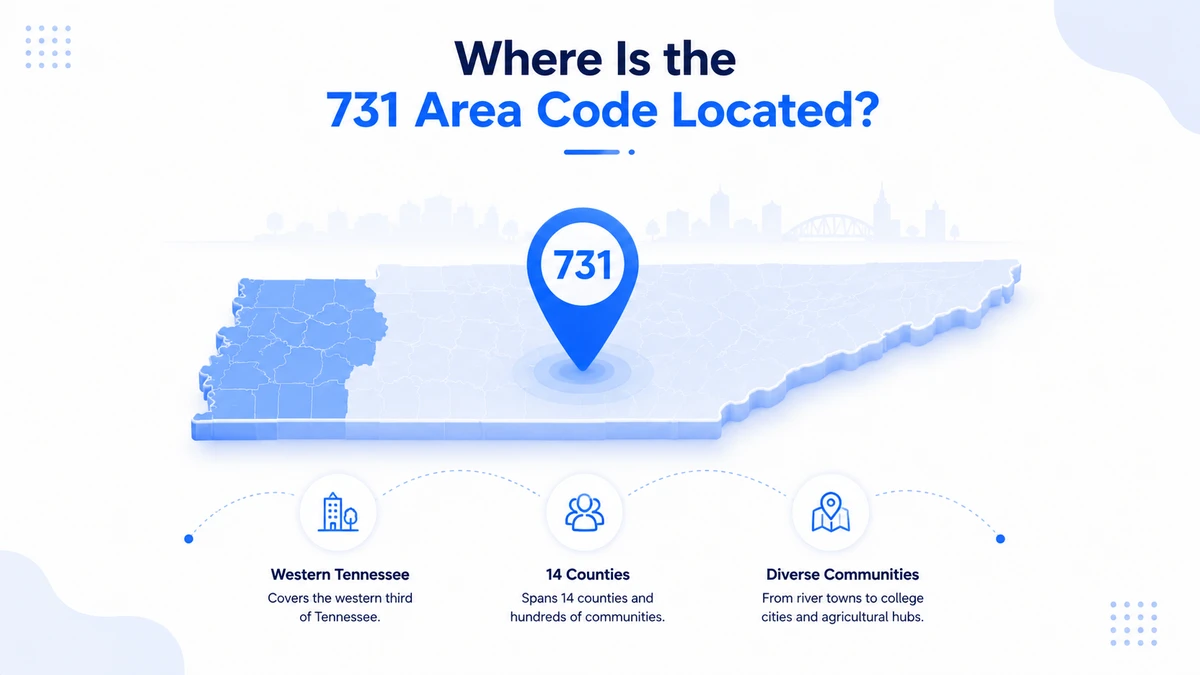
The 731 area code spans the entire western third of Tennessee — a territory that covers fourteen counties and hundreds of communities from the northernmost tip of the state at the Kentucky border to the southernmost point at the Mississippi state line. Just as other area codes in the mid-South define distinct regional economies and identities, the 731 footprint brings together agricultural heartland, college towns, river communities, and a growing manufacturing corridor under one telephone prefix.
Jackson and Madison County
Jackson is the undisputed center of the 731 region and the largest city in western Tennessee outside of Memphis. Home to approximately 65,000 residents, Jackson serves as the commercial, medical, and educational hub for a sixteen-county region that stretches across the entire western third of the state. West Tennessee Healthcare — the area's largest employer — operates Jackson-Madison County General Hospital and a network of clinics throughout the region. The city is also celebrated for its railroad heritage: the legendary Casey Jones, immortalized in folk song and railroad lore, lived and died in Jackson, and the Casey Jones Village museum draws visitors from across the country.
Northern 731 Communities
The northern counties of the 731 footprint anchor several important regional centers. Dyersburg, the seat of Dyer County, is the second-largest city in western Tennessee and a key agricultural processing and manufacturing hub. Union City in Obion County sits near the Kentucky border and serves as the commercial center for northwestern Tennessee. Martin, in Weakley County, is home to the University of Tennessee at Martin (UTM) — a four-year public university enrolling more than 6,000 students — and Paris, the Henry County seat on Kentucky Lake, draws fishing and outdoor recreation tourists from across the mid-South.
Southern and Western 731 Communities
The 731 area code also covers Brownsville in Haywood County — a historically significant community with deep roots in the civil rights movement and Tennessee blues music — Covington in Tipton County, Humboldt and Milan in Gibson County, and McKenzie and Huntingdon in Carroll County. These smaller cities and towns anchor the cotton, soybean, and corn agriculture that defines the economic backbone of the region stretching between Jackson and the Mississippi River.
731 Area Code Time Zone
The 731 area code operates entirely on Central Time (CT) — there is no time zone boundary within the western Tennessee region. Central Standard Time (CST, UTC-6) applies from November through mid-March, and Central Daylight Time (CDT, UTC-5) runs from mid-March through early November.
Before calling any 731 phone number from the West Coast, add two hours — a 9 AM call from Los Angeles arrives at 11 AM CT in Jackson. Mountain Time callers are one hour behind the 731 region. Eastern Time callers are one hour ahead of Central, so a noon call from Nashville (which uses CT) stays in sync with any 731 contact. Jackson's hospitals, manufacturing plants, and UTM offices all run on a standard Central Time business day.
| Caller's Time Zone | Local Time at 731 Contact |
|---|---|
| Pacific Time (PT) | +2 hours |
| Mountain Time (MT) | +1 hour |
| Central Time (CT) | Same time |
| Eastern Time (ET) | −1 hour |
Western Tennessee businesses answer local numbers — a 731 prefix tells Jackson, Dyersburg, and every community in the region that you're part of their market
Get a virtual 731 phone number through CallMama and start reaching western Tennessee customers from wherever your business operates.
History of the 731 Area Code
Tennessee's telephone history under the NANP dates to 1947, when the entire state was divided into three calling regions. The 615 code covered most of Tennessee including Nashville, and the 901 code covered the western portion of the state — the broad swath of territory from the Kentucky border to the Mississippi state line, including Memphis, Jackson, and every rural county in between.
As Memphis grew through the 1980s and 1990s, the 901 area code came under increasing strain. The explosion of mobile phones, pagers, fax machines, and internet dial-up connections in the mid-1990s accelerated number depletion far faster than planners had anticipated. In 1999, regulators split the 901 territory: Memphis and Shelby County retained the 901 code, and the 731 area code was assigned to all of western Tennessee outside of the Memphis metro. The split gave western Tennessee its own dedicated identity for the first time, separating the rural and small-city communities of the region from the large urban code they had shared with Memphis for more than five decades. Illinois followed a similar path when the 618 area code took over southern Illinois' rural territory to relieve numbering pressure.
How to Get a Virtual Phone Number from CallMama
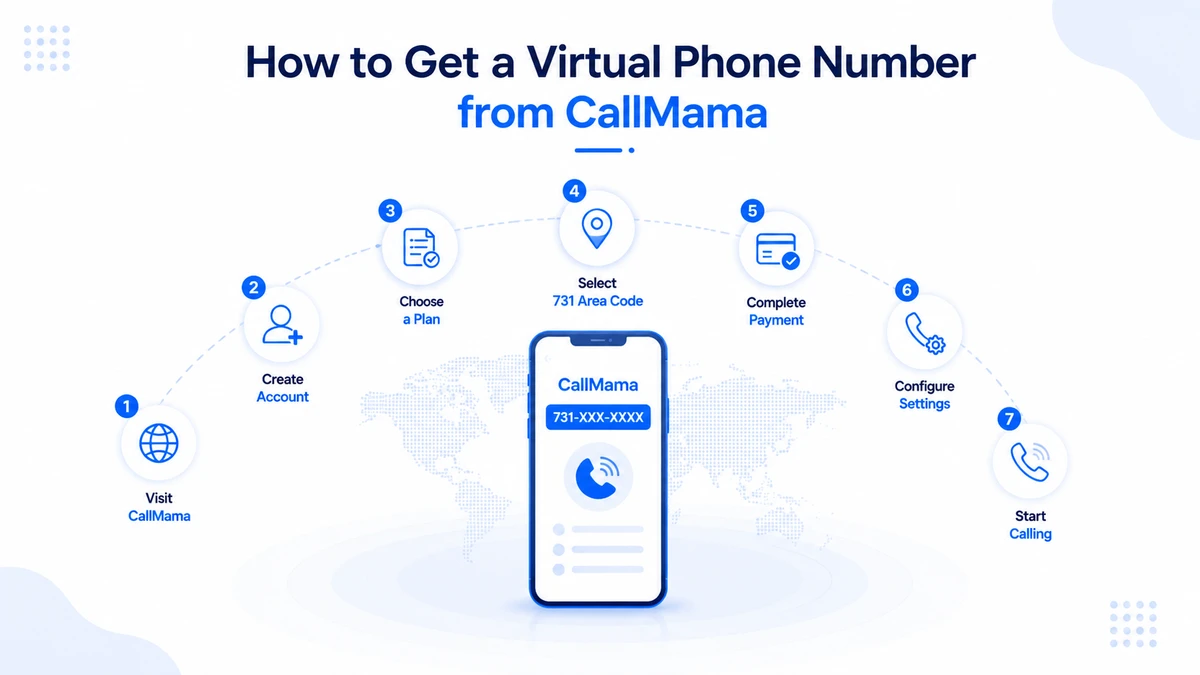
CallMama makes it simple to get a virtual 731 phone number without a Tennessee address, a Jackson office, or any physical presence in the state. Whether you're targeting Jackson's healthcare market, Dyersburg's manufacturing corridor, or the college communities around UTM in Martin, CallMama activates your number instantly and routes calls to any device, anywhere in the world.
- Visit callmama.com or download the CallMama app from the App Store or Google Play to get started.
- Create a free account using your email address — no credit card required at signup.
- Choose a plan that fits your needs — monthly subscriptions and pay-as-you-go options are both available.
- Select your virtual number — choose the United States, then pick the 731 area code.
- Complete payment and your number activates instantly from your dashboard.
- Configure call forwarding, voicemail, or SMS routing to direct calls wherever you work.
- Start making and receiving calls with your new western Tennessee number right away.
Is the 731 Area Code Safe? Common Scams to Watch
The 731 area code is a legitimate, active geographic code used by residents, businesses, hospitals, and universities across western Tennessee. Like every US area code, it is exploited by scammers through neighbor spoofing— generating fake local 731 numbers to make calls appear familiar to western Tennessee residents, who are more likely to answer a number from their own region.
Common scams using a spoofed 731 number include:
- Utility disconnection fraud — scammers impersonate Jackson Energy Authority or Entergy Tennessee representatives, threatening immediate power shutoff unless same-day payment is made by gift card or wire transfer to western Tennessee customers.
- Agricultural scams — fraudulent callers pose as farm equipment dealers, crop insurance agents, or USDA representatives, targeting the large farming community across Haywood, Gibson, Dyer, and Tipton counties with fake deals or false subsidy program claims.
- Government and tax impersonation — callers pose as Tennessee Department of Revenue agents or IRS representatives, demanding immediate payment to avoid arrest or legal action on fabricated tax debts targeting residents throughout the 731 region.
If you receive a suspicious 731 area code call, do not call back or provide any personal or financial information. Verify the number through a reverse-lookup tool and report suspected spoofed calls directly to the FCC complaint portal for investigation.
Why Businesses Choose a 731 Area Code
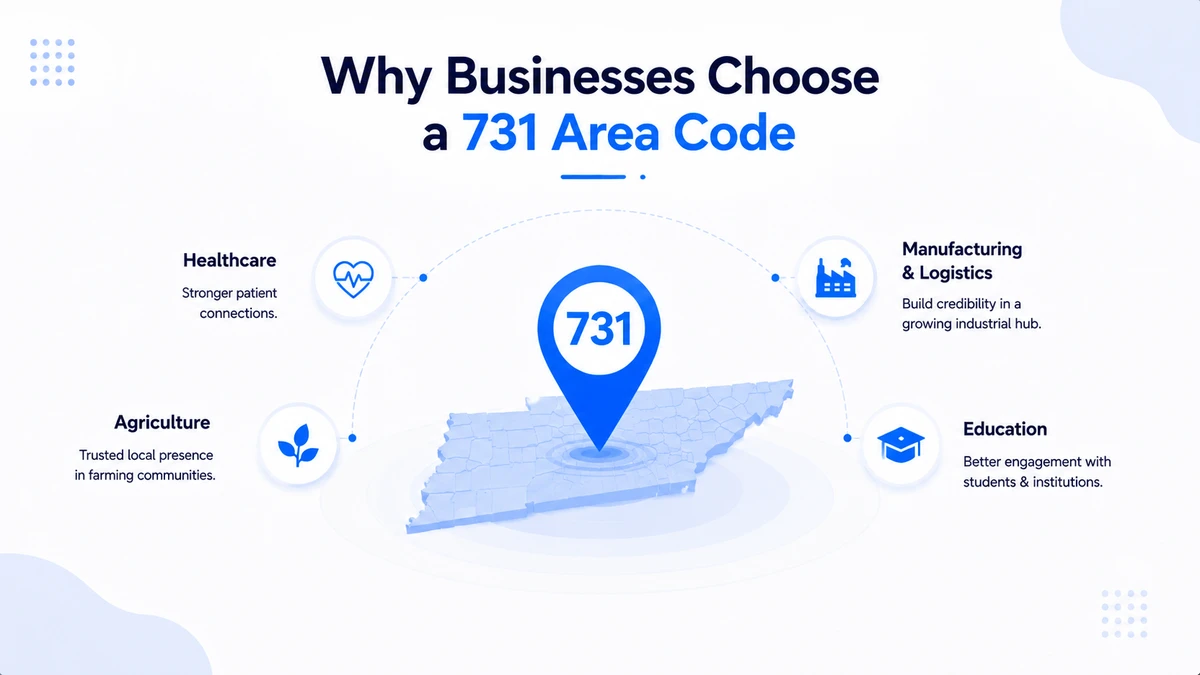
A virtual 731 area code number gives any business immediate local credibility across western Tennessee — a region where community trust and recognizable local numbers drive purchasing decisions in healthcare, agriculture, manufacturing, and education. Studies consistently show that local phone numbers generate significantly higher answer rates than toll-free or out-of-state alternatives, and the 731 footprint covers a growing market with strong industrial and healthcare anchors.
Key sectors that benefit most from a 731 local presence include:
- Healthcare — West Tennessee Healthcare is the largest employer in the 731 region, operating Jackson-Madison County General Hospital and a broad network of clinics; medical suppliers, insurance providers, and telehealth companies using a local number consistently achieve higher patient connection rates than out-of-state alternatives.
- Manufacturing and logistics — Jackson hosts major operations from companies including Procter & Gamble and Kellogg, and the region's position along Interstate 40 makes it a key distribution corridor between Memphis and Nashville; vendors and contractors with a 731 prefix build immediate credibility with plant managers and procurement teams.
- Agriculture and agribusiness — western Tennessee is one of the state's most productive agricultural zones, with cotton, soybeans, and corn as dominant crops across Dyer, Gibson, Haywood, and Tipton counties; seed dealers, equipment suppliers, and agri-financial services gain a distinct trust advantage with a local area code.
- Education and student services — the University of Tennessee at Martin enrolls over 6,000 students in Weakley County, and Lambuth University and other institutions in Jackson generate a large student and faculty population that responds significantly better to local 731 numbers than to national hotlines.
If you ever receive a suspicious call, you can review official guidance on caller ID spoofing at the FCC guidelines.
Conclusion
The 731 area code defines western Tennessee as a distinct telephone region — a separation from Memphis that has given Jackson, Dyersburg, Martin, and dozens of communities their own local identity on the phone since 1999. From the Casey Jones heritage in Jackson and the University of Tennessee at Martin to the cotton fields of Haywood County and the river bluffs of Obion, the 731 footprint spans a region of remarkable agricultural strength, manufacturing growth, and small-town character. Understanding which cities fall within this code, how Central Time affects your calling schedule, and how to spot spoofed 731 calls gives you a complete picture of western Tennessee's telephone landscape. Whether you're verifying an unknown call or evaluating the western Tennessee market for the first time, the 731 area code now holds no more mystery.
If you are ready to connect with western Tennessee, a virtual 731 prefix is the fastest and most affordable way to establish local credibility in the region. A local 731 number reaches Jackson's hospital networks, Martin's campus communities, and Dyersburg's manufacturing corridor in a way that out-of-state numbers simply cannot replicate. There are no Tennessee addresses to rent, no long-term contracts to sign, and no hardware to install — just instant activation and a local prefix that western Tennessee residents and businesses recognize and trust. Take the first step today and start building a genuine connection with one of the mid-South's most economically diverse and historically rich regions.
A Virtual 731 Number Opens Western Tennessee — From Jackson's Hospitals and Martin's Campus to Dyersburg's Factories and the Mississippi River Communities
No Tennessee office required — just instant activation and a local 731 prefix that the region recognizes and picks up.
