Introduction
The 730 area code is an overlay code serving southern Illinois — a diverse region anchored by the Metro East communities across the Mississippi River from St. Louis and stretching through Carbondale, the Shawnee Hills, and the Ohio River border country to the far south. Understanding the 730 area code matters whether you received an unexpected call and want to verify its origin, you're researching Illinois phone coverage for business or personal reasons, or you're considering a virtual number with a credible southern Illinois presence. This guide covers every major city and county in the 730 footprint, explains the Central Time zone and 10-digit dialing rules that come with an overlay code, traces the history of this southern Illinois prefix, and shows exactly how to get a local number in minutes. Everything you need about the 730 overlay — from coverage maps and time zone tables to scam alerts and business strategy — is organized and ready below.
Key Takeaways
- The 730 area code is an overlay for the 618 area code across southern Illinois — it shares the same geographic territory and does not replace or split any existing numbers.
- All communities in the 730 footprint operate on Central Time (CT) — UTC-6 during standard time and UTC-5 during daylight saving time from mid-March through early November.
- Because 730 is an overlay, all callers within the 618/730 region must dial all 10 digits for every local call, including calls to neighbors in the same county.
- A virtual 730 number can be activated instantly through a VoIP provider, giving businesses a local southern Illinois presence without a physical address in the state.
What Is the 730 Area Code?
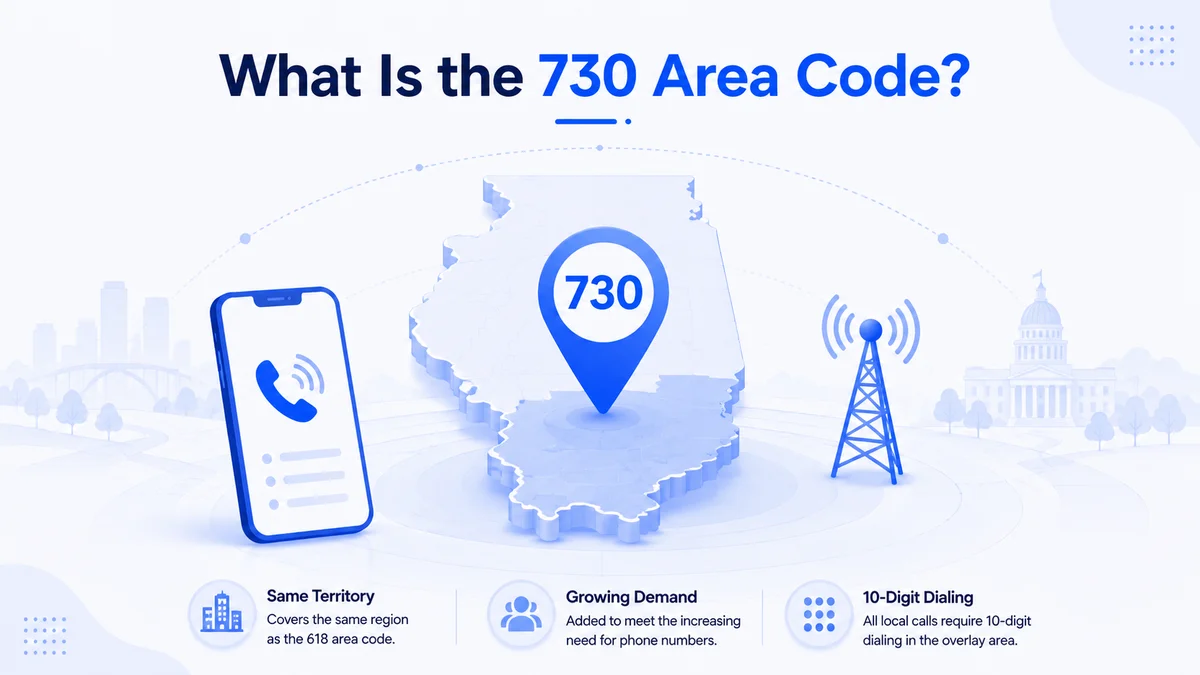
The 730 area code is a North American Numbering Plan (NANP) overlay code assigned to the same geographic territory already covered by the 618 area code across southern Illinois. Unlike a geographic split — where a region is divided into two distinct zones, each receiving its own code — an overlay assigns an entirely new code to the same existing territory so that a fresh supply of phone number combinations becomes available without requiring existing customers to change their numbers.
The 730 overlay was introduced to handle growing phone number demand across southern Illinois, driven by the widespread adoption of mobile phones, VoIP services, and internet-connected devices throughout the region. With two active codes now sharing the same footprint — 618 and 730 — every caller within the overlay zone must dial all 10 digits for local calls, even when reaching a neighbor down the street.
Where Is the 730 Area Code Located?
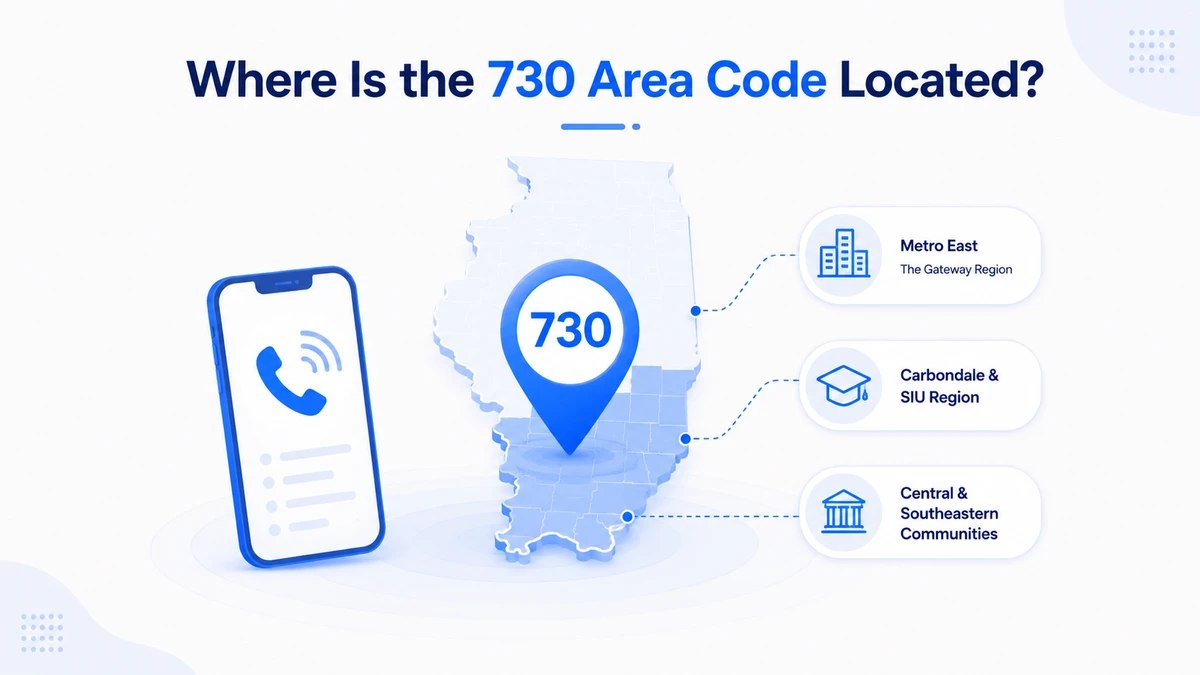
The 730 area code covers the same geographic territory as the 618 area code — the southern third of Illinois, a region that spans from the Metro East communities bordering St. Louis, Missouri, south through the agricultural heartland, Shawnee National Forest, and the Ohio and Mississippi River borders. Just as other area codes in the Midwest define distinct regional economies and communities, the 730 overlay brings together one of Illinois's most geographically and economically varied regions under a single telephone prefix.
Metro East — The Gateway Region
The Metro East area — anchored by St. Clair and Madison counties — is the commercial and population center of the 730 footprint. East St. Louis, Belleville, O'Fallon, Collinsville, Edwardsville, Alton, and Granite City form a dense urban corridor directly across the Mississippi River from downtown St. Louis. This region serves as the Illinois gateway to the broader St. Louis metropolitan area, home to the iconic Gateway Arch National Park on the Missouri side. Edwardsville hosts Southern Illinois University Edwardsville (SIUE), a major public university drawing students and faculty from across the region.
Carbondale and the Southern Illinois University Region
Carbondale, the largest city in Jackson County, is the academic and cultural heart of downstate southern Illinois. Southern Illinois University Carbondale (SIU) — with over 12,000 students — drives the local economy and shapes the city's character as a college town surrounded by the natural beauty of Shawnee National Forest and Giant City State Park. Murphysboro, the Jackson County seat, and dozens of smaller communities in the surrounding area round out one of Illinois's most recognizable collegiate regions.
Central and Southeastern Communities
The 730 area code also covers Mount Vernon (the Jefferson County seat and a key regional trade hub along Interstate 57), Centralia, Benton, Marion, and Harrisburg — a string of smaller cities that anchor the agricultural and industrial economy of central and southeastern southern Illinois. The region's coal mining history, river commerce legacy, and proximity to the Cache River Wetlands make it one of Illinois's most historically layered landscapes.
730 Area Code Time Zone
The 730 area code operates entirely on Central Time (CT) — there is no time zone variation anywhere within the southern Illinois overlay region. Central Standard Time (CST, UTC-6) applies from November through mid-March, and Central Daylight Time (CDT, UTC-5) runs from mid-March through early November.
Before calling any 730 phone number from the West Coast, callers need to add two hours — a 9 AM call from Los Angeles arrives at 11 AM CT in East St. Louis. Mountain Time callers are one hour behind the 730 region. Eastern Time callers are one hour ahead, so a noon call from New York City hits the 730 footprint at 11 AM. Belleville businesses, SIU offices in Carbondale, and Marion area employers all operate on a standard 8 AM–5 PM Central Time business day.
| Caller's Time Zone | Local Time at 730 Contact |
|---|---|
| Pacific Time (PT) | +2 hours |
| Mountain Time (MT) | +1 hour |
| Central Time (CT) | Same time |
| Eastern Time (ET) | −1 hour |
Southern Illinois businesses answer local numbers — a 730 prefix tells the Metro East, Carbondale, and the entire 618/730 region that you belong to their community
Get a virtual 730 phone number through CallMama and start reaching southern Illinois customers from wherever your business operates.
History of the 730 Area Code
Southern Illinois's telephone history begins in 1947, when the NANP divided the United States into large calling regions. Illinois was split into three original codes: 312 for the Chicago metro area, 217 for central Illinois, and 618 for the southern third of the state — covering everything from the Metro East to Cairo at the southernmost tip where the Mississippi and Ohio rivers meet.
The 618 code served southern Illinois through most of the 20th century without change. By the late 1990s and 2000s, the rapid spread of mobile phones, pagers, fax lines, and internet dial-up connections began consuming available number combinations at a pace the original 1947 allocation could not sustain. Rather than split the 618 territory — which would have forced existing customers to change their numbers — regulators approved the 730 as a new overlay code for the same southern Illinois footprint. The overlay approach preserved every existing 618 number while opening a new supply of 730 combinations, and 10-digit dialing became mandatory throughout the region from that point forward.
How to Get a Virtual Phone Number from CallMama
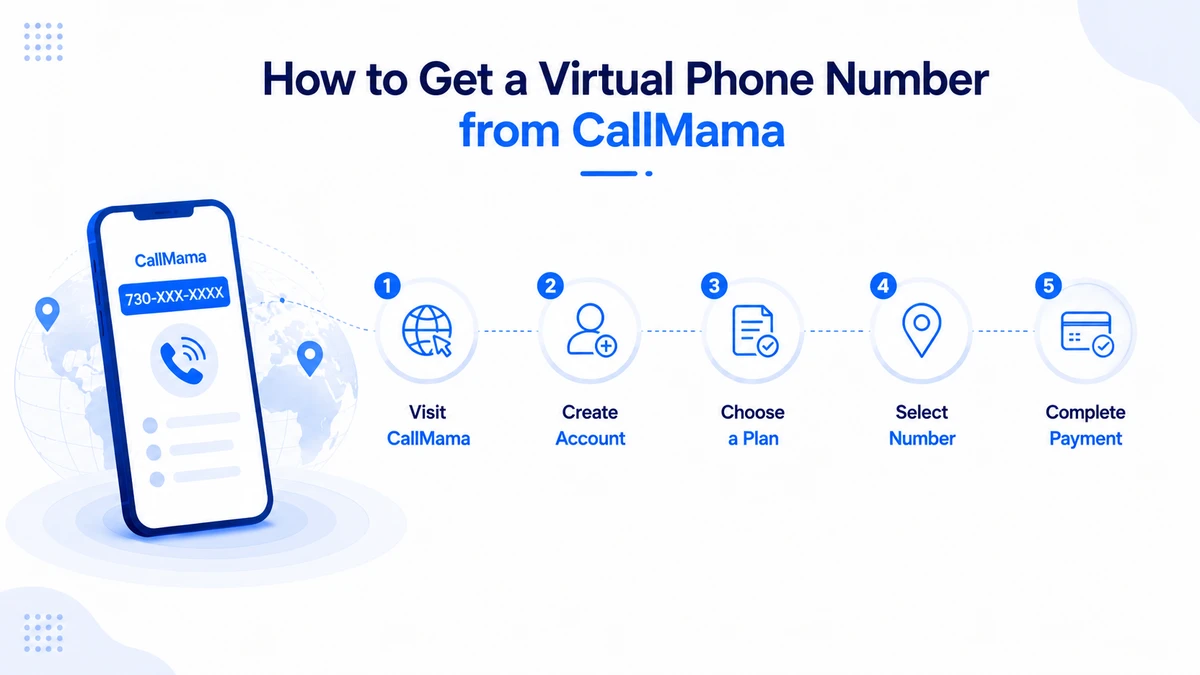
CallMama makes it simple to get a virtual 730 phone number without an Illinois address, a Belleville office, or any physical presence in the state. Whether you're targeting the Metro East's logistics corridor, Carbondale's student population, or Mount Vernon's regional trade market, CallMama activates your number instantly and routes calls to any device, anywhere in the world.
- Visit callmama.com or download the CallMama app from the App Store or Google Play to get started.
- Create a free account using your email address — no credit card required at signup.
- Choose a plan that fits your needs — monthly subscriptions and pay-as-you-go options are both available.
- Select your virtual number — choose the United States, then pick the 730 area code.
- Complete payment and your number activates instantly from your dashboard.
- Configure call forwarding, voicemail, or SMS routing to direct calls wherever you work.
- Start making and receiving calls with your new southern Illinois number right away.
Why Businesses Choose a 730 Area Code
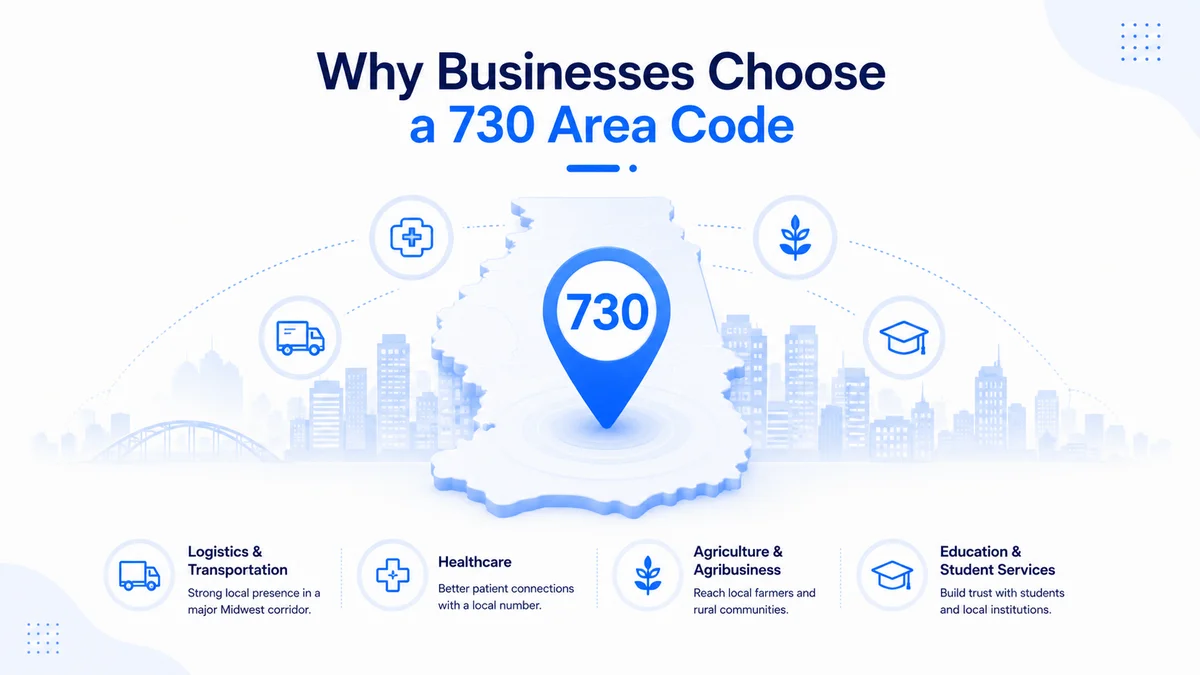
A virtual 730 area code number gives any business immediate local credibility across southern Illinois — a region where community identity and local familiarity drive purchasing decisions in healthcare, agriculture, logistics, and education. Research consistently shows that local phone numbers generate significantly higher answer rates than toll-free or out-of-state alternatives, and the 730 footprint offers access to one of the Midwest's most strategically positioned markets.
Key sectors that benefit most from a 730 local presence include:
- Logistics and transportation — the Metro East sits at the convergence of multiple major Interstate highways and the nation's largest inland river port system; freight brokers, warehousing firms, and supply chain vendors using a local 730 prefix build faster credibility with shippers and carriers operating through this critical Midwest corridor.
- Healthcare — Memorial Hospital in Belleville, OSF Healthcare, and SIU School of Medicine generate significant administrative and patient-facing call volume across the region; service providers using a local number in this space consistently achieve higher patient connection rates.
- Agriculture and agribusiness — southern Illinois is one of the state's most productive agricultural zones, with major grain, livestock, and specialty crop operations spread across dozens of rural counties; seed, equipment, and commodity businesses with a recognizable 730 prefix reach farm operators more effectively than unfamiliar out-of-state lines.
- Education and student services — with SIU Carbondale and SIUE Edwardsville together enrolling tens of thousands of students annually, tutoring services, housing providers, and student-facing businesses gain an immediate local trust signal from a southern Illinois area code.
Is the 730 Area Code Safe? Common Scams to Watch
The 730 area code is a legitimate, active overlay code used by residents, businesses, hospitals, and universities across southern Illinois. Like every US area code, it is exploited by scammers through neighbor spoofing — generating fake local 730 numbers to increase the likelihood that targets will answer, since the number appears to originate from within the community.
Common scams using a spoofed 730 number include:
- Utility disconnection fraud — scammers impersonate Ameren Illinois representatives, threatening immediate power shutoff to East St. Louis or Belleville customers unless same-day payment is made by gift card or wire transfer.
- Student loan and university scams — fraudulent callers pose as SIU or SIUE financial aid officials, pressuring students and families to act urgently on fabricated loan forgiveness programs or tuition payment threats.
- Government and tax impersonation — callers pose as Illinois Department of Revenue agents or IRS representatives, demanding payment to avoid arrest or penalties on invented tax debts targeting Metro East and downstate Illinois residents.
If you receive a suspicious 730 area code call, do not call back or provide any personal or financial information. Verify the number through a reverse-lookup service and report suspected spoofed calls to the FTC fraud report portal for investigation.
Conclusion
The 730 area code is southern Illinois's newest telephone prefix — an overlay solution that expands calling capacity across the 618 footprint without disrupting residents or businesses already using 618 numbers throughout the Metro East, Carbondale, and the communities stretching to the Ohio River. From East St. Louis's riverside commerce and Belleville's suburban growth to SIU's academic campus in Carbondale and the agricultural plains of Jefferson and Saline counties, the 730 overlay covers a region of remarkable economic depth and geographic range. Understanding how this overlay code works, which cities it serves, and what Central Time means for your outreach schedule gives you a complete picture of one of Illinois's most strategically important calling regions. Whether you're verifying an unknown call or evaluating a southern Illinois market entry, the 730 area code now provides all the context you need.
If you are ready to establish a presence in southern Illinois, a virtual 730 prefix is the fastest and most cost-effective starting point available today. A local 730 phone number opens conversations with Metro East logistics hubs, Carbondale student markets, and downstate Illinois communities that out-of-state numbers simply cannot reach with the same level of trust and recognition. There are no Illinois addresses to maintain, no residency requirements to meet, and no long-term contracts required — just instant activation and a local number that southern Illinois residents and businesses recognize as their own. Take the first step today and start connecting with one of the Midwest's most historically rich and economically diverse regions.
A Virtual 730 Number Puts You Inside Southern Illinois — Trusted by Metro East Businesses, Carbondale's Campus, and Communities Across the 618/730 Region
No Illinois office required, no setup fees — just a local 730 prefix that southern Illinois communities recognize and pick up.
