Key Takeaways
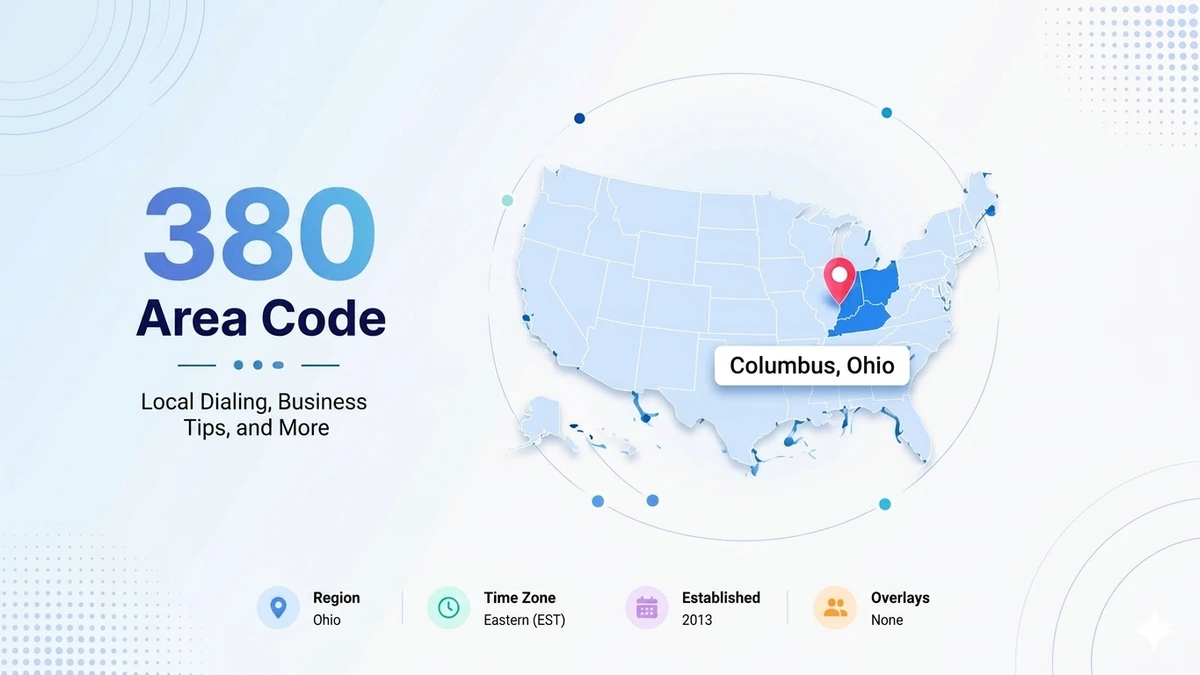
- The 380 area code has served Columbus, Ohio, since February 27, 2016, as an overlay to the original 614 area code.
- It covers 6 counties — Franklin, Delaware, Fairfield, Licking, Madison, Pickaway, and Union — and a metro population of 2.1 million.
- Mandatory 10-digit dialing for all calls (local and long-distance) took effect on January 30, 2016, before 380 went live.
- Columbus is Ohio's state capital, the 14th largest city in the United States, and one of the fastest-growing metros in the Midwest.
- Businesses using a 380 number report higher call response rates from local customers compared to generic toll-free numbers.
- You can get a virtual 380 number in minutes through providers like CallMama without changing your existing SIM card.
Columbus, Ohio, is one of the fastest-growing cities in the United States — and its phone infrastructure has had to keep pace. The 380 area code was introduced on February 27, 2016, as an overlay to the original 614 area code, which had served the Columbus region since 1947. With a metropolitan population of over 2.1 million people and a booming tech, healthcare, and education economy, the Columbus region needed a second area code to handle the sheer volume of new phone numbers being assigned.
Whether you are a Columbus resident curious about a call you received, a business owner looking to establish a local presence, or someone considering a 380 virtual number — this guide covers everything you need to know. From its exact launch date and counties covered to dialing rules, scam warnings, and how to get your own 380 number today.
How Area Code 380 Works
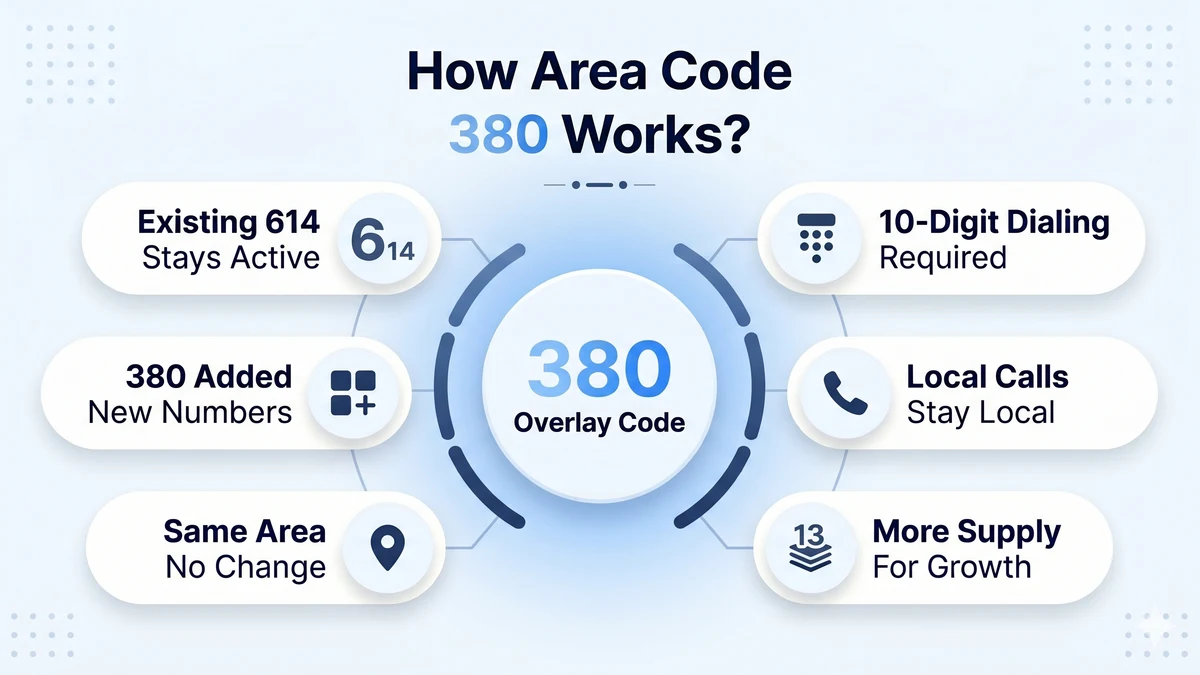
The 380 area code is an overlay area code — a second area code assigned to the exact same geographic territory as the existing 614 code. Rather than splitting the region and forcing current 614 customers to change their numbers, the Ohio Public Utilities Commission (PUCO) chose an overlay to preserve existing service while making new numbers available.
The 380 overlay was first proposed in 2001 when 614 showed early signs of exhaustion. However, the widespread adoption of number pooling — a conservation technique that allows carriers to share blocks of numbers — delayed its implementation for over a decade. By 2015, number pooling was no longer enough. On January 14, 2015, the PUCO ordered the telecommunications industry to proceed with the 380 overlay, and the new code officially went live on February 27, 2016, becoming the 386th area code in service across the United States.
Key operational features of the 380 overlay include:
- Same geographic footprint as the 614 area code across central Ohio
- Assigned to new subscribers while existing 614 customers keep their numbers
- Mandatory 10-digit dialing for all calls within the region, effective January 30, 2016
- Governed by the North American Numbering Plan (NANP)
How Overlay Area Codes Differ
Traditional area code exhaustion used to be handled through geographic splits — dividing one region into two, with one portion keeping the old code and the other receiving a new one. This approach forced businesses to reprint materials, update websites, and notify customers of number changes. The overlay approach avoids all of that disruption.
With an overlay, both area codes coexist within the same city and county. A house on one side of a Columbus street might have a 614 number; the house next door might have 380. Neither party has to change their number. The trade-off is that all callers — even those making a local call across the street — must dial all 10 digits every time. This was a significant adjustment for Columbus residents in 2016, but it has since become the standard expectation. North Texas went through a similar shift with the 940 area code.
Key Features of Area Code 380
The 380 area code was designed with reliability and scalability in mind. Because it operates as a true overlay with 614, calls between 380 and 614 numbers are treated as local — no long-distance charges apply for calls between the two codes within the covered region. This is an important distinction for businesses comparing 380 numbers against out-of-state or toll-free alternatives.
Additionally, virtual 380 numbers are now available through VoIP providers, making it possible for businesses outside Columbus to project a local Columbus presence without a physical office in Ohio.
10-Digit Dialing Explained
Mandatory 10-digit dialing in the Columbus region took effect on January 30, 2016 — nearly four weeks before 380 numbers were first issued. This transition period gave residents and businesses time to update their speed-dial lists, automated systems, and security keypads before the new code arrived. Today, every call placed within the 380/614 region requires the full area code plus the seven-digit number, regardless of whether you are calling across town or across the state.
How to Dial Numbers with the 380 Area Code
Local Calls
For any call within the Columbus region — whether to a 380 or a 614 number — you must always dial the full 10-digit number. The format is 380-XXX-XXXX or 614-XXX-XXXX. Do not dial a leading "1" for local calls; that prefix is reserved for long-distance. Attempting to dial just seven digits will result in a recorded message instructing you to redial with the area code included.
This applies to all call types within the region — landlines, mobile phones, business phone systems, and VoIP services alike. If you have saved contacts with seven-digit numbers in your phone from before 2016, those entries will need updating.
Long-Distance Calls
To reach a 380 number from outside the Columbus metropolitan region, dial 1-380-XXX-XXXX. The leading "1" is the country code for the United States and indicates a long-distance call. If you are calling from outside the US — say, from Canada, the UK, or India — dial your country's international exit code, followed by +1-380-XXX-XXXX.
Long-distance charges between 380 and 614 numbers are waived within the same overlay region, but calls to other Ohio area codes such as 740, 419, or 513 are subject to standard long-distance rates depending on your carrier and plan.
Toll-Free and Premium Numbers
Toll-free numbers — those beginning with 800, 833, 844, 855, 866, 877, or 888 — can be dialed as 1-8XX-XXX-XXXX from any phone in the 380 area. The cost of these calls is borne entirely by the receiving business, not the caller. Premium-rate numbers (those with 900 prefixes) carry per-minute charges that appear on your phone bill; always confirm rates with your carrier before dialing.
Where Is the 380 Area Code Located?
The 380 area code covers central Ohio, serving the same geographic territory as the 614 area code. The region is anchored by Columbus — Ohio's state capital and largest city, home to nearly 800,000 residents within city limits and part of a metropolitan statistical area (MSA) of over 2.1 million people. That makes Columbus not only the largest metro in Ohio, but also the 14th largest metropolitan area in the entire United States.
The 380/614 coverage area spans six counties and dozens of communities:
| County | Notable Cities |
|---|---|
| Franklin | Columbus, Upper Arlington, Bexley, Grandview Heights, Whitehall, Hilliard, Reynoldsburg, Worthington, Gahanna |
| Delaware | Dublin, Westerville, Powell, Delaware City |
| Fairfield | Lancaster, Pickerington, Canal Winchester |
| Licking | Newark, Heath, Pataskala, New Albany |
| Madison | London, Grove City (portions) |
| Pickaway | Circleville, Ashville, South Bloomfield |
Columbus itself is a remarkably diverse city. It is home to The Ohio State University — one of the largest universities in the US by enrollment — as well as the Ohio State Wexner Medical Center, consistently ranked among the nation's top hospitals. The Scioto Mile, a 175-acre riverside parkland stretching through downtown, reflects the city's investment in quality of life. Major employers in the region span healthcare (OhioHealth, Nationwide Children's Hospital), finance (Nationwide Insurance, JPMorgan Chase), retail (Limited Brands, Abercrombie & Fitch), and a rapidly expanding technology sector.
This economic diversity is precisely why 380 numbers are in demand — the Columbus market attracts businesses from nearly every industry, all of whom benefit from a recognizable local area code. Other multi-county metros show the same pattern, such as the 913 area code serving the Kansas City suburbs.
Phone Number Format and Dialing
Local and National Phone Number Formats
Every U.S. phone number follows a standardized three-part structure defined by the North American Numbering Plan (NANP): the area code (NPA — Numbering Plan Area), the central office code (NXX — the exchange), and the subscriber line number (the final four digits). For 380 numbers, this looks like:
- Local display format: (380) XXX-XXXX
- Standard dialing format: 380-XXX-XXXX
- National long-distance format: 1-380-XXX-XXXX
- International format (E.164): +1-380-XXX-XXXX
When saving a 380 number in a contact app or CRM, always use the full 10-digit format. Business phone systems that rely on automatic dialing or click-to-call features should be configured to prepend the area code automatically to avoid misdials within the overlay region.
Dialing Procedures
The key thing to remember about dialing in the 380/614 overlay region is that seven-digit dialing no longer works. Since January 30, 2016, all calls — including purely local calls to a neighbor — require the full 10-digit number. This rule applies to both 380 and 614 numbers dialed from within the Columbus region.
Businesses operating automated call systems, alarm systems, elevator emergency phones, fax machines, or medical alert devices should have already updated these systems when the overlay launched. If you acquire a 380 number for a new office or location, make sure all automated communication tools are configured for 10-digit dialing from day one.
Ten-Digit Dialing
Ten-digit dialing is now the universal standard throughout the 380/614 overlay region. The Federal Communications Commission (FCC) has also mandated 10-digit dialing nationally for mental health crisis line purposes (988), which has further normalized this practice across the United States. For 380 callers, this means no exceptions — every number, whether it is your next-door neighbor's landline or a business two streets away, requires all 10 digits.
| Dialing Format | Call Type |
|---|---|
| 380-XXX-XXXX | Local call within 380/614 overlay region |
| 614-XXX-XXXX | Local call to 614 number (same region, no charge) |
| 1-380-XXX-XXXX | Long-distance call from outside Columbus region |
| +1-380-XXX-XXXX | International call to a 380 number |
| 1-800-XXX-XXXX | Toll-free call (no charge to caller) |
Time Zone and Business Hours in the 380 Area Code
The entire 380 area code region observes Eastern Time (ET): Eastern Standard Time (EST, UTC−5) during winter and Eastern Daylight Time (EDT, UTC−4) during summer. Daylight Saving Time begins on the second Sunday in March and ends on the first Sunday in November.
Columbus sits at the eastern edge of the US central business belt, meaning it is 1 hour ahead of Chicago, 2 hours ahead of Denver, and 3 hours ahead of Los Angeles. When scheduling calls or virtual meetings with clients or partners in other time zones, this offset is critical. A Columbus business open at 9 AM ET is already mid-morning for New York partners and before dawn for California contacts.
Typical business hours in the Columbus region follow standard Eastern Time practices, though hours vary widely by industry:
| Industry | Typical Hours (ET) |
|---|---|
| Corporate Offices | 9:00 AM – 5:00 PM, Mon–Fri |
| Retail | 10:00 AM – 9:00 PM, Mon–Sat; 11:00 AM – 6:00 PM Sun |
| Healthcare / Medical | 8:00 AM – 6:00 PM, Mon–Fri; urgent care weekends |
| Restaurants | 11:00 AM – 11:00 PM (late night varies) |
| Financial Services | 9:00 AM – 4:00 PM, Mon–Fri |
| Government / City Services | 8:00 AM – 5:00 PM, Mon–Fri |
If you are using a virtual 380 number to serve Columbus customers from a different time zone, configure your voicemail and call routing to reflect Columbus business hours. Calls received outside of 9 AM–5 PM ET can be automatically routed to voicemail or an after-hours answering service, ensuring no opportunity is missed.
What Are the Benefits of Area Code 380?
The benefits of a 380 area code go well beyond simply having a working phone number. For Columbus residents, the 380 code delivers a sense of local identity— the same way 614 has become a cultural emblem of Columbus, 380 is increasingly recognized as part of that same community fabric.
For businesses, the advantages are even more concrete:
- Higher call answer rates: Studies consistently show that consumers are significantly more likely to answer calls from local area codes than from toll-free or out-of-state numbers. A 380 number signals "someone from Columbus is calling," which dramatically improves first-contact success for sales and service teams.
- No long-distance charges within the overlay: Calls between 380 and 614 numbers within the Columbus region are treated as local, saving businesses on monthly phone bills compared to calling across area code lines.
- Emergency response compatibility: Local area codes are prioritized by emergency management systems during regional crises, ensuring faster connection times when it matters most.
- Local SEO signal: Google's local search algorithm factors in phone number area codes as one indicator of geographic relevance. A 380 or 614 number on your Google Business Profile strengthens your association with Columbus in local search results.
- Community trust and economic participation: Columbus consumers actively prefer supporting local businesses. A recognizable local number positions your business as part of the community rather than a distant corporation.
Business Implications of the 380 Area Code
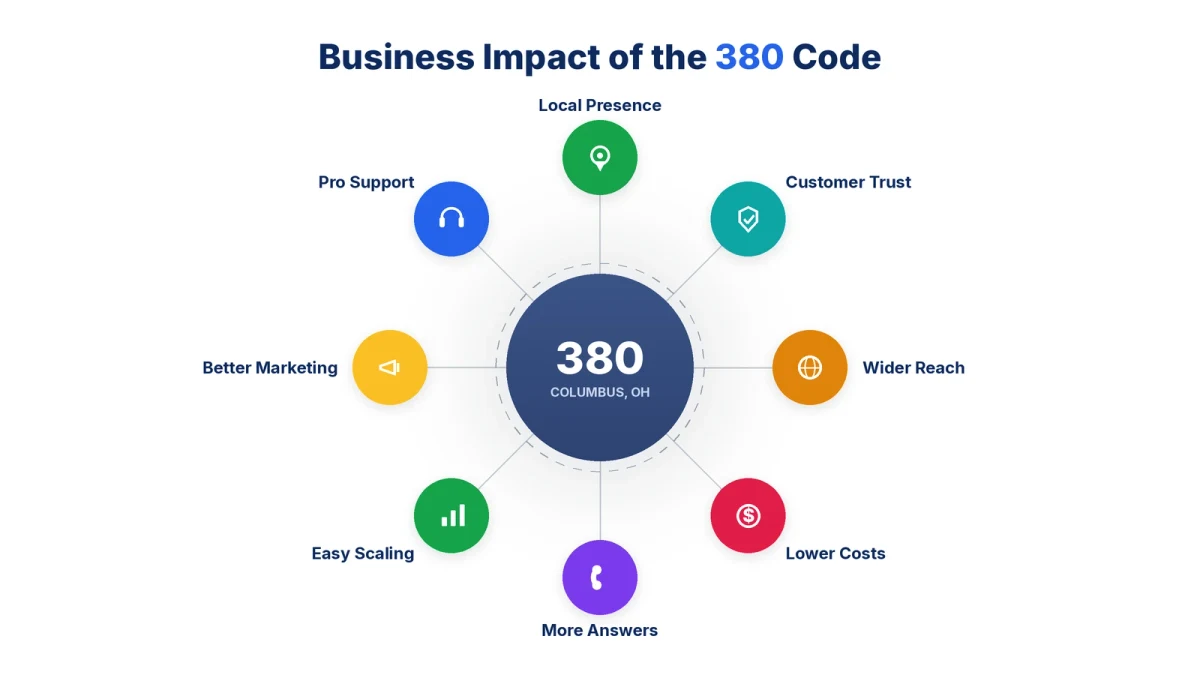
Local Presence
Columbus is one of the Midwest's most competitive business markets, home to 16 Fortune 500 companies and a rapidly expanding startup ecosystem centered around Ohio State University's research programs and tech incubators. In this environment, first impressions matter enormously — and nothing signals "we are part of your community" more immediately than a local area code.
When a Columbus resident sees an incoming call from a 380 or 614 number, they recognize it as local and are far more likely to answer. Research from RingLead and similar sales intelligence platforms consistently shows that local numbers achieve 4× higher connection rates compared to toll-free numbers. For businesses conducting outbound sales, customer support, or appointment reminders, this difference is significant.
Virtual 380 numbers make this advantage accessible to businesses of any size — from a solo freelancer wanting to project professionalism to a national company opening a Columbus branch without a physical office.
Business Credibility
A local area code does more than improve answer rates — it communicates accountability and permanence. Businesses with toll-free numbers can appear transient or automated to prospective customers, while a 380 number suggests a company with roots in the Columbus community.
This perception gap is particularly important for:
- Startups and early-stage businesses competing against established local players
- Service businesses (plumbers, electricians, real estate agents, consultants) where trust is the primary purchase driver
- Healthcare providers who need patients to feel comfortable enough to answer or return calls
- E-commerce businesses targeting the Columbus market who want to appear locally established
A 380 number is a low-cost, high-impact credibility signal that takes minutes to set up but delivers long-term customer trust dividends.
Market Access
The Columbus metro area is one of the most economically dynamic markets in the Midwest. Franklin County alone has a GDP exceeding $100 billion, and the region's young, highly educated workforce — shaped in part by Ohio State University's 60,000+ students — creates consistent demand across retail, technology, food service, healthcare, and professional services.
A 380 area code provides direct market access to this demographic. Businesses can use local numbers to:
- Target Columbus-area customers in local advertising (Google Local, Yelp, Nextdoor)
- Partner with other Columbus businesses who prefer to work with locally identified vendors
- Qualify for local business directories and Columbus Chamber of Commerce listings
- Appear in Columbus-specific phone lookups and local business searches
| Aspect | Importance | Impact on Business |
|---|---|---|
| Local Presence | Boosts consumer trust and answer rates | Up to 4× higher call connection rates vs. toll-free |
| Business Credibility | Signals permanence and community roots | Stronger customer relationships and lower churn |
| Market Access | Opens doors to local partnerships and directories | Expands Columbus customer base and referral network |
Get Your 380 Columbus Number Today
Establish a local presence in Columbus and throughout Ohio with a 380 virtual phone number from CallMama. No SIM card required — get started in minutes.
How to Get a 380 Area Code Phone Number from Major Providers
You do not need to live in Columbus or even in Ohio to get a 380 area code phone number. Virtual number providers have made it possible to acquire any area code number in the US in minutes, from anywhere in the world. The right provider depends on your needs: are you an individual wanting a second number for privacy, a small business building a local presence, or an enterprise needing advanced call management?
| Provider | Best For | Key Features |
|---|---|---|
| CallMama | International callers, budget-conscious users | Low-cost international calls, mobile app, instant setup |
| OpenPhone | Startups, freelancers, remote teams | Unlimited texting, team inboxes, app integrations |
| Verizon | Users wanting carrier-grade reliability | Nationwide network, HD voice, device bundles |
| Ringflow | Growing businesses needing call management | Advanced IVR, call queuing, VoIP infrastructure |
CallMama
CallMama is the fastest way to get a 380 area code number — especially if you also need to make affordable international calls. The platform is built for users who want a US local number without the complexity of a traditional carrier contract. Key advantages include:
- Instant number activation with no hardware or SIM card required
- Transparent pricing with no hidden fees or long-term commitments
- Full mobile app support for iOS and Android
- Competitive international calling rates to 150+ countries
- Call forwarding to any existing number, anywhere in the world
OpenPhone
OpenPhone is built for modern professionals who need more than just a phone number. Their platform functions as a full business communication hub, allowing teams to share a single 380 number with a collaborative inbox. Standout features include:
- Unlimited calling and texting within the US and Canada
- Shared team inboxes so multiple employees can manage one number
- Integrations with HubSpot, Slack, Zapier, and other business tools
- Auto-replies, scheduled texts, and contact notes built in
Verizon
For users who want a physical SIM and a 380 number tied to a carrier plan, Verizon offers strong coverage across Franklin County and the broader Columbus metro. Verizon's network consistently ranks among the top for reliability in Ohio. Options include:
- Consumer and business wireless plans with 380 number selection at sign-up
- HD Voice (VoLTE) for crystal-clear call quality
- Integrated voicemail, call forwarding, and Wi-Fi calling features
- Number porting from any existing provider
Ringflow
Ringflow targets businesses that need enterprise-grade call handling at a mid-market price. Their VoIP platform supports advanced features that basic carriers don't offer, making it a strong choice for call centers and multi-location businesses using 380 numbers for customer service:
- Multi-level IVR (Interactive Voice Response) for professional call routing
- Call queuing, recording, and analytics dashboards
- CRM integrations for connecting calls to customer records
- Scalable pricing — add or remove 380 numbers as your team grows
The Future of the 380 Area Code
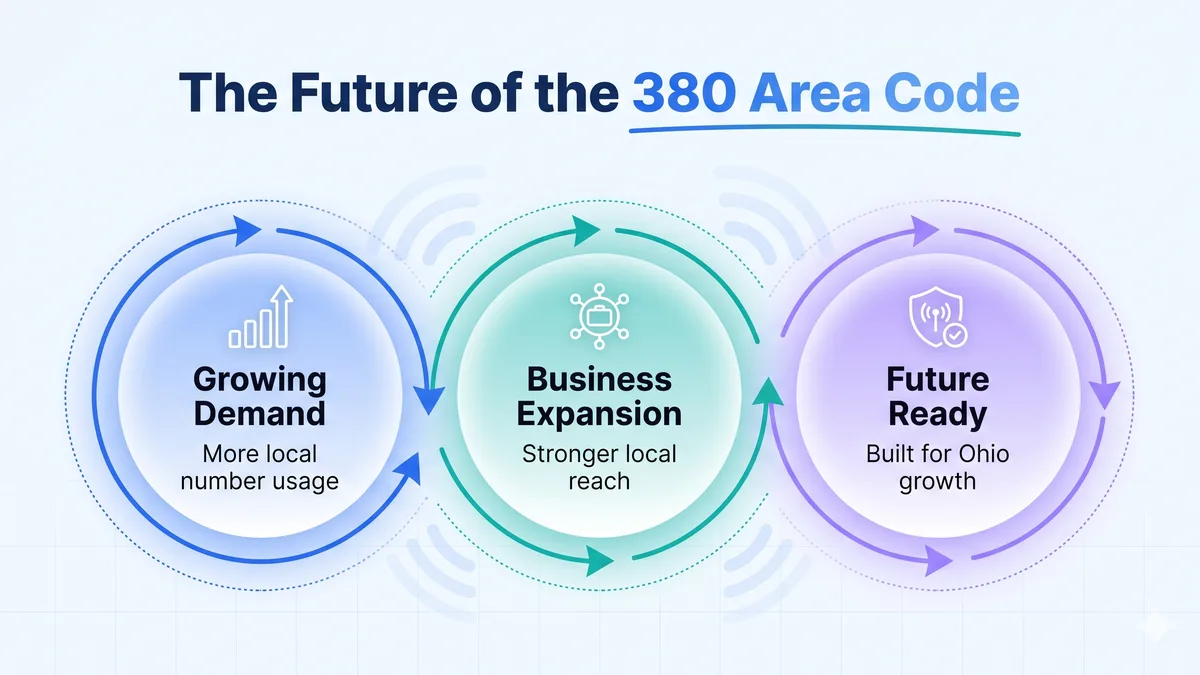
Columbus is not slowing down. The city has ranked among the top 10 fastest-growing large cities in the US for the past decade, with consistent in-migration from younger professionals drawn to its job market, affordability, and quality of life. As the Columbus metro continues to grow, the demand for new phone numbers will grow with it — and the 380 area code is central to that expansion.
Several forces will shape how 380 evolves over the coming years:
- Population growth: Franklin County adds tens of thousands of new residents annually. Each new household and business represents demand for at least one phone number, gradually consuming available 380 and 614 number blocks.
- The shift to VoIP and soft phones: More businesses are replacing traditional landlines with cloud-based phone systems. VoIP adoption multiplies the number of virtual lines a single business maintains, accelerating number consumption even without population growth.
- IoT and connected devices: Smart meters, fleet tracking systems, medical monitoring devices, and retail POS systems increasingly require dedicated SIM cards and assigned phone numbers, adding millions of new number assignments nationwide each year.
- Regulatory evolution: The PUCO and FCC continue to refine number pooling and conservation policies. A third overlay code for the Columbus region — or an expansion of 380's geographic boundaries — remains possible if number exhaustion accelerates.
| Factor | Impact on Area Code |
|---|---|
| Population Growth | Accelerated consumption of available 380 number blocks |
| VoIP and Cloud Phone Adoption | Higher number demand per business; potential for third overlay |
| IoT Device Proliferation | Millions of new number assignments for connected devices |
| Regulatory Changes | Possible new conservation strategies or additional overlay codes |
For individuals and businesses, the practical takeaway is straightforward: secure your 380 number now. Premium or easy-to-remember 380 numbers are a finite resource, and early adopters lock in the most memorable combinations before the pool shrinks further.
Protecting Yourself from Scams and Fraud
Common Scams
Because 380 is a relatively new area code, many people are unfamiliar with it — and scammers exploit that unfamiliarity. Receiving a call from an unknown 380 number and not knowing whether it is a local Columbus business or a fraudster is a real challenge. Common tactics include:
- Government impersonation calls: Fraudsters pose as IRS agents, Social Security Administration officials, or Columbus city inspectors, demanding immediate payment by gift card or wire transfer. No legitimate government agency calls to demand immediate payment by phone.
- Utility company scams: Callers claim to be from AEP Ohio or Columbus Gas, threatening service disconnection unless payment is made immediately. Real utility companies provide written notice before any disconnection.
- Prize and sweepstakes fraud: Callers congratulate you on winning a prize but require a processing fee or bank details to release the funds. Legitimate competitions never require upfront payment.
- Tech support scams: Callers claim your computer has a virus or your account has been compromised, asking you to install remote-access software. This gives scammers direct control of your device.
- Neighbor spoofing: Scammers use technology to display a local 380 or 614 number on your caller ID, even though they are calling from overseas. This is known as caller ID spoofing and is illegal under the Truth in Caller ID Act.
Tips for Staying Safe from Scams
- If you receive an unexpected call from a 380 number, search that number online before calling back — sites like WhoCalledMe or Google often surface user reports of scam activity.
- Never share your Social Security number, bank account details, or passwords over the phone, regardless of how urgent the caller sounds.
- Use your phone's built-in call-blocking features or apps like Hiya, Nomorobo, or Robokiller to automatically screen suspected spam calls.
- Register your number at donotcall.gov to reduce legitimate telemarketing. Note that scammers often ignore this list, so it will not stop all unwanted calls.
- If a caller pressures you for immediate action or payment, hang up. Legitimate organizations give you time to verify and decide.
How to Report Scams and Fraudulent Activities
Reporting scam calls helps law enforcement build cases against fraudsters and protects future victims. If you receive a suspicious call from a 380 number:
- File an FTC fraud report — the FTC uses these reports to identify patterns and take enforcement action.
- Report caller ID spoofing to the FCC at fcc.gov/consumers/guides/filing-informal-complaint.
- Contact your phone carrier's fraud department — most carriers allow you to report scam numbers that they can block at the network level.
- File a report with your local Columbus Police Department (614-645-4545) if the call included a specific threat or resulted in financial loss.
- Alert neighbors and community members through local Facebook groups or Nextdoor to warn others about active scam numbers in the 380 region.
Why Choose a 380 Area Code Number Over Other Options?
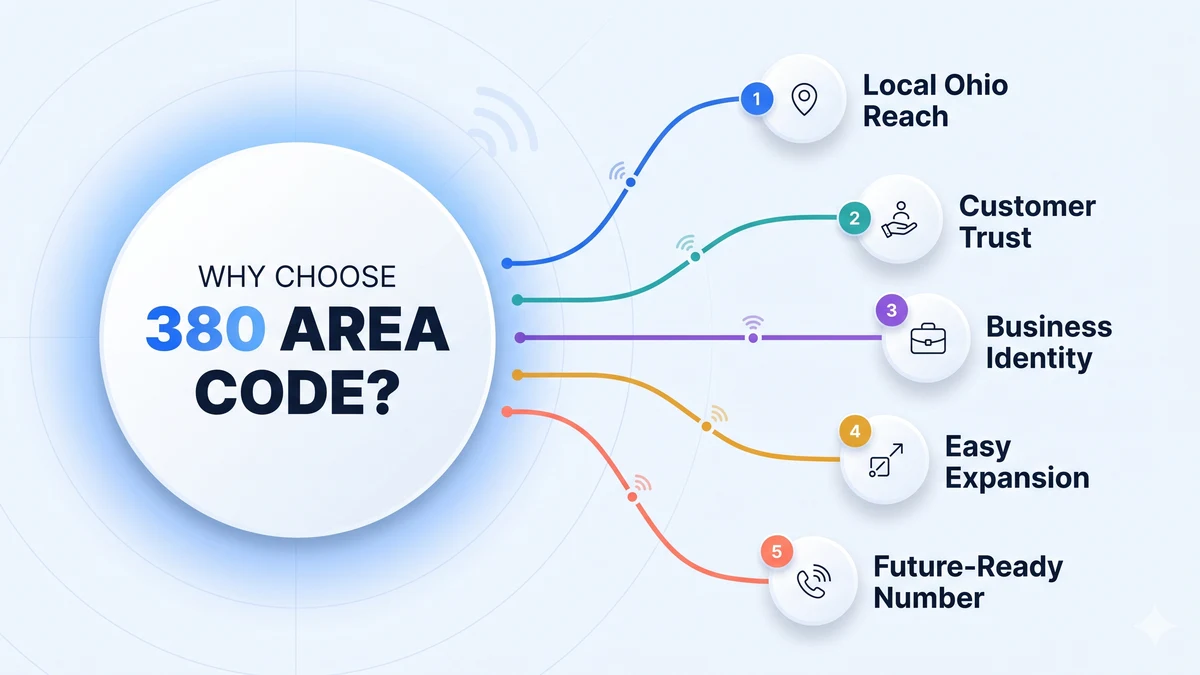
When deciding between a 380 local number, a toll-free 800 number, or an out-of-state area code, the 380 wins on nearly every dimension for anyone targeting the Columbus market. Here is why:
380 vs. Toll-Free Numbers: Toll-free numbers (800, 888, etc.) signal a large, impersonal corporation. They are great for national brands, but they actively hurt local trust. Columbus consumers who see a toll-free number are less likely to answer, more likely to assume it is spam, and less inclined to feel they are supporting a local business. A 380 number solves all three of these problems.
380 vs. Out-of-State Numbers: If you are building a business in Columbus but your phone number shows a New York or California area code, you immediately signal that you are not local — even if you are. A virtual 380 number corrects this perception at a minimal cost.
380 vs. 614: Both are equally local and equally trusted by Columbus residents. The practical differences are minimal — 614 carries more cultural recognition as a legacy Columbus symbol, while 380 is increasingly associated with Columbus's new, tech-forward growth era. For a new business, either works. For a business that wants to signal modernity and growth, 380 has a subtle advantage.
- Instant local credibility in Ohio's largest metro market
- Significantly higher call answer rates vs. toll-free or out-of-state numbers
- Local SEO benefit for Google Business Profile and Columbus-area searches
- No long-distance charges for calls between 380 and 614 within the region
- Easy setup via virtual number providers — active in minutes, no hardware required
- Appeals to Columbus's growing population of young professionals and tech-savvy consumers
Whether you are a local startup, a national brand entering the Columbus market, a freelancer building a professional image, or an individual wanting a second number for privacy, the 380 area code delivers outsized value relative to its cost.
Conclusion
The 380 area code is far more than a set of three digits dialed before a Columbus phone number. It represents the growth, ambition, and ongoing evolution of one of America's most dynamic cities. Introduced on February 27, 2016, to relieve pressure on the original 614 area code, 380 now serves millions of residents and businesses across six central Ohio counties.
Understanding the 380 area code matters for everyone in — or doing business with — the Columbus region. Knowing how to dial correctly, which counties are covered, what time zone applies, how to spot a scam call, and how to get your own 380 number are all practical skills that directly improve how you communicate.
For businesses, the message is clear: a 380 area code number is one of the most cost-effective investments you can make in your Columbus market presence. It builds trust before you say a word, increases the likelihood that potential customers will answer your call, and positions your brand as an authentic part of the Columbus community. With providers like CallMama making virtual 380 numbers available instantly and affordably, there is no reason to wait.
Download the CallMama App
Make affordable calls to and from Columbus, Ohio with the CallMama app. Get a virtual 380 number and stay connected with your community from anywhere.
