Introduction
The 301 area code is one of the most strategically positioned dialing regions in the United States, anchoring the Maryland suburbs directly west and south of Washington, D.C. Understanding this area code matters whether you are a business targeting the federal government corridor, a resident screening an incoming call, or someone looking to establish a Maryland presence from anywhere in the country. This guide covers every city and county in the 301 area code region, its time zone, scam patterns, full history, and exactly how to get a 301 phone number in minutes. By the end, you will have everything you need to take action immediately.
Key Takeaways
- The 301 area code covers western and southern Maryland — including Montgomery, Prince George's, and Frederick counties — home to some of the most economically powerful suburbs in America.
- All cities in the 301 region operate in the Eastern Time Zone, running UTC−5 in winter and UTC−4 during Daylight Saving Time.
- Area code 301 was one of the original NANP codes launched in 1947, originally covering all of Maryland before multiple splits reduced it to its current footprint.
- Scammers actively spoof 301 numbers to target residents and federal employees — recognizing the warning signs keeps you protected.
- You do not need a Maryland address to own a 301 number — virtual providers activate a local line in under five minutes, with no hardware or contract required.
What Is the 301 Area Code?
The 301 area code is a NANP (North American Numbering Plan) geographic area code assigned to the western and southern portions of Maryland. It is one of the original 86 area codes established when AT&T created the NANP in 1947, making it one of the oldest and most historically significant codes in the country. Today it shares its territory with the 240 area code, introduced in 1997 as an overlay — both codes serve the same geography, and all local calls require 10-digit dialing.
The 301 region sits at the intersection of federal government, biomedical research, and high-income commuter communities. It borders Washington, D.C. directly, making it one of the most economically and politically significant suburban dialing zones in the nation.
301 Area Code Quick Facts
| Detail | Information |
|---|---|
| Area Code | 301 |
| Overlay Code | 240 |
| State | Maryland (MD) |
| Region | Western and Southern Maryland |
| Major Cities | Rockville, Bethesda, Silver Spring, Gaithersburg, Frederick |
| Time Zone | Eastern Time (EST/EDT) |
| UTC Offset | UTC−5 (EST) / UTC−4 (EDT) |
| Established | January 1, 1947 |
| Overlay Added | 1997 (Area Code 240) |
| Country | United States |
Where Is the 301 Area Code Located?
The 301 area code covers the western and southern half of Maryland, stretching from the D.C. border in the east to the West Virginia state line in the west, and from the Pennsylvania border in the north to the Chesapeake Bay tributaries in the south. Nine counties fall within its boundaries, spanning urban professional communities, fast-growing suburban towns, and rural western landscapes.
Counties Covered by the 301 Area Code
| County | Notable For |
|---|---|
| Montgomery County | Most populous county in Maryland; home to Bethesda, Rockville, and Silver Spring |
| Prince George's County | Borders Washington, D.C. directly; home to the University of Maryland |
| Frederick County | One of the fastest-growing counties in Maryland |
| Washington County | Home to Hagerstown, the region's western anchor city |
| Allegany County | Western Maryland gateway; historic industrial heritage |
| Garrett County | Westernmost county; major outdoor recreation destination |
| Calvert County | Southern Maryland's fastest-growing suburban county |
| Charles County | Rapidly expanding suburban communities south of D.C. |
| St. Mary's County | Home to Naval Air Station Patuxent River |
Major Cities in the 301 Coverage Area
| City | Notable For |
|---|---|
| Bethesda | National Institutes of Health headquarters; federal research hub |
| Rockville | Montgomery County seat; major biotech and pharma corridor |
| Silver Spring | Urban cultural hub; major media and entertainment companies |
| Gaithersburg | NIST federal standards lab; growing tech sector |
| Frederick | Fastest-growing city in Maryland; historic downtown |
| Hagerstown | Western Maryland commercial and logistics center |
| Waldorf | Largest census-designated place in Maryland by population |
| College Park | University of Maryland campus; research and innovation district |
For a look at another Midwest market with its own overlay history, see our 319 area code guide.
What Time Zone Does the 301 Area Code Use?
Every city within the 301 area code operates in the Eastern Time Zone. During Eastern Standard Time — November through mid-March — clocks run at UTC−5. During Eastern Daylight Time — mid-March through November — the region moves to UTC−4.
For callers outside Maryland, this offset is worth factoring in. A 9 a.m. call from California reaches 301 contacts at noon their time. Anyone coordinating remote teams or scheduling calls with D.C.-area contacts needs to account for the Eastern Time position to avoid connecting outside business hours.
| Caller's Time Zone | Difference from 301 (ET) |
|---|---|
| Central (CT) | 301 is 1 hour ahead |
| Mountain (MT) | 301 is 2 hours ahead |
| Pacific (PT) | 301 is 3 hours ahead |
The History of the 301 Area Code
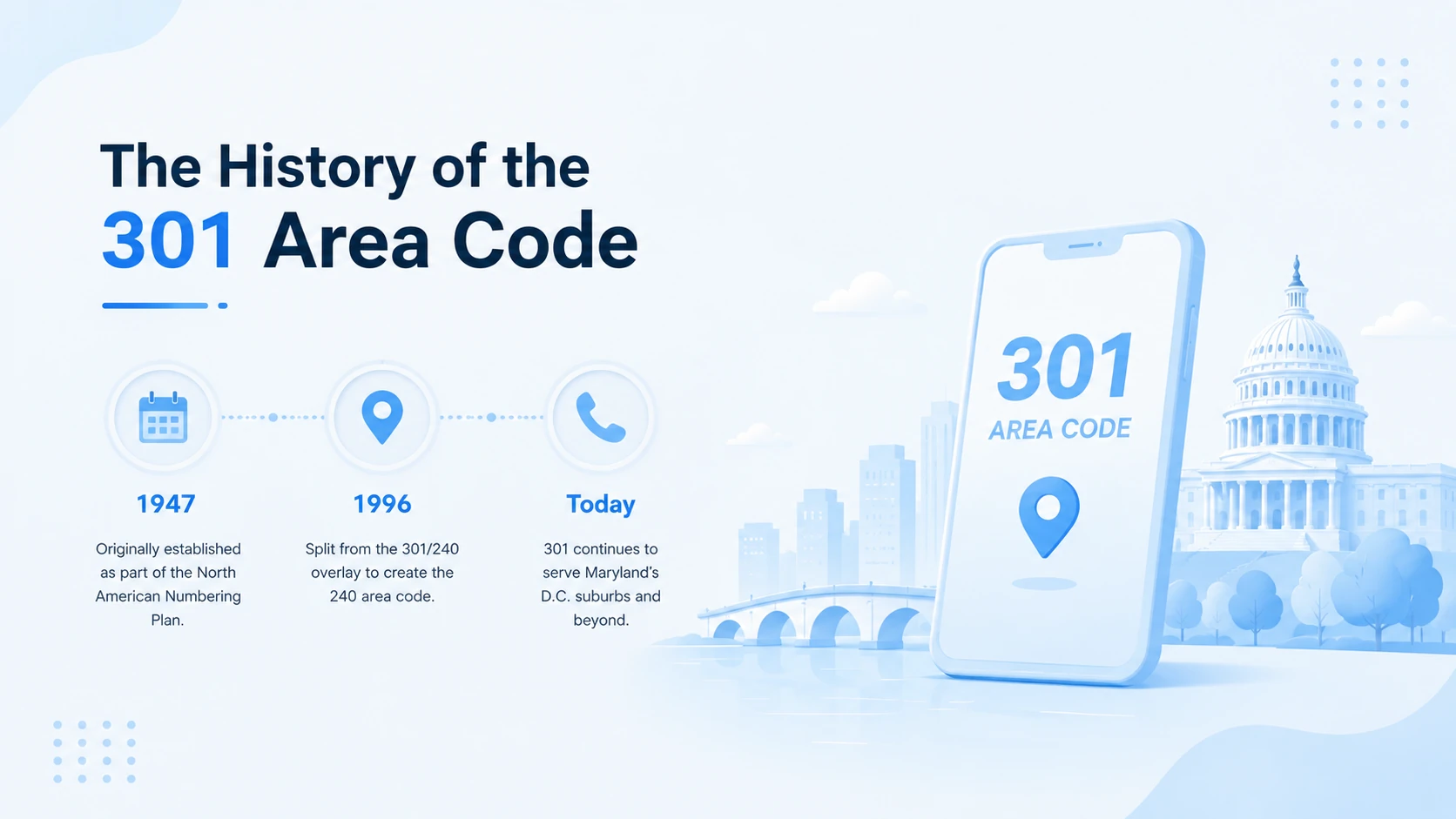
The 301 area code launched on January 1, 1947 as one of the original NANP codes. At that time, a single code covered all of Maryland, Washington D.C., and parts of Virginia — demand was manageable and splits were not yet necessary. Over the following five decades, explosive population growth and the rise of mobile phones, fax lines, and internet connections exhausted the number pool and forced a series of geographic reductions.
In 1984, the 202 area code was reassigned exclusively to Washington, D.C. In 1991, the 410 area code was carved out for eastern Maryland — including Baltimore — leaving 301 to serve only the western and southern counties. Then in 1997, the 240 area code was introduced as a full overlay across the same 301 geography, requiring 10-digit dialing for all local calls. No further splits have occurred since.
Maryland Area Code Timeline
| Year | Event |
|---|---|
| 1947 | 301 launches — covers all of Maryland, D.C., and parts of Virginia |
| 1984 | 202 reassigned exclusively to Washington, D.C. |
| 1991 | 410 split off for eastern Maryland, including Baltimore |
| 1997 | 240 overlay introduced — mandatory 10-digit dialing begins |
| 1997–present | 301 and 240 serve the same western/southern Maryland territory |
Targeting Maryland's federal corridor, biotech sector, or suburban market?
A virtual 301 phone number connects you to one of the most economically powerful suburban markets in the country — without a Maryland lease or a physical office.
Why a Local 301 Number Matters for Your Business
A 301 area code number signals to every contact in western and southern Maryland that your business is embedded in their region — not an anonymous national caller. Studies on outbound call response rates consistently show that local numbers are answered at dramatically higher rates than toll-free or out-of-state lines. In a region this dense with federal agencies, research institutions, and professional services firms, that local signal carries extra weight with every person who sees your number on their screen.
Industries That Gain the Most from a 301 Presence
- Federal contractors and consultants — A Maryland number adds credibility when reaching agency contacts in Montgomery or Prince George's County.
- Healthcare and biomedical firms — With NIH, Walter Reed, and dozens of private research campuses nearby, a 301 presence communicates genuine regional investment.
- Real estate professionals — Buyers and sellers in high-value suburban markets respond more readily to agents who appear locally rooted.
- Legal and financial services — A 301 prefix signals proximity to the D.C. metro professional market that clients value.
- E-commerce and customer service — Customers trust local-looking numbers when verifying orders or resolving issues.
Businesses expanding into the Great Plains often compare this reach with our 316 area code guide.
How to Get a Virtual Phone Number from CallMama
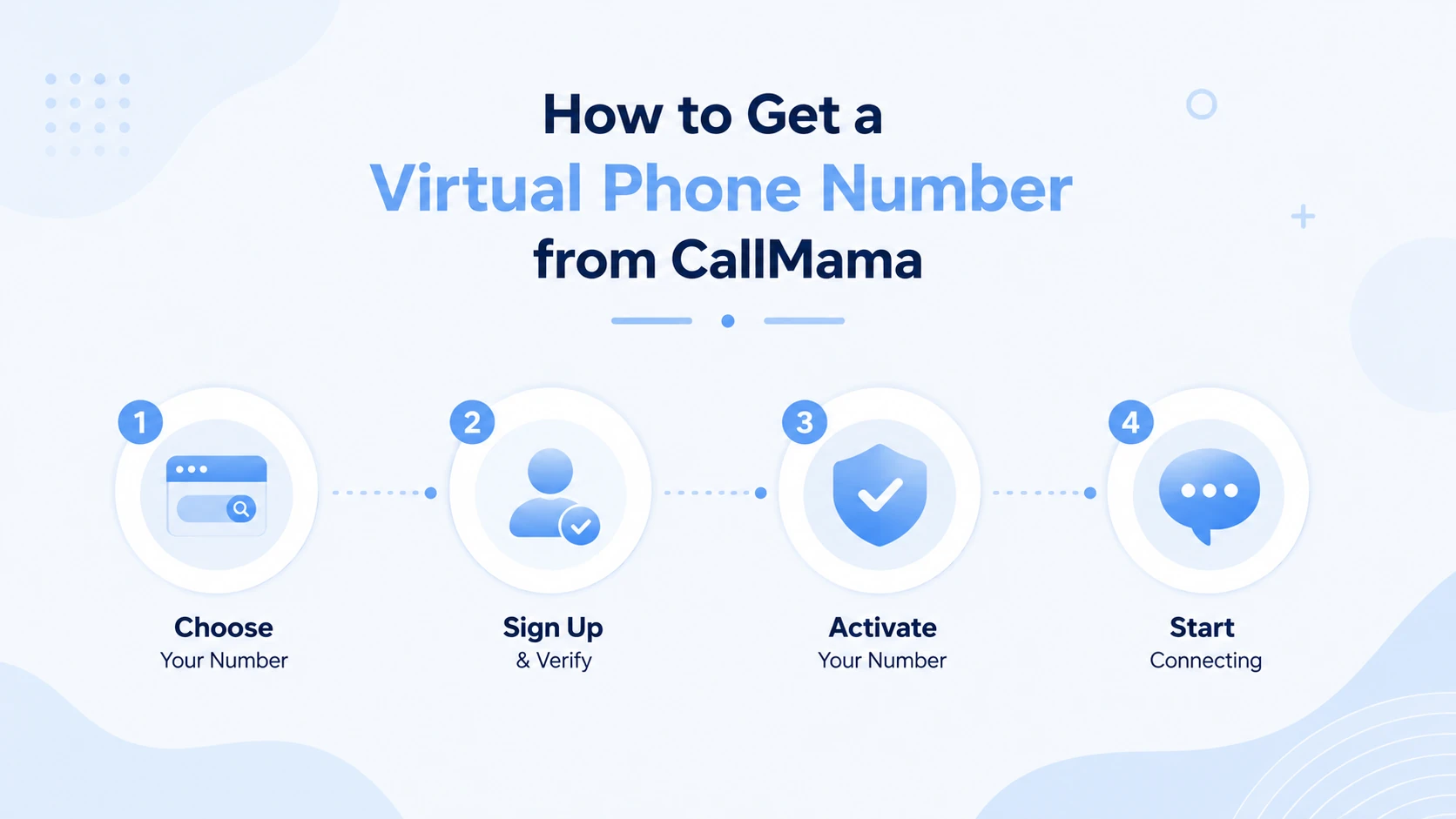
CallMama is a global virtual phone number platform that gives you a real, NANP-registered 301 number without requiring a Maryland address, a physical SIM, or any hardware. The platform includes HD voice, two-way SMS, voicemail-to-email transcription, and call forwarding — all starting at $1.99 per month with no hidden fees and no lock-in contract.
- Visit callmama.com or download the app from the App Store or Google Play — it is free to install.
- Create your free account — sign up with your email address. Verification takes under sixty seconds.
- Choose a plan — select the virtual number plan that fits your call volume and budget, starting at $1.99/month.
- Select your number — choose United States as the country, enter 301 as the area code, and browse available Maryland numbers.
- Add credit and activate — fund your account and your 301 phone number goes live immediately.
- Configure your settings — set up call forwarding, voicemail routing, and SMS preferences in the dashboard.
- Start making and receiving calls — your number works on any smartphone, tablet, or computer from day one.
Scam Calls and the 301 Area Code
The 301 area code is actively targeted by caller ID spoofing operations. Scammers display local Maryland numbers because residents, federal employees, and business contacts are far more likely to answer a familiar prefix. The concentration of government agencies and high-income households in this region makes it an especially attractive target. Knowing the common patterns is your first line of defense.
Common Scam Types in the 301 Region
| Scam Type | How It Works | Warning Sign |
|---|---|---|
| Government impersonation | Caller claims to be from the IRS or Social Security Administration, threatening arrest | Federal agencies contact you by mail — never by unsolicited call |
| Federal contractor fraud | Caller poses as a D.C.-area government vendor requesting payment or credentials | Legitimate contractors do not call unsolicited to request financial data |
| One-ring callback trick | Number rings once and disconnects, hoping curiosity makes you call a premium-rate line | Never return a call from a number that rang once with no voicemail |
| Utility shutoff threats | Caller poses as Pepco or Washington Gas demanding immediate payment | Real utilities send written notice before any shutoff action |
| Tech support fraud | Caller claims your computer has a virus and requests remote access | No legitimate company calls you unsolicited about your device |
How to Protect Yourself
- Verify independently before acting on any call that creates urgency or demands immediate payment.
- Never share personal or financial data with any unsolicited caller, regardless of how official they sound.
- Report scam calls to the Federal Trade Commission's FTC fraud report service.
- Register at donotcall.gov to reduce unwanted telemarketing volume over time.
301 Area Code vs. Neighboring Area Codes
Understanding how the 301 area code relates to surrounding codes helps you identify the origin of any Maryland or D.C.-region call at a glance.
| Area Code | Region | Key Cities |
|---|---|---|
| 301 / 240 | Western and Southern Maryland | Rockville, Bethesda, Silver Spring, Frederick |
| 410 / 443 | Eastern Maryland | Baltimore, Annapolis, Columbia |
| 202 | Washington, D.C. | All D.C. neighborhoods |
| 571 / 703 | Northern Virginia | Arlington, Alexandria, Fairfax |
| 804 | Central Virginia | Richmond, Petersburg |
Calls from 240 originate in the same western and southern Maryland geography as 301 — the two codes are interchangeable because 240 is a direct overlay on the 301 region. A call from 410 or 443 comes from eastern Maryland, including Baltimore. Calls from 202 come from within Washington, D.C. itself.
Conclusion
The 301 area code defines one of the most strategically valuable suburban markets in the United States — a nine-county region of Maryland that borders Washington, D.C. and hosts federal agencies, world-class research institutions, and millions of economically active residents. This guide has covered the full picture: which counties and cities fall within the 301 region, the Eastern Time Zone it operates in, its history from 1947 through the 240 overlay, the scam patterns that target local numbers, and how a local 301 phone number delivers immediate credibility in the D.C. metro market. Every fact you need to navigate this dialing region is now in your hands.
Converting that knowledge into action is the clear next step. A virtual 301 number activates in minutes — no Maryland address, no hardware, no long-term commitment — and positions your business inside a market where local trust carries more value than almost anywhere else in the country. Whether you serve federal contractors, healthcare clients, real estate buyers, or professional services customers across this high-value corridor, a 301 area code presence signals exactly the right thing: you are here, you are local, and you are ready to connect.
Ready to claim your Maryland presence?
Activate a virtual 301 number in minutes — no Maryland address needed, works on any device.
