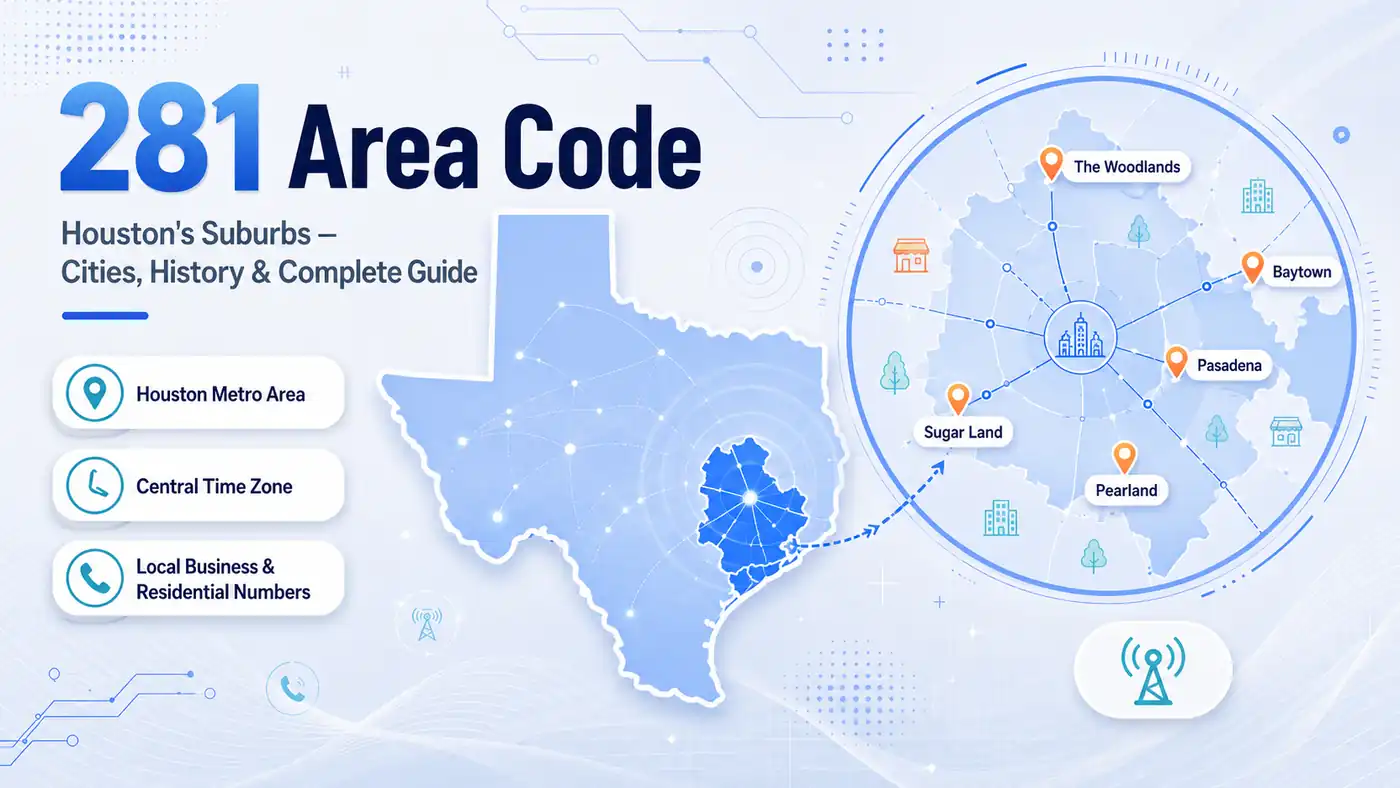
The 281 area code covers the sprawling suburban ring surrounding Houston, Texas — one of the largest and fastest-growing metro areas in the United States. If you received a call from a 281 area code number or need a local Houston-suburb prefix for your business, this is everything you need to know. This guide covers the major cities and counties served by 281, its full split history from 713, Central Time dialling rules, scam call awareness, and how to activate a virtual 281 number in under 60 seconds. Houston's suburbs are among the most economically diverse communities in America — and one area code connects them all.
Key Takeaways
- The 281 area code covers Houston's outer suburbs in Texas, including Sugar Land, Pearland, Pasadena, Baytown, Katy, and League City.
- Area code 281 was created on November 2, 1996, splitting from 713 as Houston's suburban population expanded beyond the original code's capacity.
- The 832 overlay (1999) and 346 overlay (2014) were later added to the same Houston-metro territory, so 281, 832, and 346 now coexist across the region.
- Every community in the 281 zone follows Central Time — CST (UTC−6) in winter and CDT (UTC−5) during daylight saving time.
- You can get a virtual 281 phone number in under 60 seconds — no Texas address, US SIM card, or office lease required.
What Is the 281 Area Code?
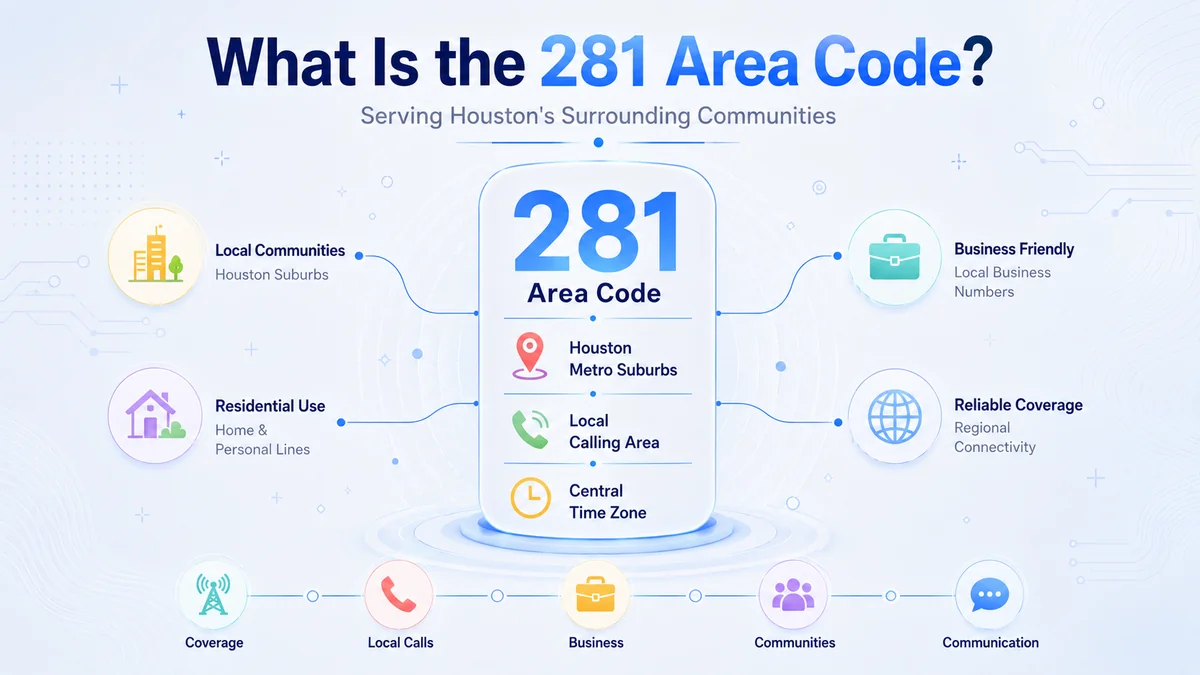
The 281 area code is a Texas prefix assigned to Houston's outer suburbs and surrounding municipalities that extend beyond the city's urban core. It does not cover downtown Houston itself — that remains primarily 713 territory — but instead wraps around it, serving a ring of rapidly growing communities that house millions of Houston's residents and workers.
When 281 was introduced in 1996, it was assigned exclusively to the suburban fringe. Since then, the 832 and 346 codes have been added as overlays to handle continued growth. All three codes now serve overlapping territory within the Houston metro, meaning a single neighbourhood may include residents and businesses with 281, 832, or 346 numbers.
At a Glance
| Detail | Information |
|---|---|
| Area code | 281 |
| Overlay codes | 832 (1999), 346 (2014) |
| State | Texas (TX) |
| Major cities | Pasadena, Sugar Land, Baytown, Pearland, League City, Katy |
| Coverage | Houston suburbs — Harris, Fort Bend, Brazoria, Galveston, Montgomery counties |
| Time zone | Central Time (CT) — entire coverage area |
| Dialling format (US) | (281) XXX-XXXX |
| Dialling format (international) | +1 281 XXX XXXX |
| Established | November 2, 1996 (split from 713) |
| Split from | 713 (central Houston) |
281 Area Code History: The 1996 Split from 713
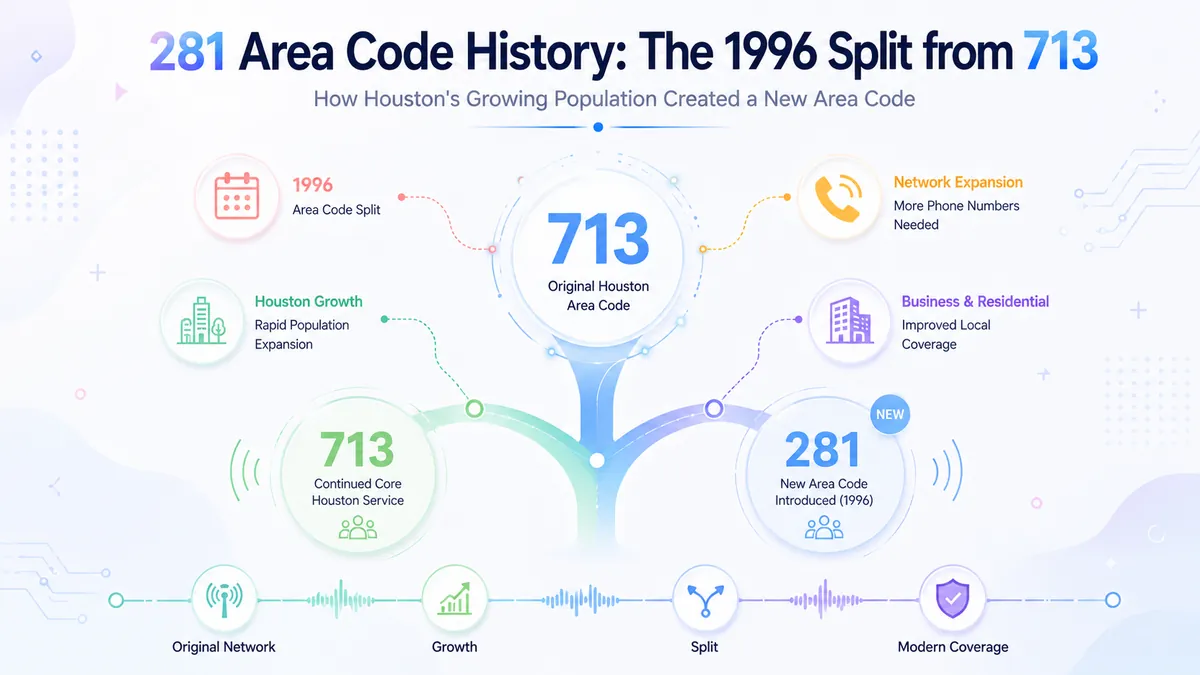
Before 1996, virtually all of Houston and its suburbs shared one area code: 713. That single prefix covered a metropolitan area that had grown into the fourth-largest city in the United States, stretching across Harris County and deep into the surrounding suburban counties of Fort Bend, Brazoria, Montgomery, and Galveston.
Why Houston Needed a New Code
By the mid-1990s, the surge in mobile phone subscriptions, fax machines, and internet dial-up lines had drained the available pool of 713 numbers at an alarming rate. State telecommunications regulators determined that a geographic split was the best solution — suburbs would receive 281, while central Houston retained 713.
Area code 281 officially launched on November 2, 1996. The split gave Houston's suburbs their own identity and created enough numbering capacity to fuel continued expansion. Growth did not stop there. In 1999, the 832 code was introduced as an overlay for the entire Houston metro — covering both 713 and 281 territory without any geographic split. The 346 overlay followed in 2014, adding a fourth code as the region's population continued to climb.
What 281 Covers Today
The 281 area code primarily serves suburban communities in Harris County outside the 610 Loop, along with parts of Fort Bend, Brazoria, Montgomery, and Galveston counties. It is one of the most recognisable Texas area codes among Houston-metro residents and businesses, carrying the identity of the city's vast and diverse suburban landscape.
Cities and Counties Covered by the 281 Area Code
The Houston suburbs served by 281 are among the fastest-growing communities in the entire United States, spanning industrial, residential, and commercial landscapes in every direction from the city's core.
Pasadena and Baytown — The Industrial Corridor
Pasadena is one of the largest cities in Harris County and a cornerstone of Houston's petrochemical industry. The Houston Ship Channel runs through its southern edge, making it one of the most important industrial communities on the entire Gulf Coast.
Baytown sits east of Houston along Galveston Bay, home to one of the largest ExxonMobil refineries in the US and a significant energy and manufacturing workforce. Both cities represent the industrial backbone of the 281 corridor.
Sugar Land and Missouri City — The Southwest Suburbs
Sugar Land is one of the most affluent and fastest-growing cities in Fort Bend County. Once defined by its Imperial Sugar Company refinery, Sugar Land is now a thriving corporate district with major employers across finance, energy services, and professional industries.
Missouri City borders Sugar Land to the north, offering master-planned residential communities and commercial corridors convenient to both downtown Houston and the Fort Bend County seat at Richmond.
Pearland, League City, and Friendswood
Pearland in Brazoria County has ranked among the fastest-growing cities in Texas for over a decade, driven by proximity to the Texas Medical Center just 15 miles to the north. League City and Friendswood in Galveston County round out the southern suburbs, combining residential growth with easy access to NASA's Johnson Space Center at Clear Lake.
Other 281 Communities
The 281 region also covers Spring, Humble, La Porte, Deer Park, Katy (in part), and dozens of smaller unincorporated Harris County communities that make up the suburban sprawl surrounding Houston's core.
For Houston's other overlapping prefix, see the 832 area code guide.
Calling Anyone in Houston's Suburbs?
The CallMama app routes your calls over Wi-Fi — reach any 281 number at zero cost from anywhere in the world.
281 Area Code Time Zone
Every community in the 281 coverage area — from Pasadena's refineries to Sugar Land's corporate campuses — follows a single time zone: Central Time (CT).
Central Time at a Glance
- Central Standard Time (CST): UTC−6, from the first Sunday in November to the second Sunday in March
- Central Daylight Time (CDT): UTC−5, from the second Sunday in March to the first Sunday in November
- Same zone as: Dallas, Austin, San Antonio, Chicago, and New Orleans
For UK callers, the Houston area is 6 hours behind London in winter and 5 hours behind during British Summer Time. A 3 PM London call reaches Houston at 9 AM in winter — a practical window for international business on both sides of the Atlantic.
How to Dial a 281 Number — From the US and Abroad
From Within the US
Dial 1 + 281 + the 7-digit number for any call to a 281 subscriber from outside the Houston metro. Because 832 and 346 overlay the same territory, 10-digit dialling is mandatory throughout the Houston metro — even a call between two neighbours requires the full area code plus number.
From Abroad
- From the UK: 00 1 281 XXX XXXX
- From Australia: 0011 1 281 XXX XXXX
- From Europe: 00 1 281 XXX XXXX
- Using + notation (any smartphone): +1 281 XXX XXXX
5 Reasons Businesses Get a 281 Number
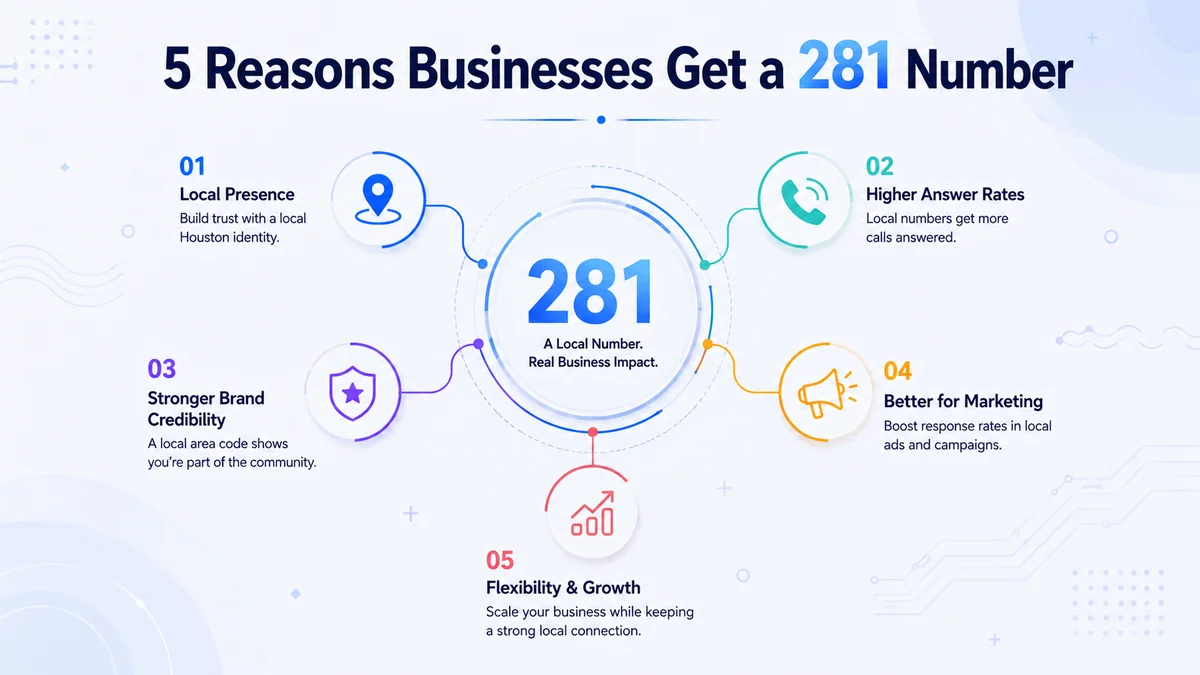
A 281 phone number signals to Houston-suburb clients that you are already embedded in their market — not an outside vendor calling cold from across the country. Here are five reasons businesses in energy, healthcare, aerospace, retail, and tech choose a local 281 prefix.
1. The Global Energy Industry
The Houston Ship Channel corridor — anchored in Pasadena and Baytown — is one of the largest petrochemical manufacturing hubs in the world. Energy suppliers, engineering consultancies, and logistics providers working in this corridor gain immediate credibility with a familiar 281 prefix on every outbound call.
2. Proximity to the Texas Medical Center
The Texas Medical Center — just north of Pearland and accessible across the southern 281 zone — is the largest medical complex in the world, employing over 100,000 people. Medical suppliers, staffing firms, and healthcare technology companies that carry a local 281 number project authentic presence to TMC procurement teams.
3. NASA and the Aerospace Sector
League City and Friendswood sit minutes from NASA's Johnson Space Center at Clear Lake — home to mission control for every US human spaceflight programme. Aerospace contractors and research partners serving this corridor benefit from a recognisable South Houston prefix that signals local market knowledge.
4. Retail and Commercial Expansion
Sugar Land Town Square and the commercial corridors of Pearland and Katy represent some of the most active retail development in the Houston region. Businesses serving this suburban customer base use a 281 number to blend naturally into a community that prefers dealing with local contacts.
5. America's Fastest-Growing Suburban Market
Fort Bend County — home to Sugar Land and Missouri City — has consistently ranked among the fastest-growing counties in the entire United States. A local 281 area code number positions any business inside this growth wave from day one, without requiring a physical Texas office.
Businesses expanding statewide often pair a 281 presence with one in Dallas — see the 214 area code guide.
Get a 281 Number in Under 60 Seconds
Getting a virtual 281 prefix requires no Texas mailing address, no US SIM card, and no physical phone line. The entire process takes under a minute:
- Step 1 — Choose a provider: Select a virtual phone platform that covers the 281 region and supports inbound calls, outbound calls, and SMS messaging.
- Step 2 — Browse available numbers: Filter by 281 and select your preferred number — some providers list numbers tied to specific Houston-suburb city prefixes.
- Step 3 — Set up call routing: Forward incoming calls to your mobile, laptop, tablet, or a shared team line — from wherever you work.
- Step 4 — Activate: Most virtual numbers go live within minutes of sign-up, with no hardware installation required.
What Comes with Your 281 Number
- Inbound and outbound calls displaying a Houston-suburb 281 prefix
- SMS and text messaging from a recognised local number
- Voicemail-to-email or voicemail-to-text transcription
- Call forwarding to any device, anywhere in the world
- Number portability — transfer your number to another provider at any time
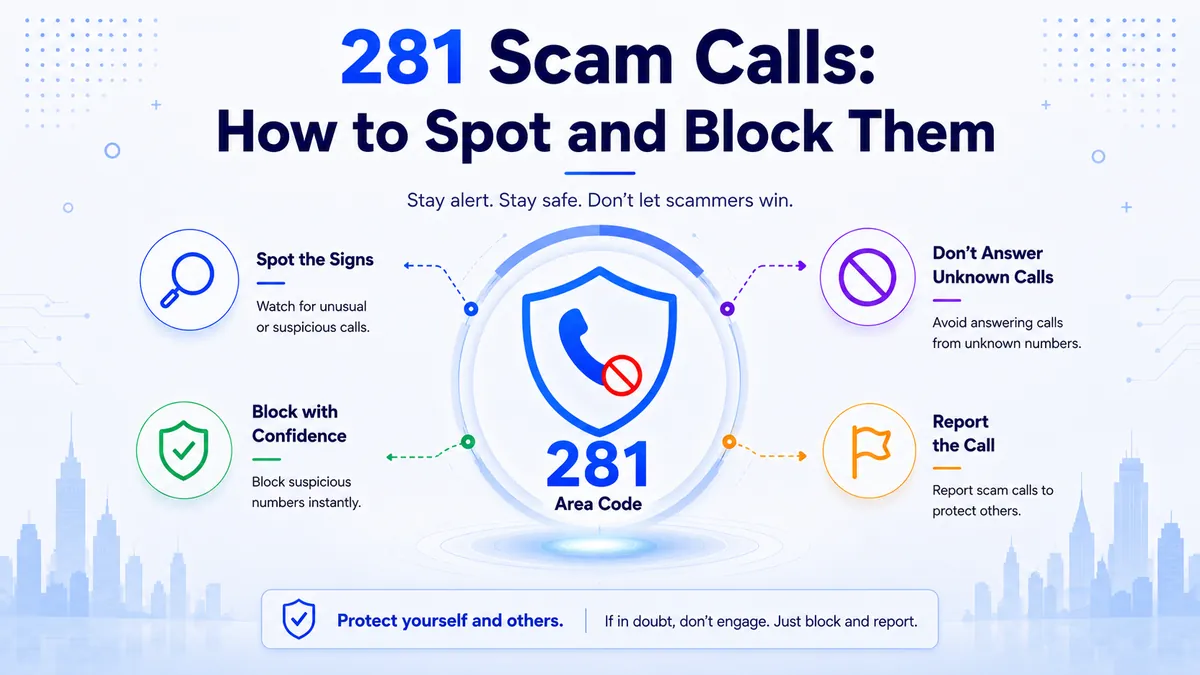
281 Scam Calls: How to Spot and Block Them
The 281 prefix is legitimate — used daily by millions of residents, businesses, hospitals, schools, and energy companies across Houston's suburbs. Like all US area codes, however, it can be spoofed by scammers who want their call to appear as a familiar local number.
Warning Signs of a Spoofed 281 Call
- The caller creates urgency — threatening arrest, debt collection, or account suspension
- Payment is demanded via wire transfer, cryptocurrency, or prepaid gift cards
- The caller claims to represent the IRS, Social Security Administration, or a Texas state agency
- No verifiable callback number or business name is provided when asked directly
- The caller pressures you to stay on the line rather than hang up to verify
What to Do
Hang up without sharing any personal or financial information. Look up the organisation's official number independently and call back through that contact — not the number that called you. Report suspicious 281 calls to the FTC fraud report service. A free reverse phone lookup can quickly confirm whether a 281 phone number belongs to a verified Houston-suburb business or has been flagged as a known spam source.
The Complete 281 Picture
The 281 area code has connected Houston's outer suburbs since November 1996, serving millions of residents across Sugar Land, Pearland, Pasadena, Baytown, and dozens of growing communities in Harris, Fort Bend, Brazoria, and Galveston counties. It operates on Central Time, requires 10-digit dialling throughout the Houston metro, and coexists with the 832 and 346 overlays added to meet the region's relentless expansion. The 281 region spans multiple counties and industries, making it one of the most economically diverse suburban areas in the United States. Whether you are identifying a caller, scheduling across time zones, or reaching a client in the world's largest medical or petrochemical complex, the 281 picture is now complete.
Getting a virtual 281 phone number places your business directly inside one of America's fastest-growing metro regions — with no Texas address, no SIM card, and no office lease required. Contacts across Sugar Land, Pearland, and Pasadena see a familiar local prefix every time you call, turning a cold outreach into a trusted local connection. If Houston's suburbs matter to your business, a 281 prefix signals you belong there. Activate your number today through CallMama and start building real, local trust across the entire Houston metro.
Ready to Own a Houston Number Without Moving to Texas?
A virtual 281 number connects you to one of America's biggest growth markets in under 60 seconds — no contracts, no hardware, no address required.
