Introduction
The 520 area code covers Tucson and southern Arizona — a region defined by desert landscapes, a thriving university city, major defense installations, and a vibrant US-Mexico border economy that sets it apart from every other calling zone in the Southwest. Understanding the 520 area code matters whether you are verifying a call from the Tucson metro, searching for a 520 phone number, or expanding your business into one of the fastest-growing markets in the Sunbelt. This guide covers the cities it serves, Arizona's unique time zone rules, the full history of the code, and exactly how to get your own number without relocating to Arizona. Every answer is here — read on.
Key Takeaways
- The 520 area code covers Tucson and southern Arizona, including Pima, Santa Cruz, and Cochise counties across the US-Mexico border region.
- Arizona does not observe daylight saving time, so the 520 area code stays on Mountain Standard Time (UTC-7) year-round — unlike most other U.S. states.
- The 520 prefix was created in 1995 as a split from the original 602 code, and was further refined in 2001 when 928 took over northern and western Arizona.
- Tucson is the largest city in the 520 region and Arizona's second-largest city, home to the University of Arizona and major aerospace and defense employers.
- You can get a 520 phone number through a virtual provider in minutes without moving to Arizona.
What Is the 520 Area Code and Where Is It Located?
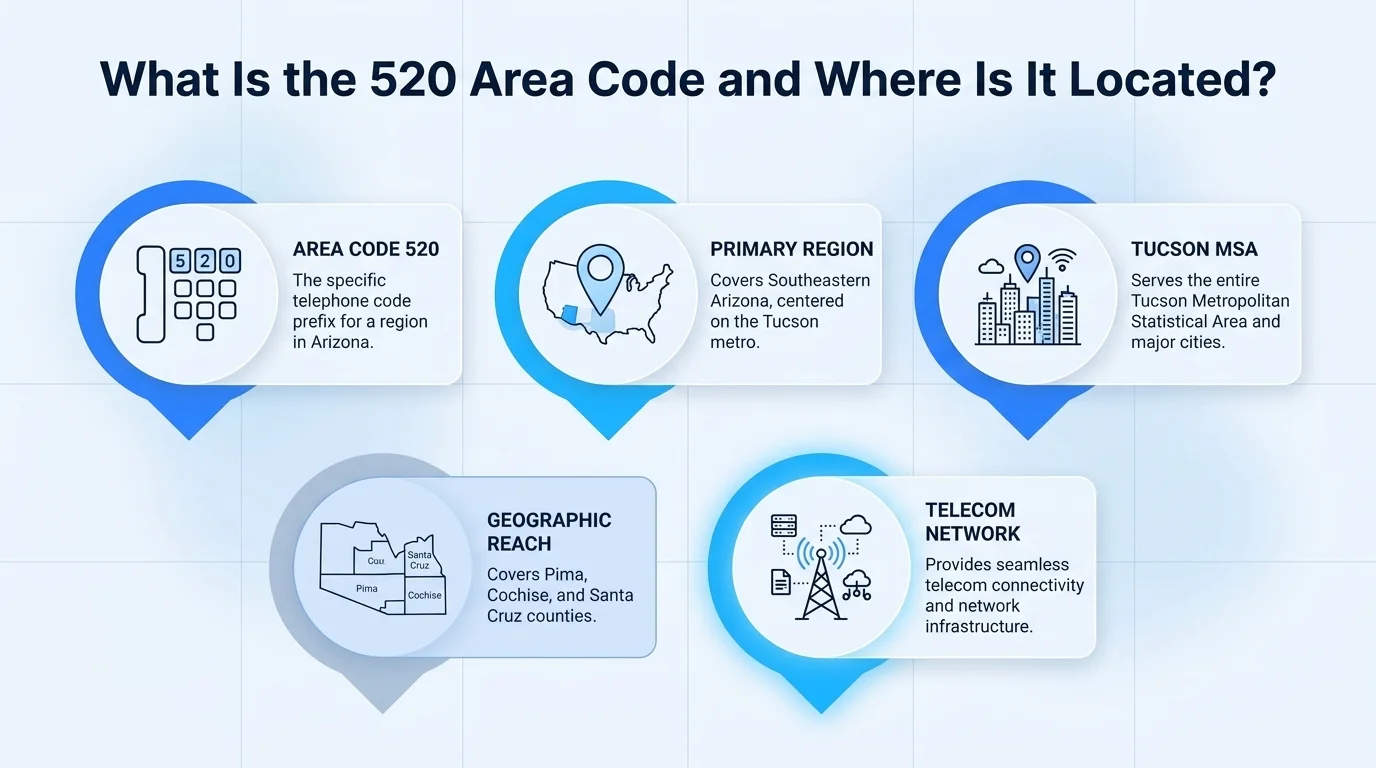
The 520 area code covers the southern portion of Arizona — primarily Pima County (Tucson), Santa Cruz County (Nogales), Cochise County (Sierra Vista, Douglas, Bisbee, Tombstone), and parts of several other southern Arizona counties. This region sits in the heart of the Sonoran Desert and shares a long international border with the Mexican state of Sonora, giving the 520 area code a distinctive cross-border economic character found nowhere else in American telecommunications.
The 520 area code is not an overlay — it is the sole prefix for its territory and coexists with neighboring codes 602, 480, and 623 (Phoenix metro) to the north, 928 (northern and western Arizona) to the northwest, and New Mexico's 505 to the east. No second code shares the 520 geography, making it the single point of local identity for all of southern Arizona's communities.
For a comparable regional profile in the Southwest, our guide on the 435 area code covers rural Utah — another expansive western region where a single code serves a wide geographic footprint with strong local identity.
520 Area Code Quick Facts
| Detail | Information |
|---|---|
| Area Code | 520 |
| State | Arizona |
| Region | Tucson and southern Arizona |
| Time Zone | Mountain Standard Time (MST) — year-round |
| UTC Offset | UTC-7 (no daylight saving time) |
| Established | 1995 |
| Split From | 602 (Arizona) |
| Overlay Code | None |
Is 520 Exclusive to Arizona?
Yes — area code 520 covers only southern Arizona. It does not cross into New Mexico, Utah, Colorado, or Mexico. Every 520 number originates from within Arizona's southern counties, making it a clear regional identifier for the Tucson metro and the surrounding border communities.
Which Cities Does the 520 Area Code Cover?
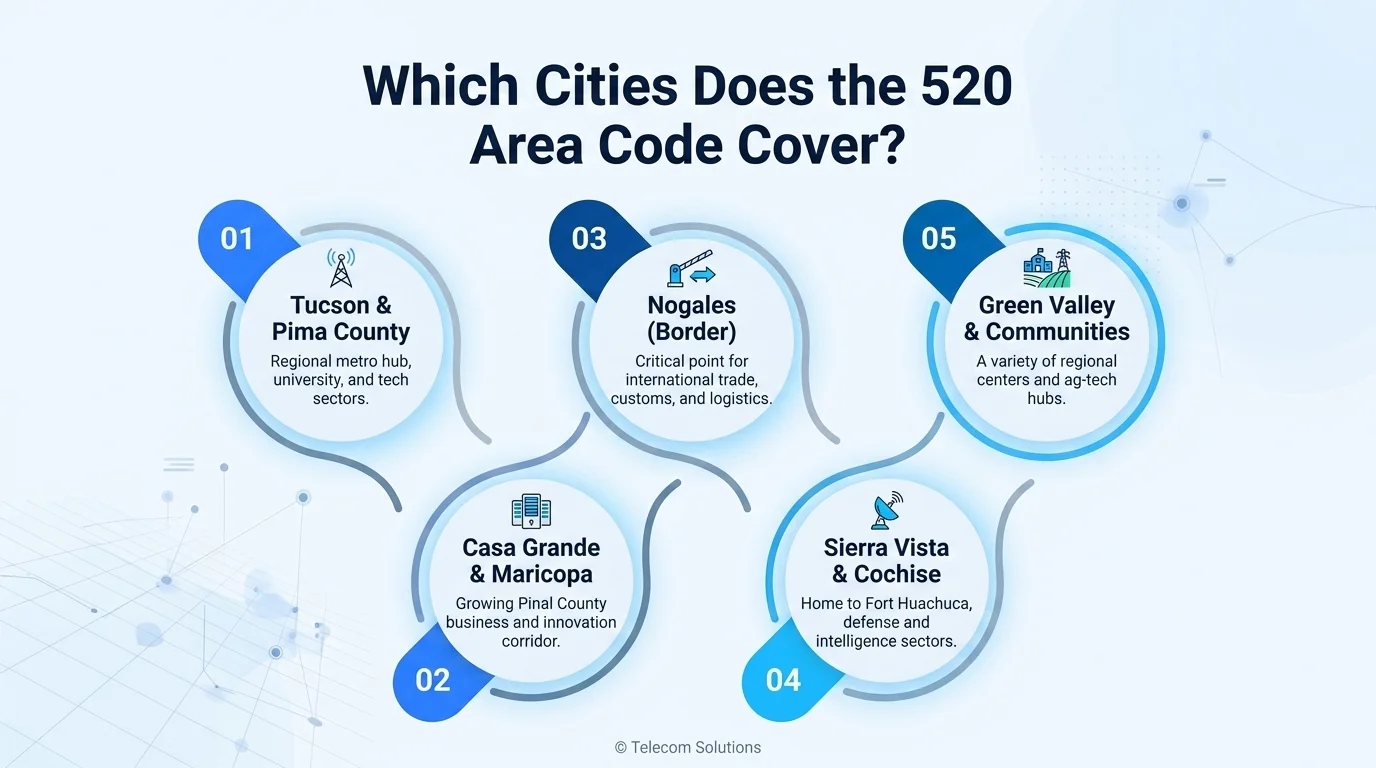
The 520 area code serves a diverse range of communities — from Arizona's second-largest urban center to small border towns with rich bicultural identities. Here are the major cities it covers:
- Tucson — The anchor city of the 520 area code, home to the University of Arizona with over 47,000 students, Raytheon Missiles & Defense, Davis-Monthan Air Force Base, and a rapidly growing bioscience and tech sector
- Sierra Vista — A military community in Cochise County anchored by Fort Huachuca, the U.S. Army's primary intelligence training center and a major regional employer
- Nogales — A busy border city at the US-Mexico crossing into Nogales, Sonora, handling billions of dollars in cross-border trade annually and serving as one of the most active ports of entry on the southern border
- Douglas — A historic copper-mining and border trade city in southeastern Cochise County with deep cultural and economic ties to Agua Prieta, Mexico
- Marana — One of Arizona's fastest-growing cities, expanding rapidly north and northwest of Tucson with major residential, commercial, and industrial development
- Oro Valley — An affluent suburb north of Tucson, consistently ranked among the safest and most prosperous communities in the entire Southwest
- Green Valley & Sahuarita — Growing communities south of Tucson with strong retirement and family demographics and expanding healthcare infrastructure
- Bisbee & Tombstone — Historic Cochise County towns that attract significant heritage tourism, with Tombstone's "Wild West" identity drawing visitors from around the world
Is the 520 Area Code Only for Tucson?
No — while Tucson dominates the 520 area code by population, the code stretches across an enormous territory from the Tucson metro south to the Mexican border at Nogales and Douglas, and east through Cochise County all the way to the New Mexico state line. The 520 region is geographically comparable in size to several entire states. Similar western profiles appear in the 509 area code region, where a single prefix serves an equally vast multi-county western territory.
520 Area Code Time Zone
The 520 area code follows one of the most distinctive time zone rules in the country. Arizona — with the exception of the Navajo Nation — does not observe daylight saving time. That means the entire 520 territory stays on Mountain Standard Time (MST) at UTC-7 every single day of the year, whether it is January or July.
This has a practical scheduling effect that many callers overlook: during winter months, the 520 region aligns with Mountain Time for the rest of the country. But during summer daylight saving time, 520 effectively operates on the same clock as the Pacific Time zone — while states like Utah, Colorado, and New Mexico advance their clocks forward, Arizona stands still.
When scheduling calls with 520 contacts year-round: callers from the Eastern time zone are always three hours ahead, Central callers are always two hours ahead, and Mountain callers are in sync during winter but one hour ahead in summer.
Build Your Tucson Presence Today
A local 520 number connects your business to Tucson, Sierra Vista, the border market in Nogales, and every other southern Arizona community — activate one in minutes, no Arizona address required.
The History of the 520 Area Code
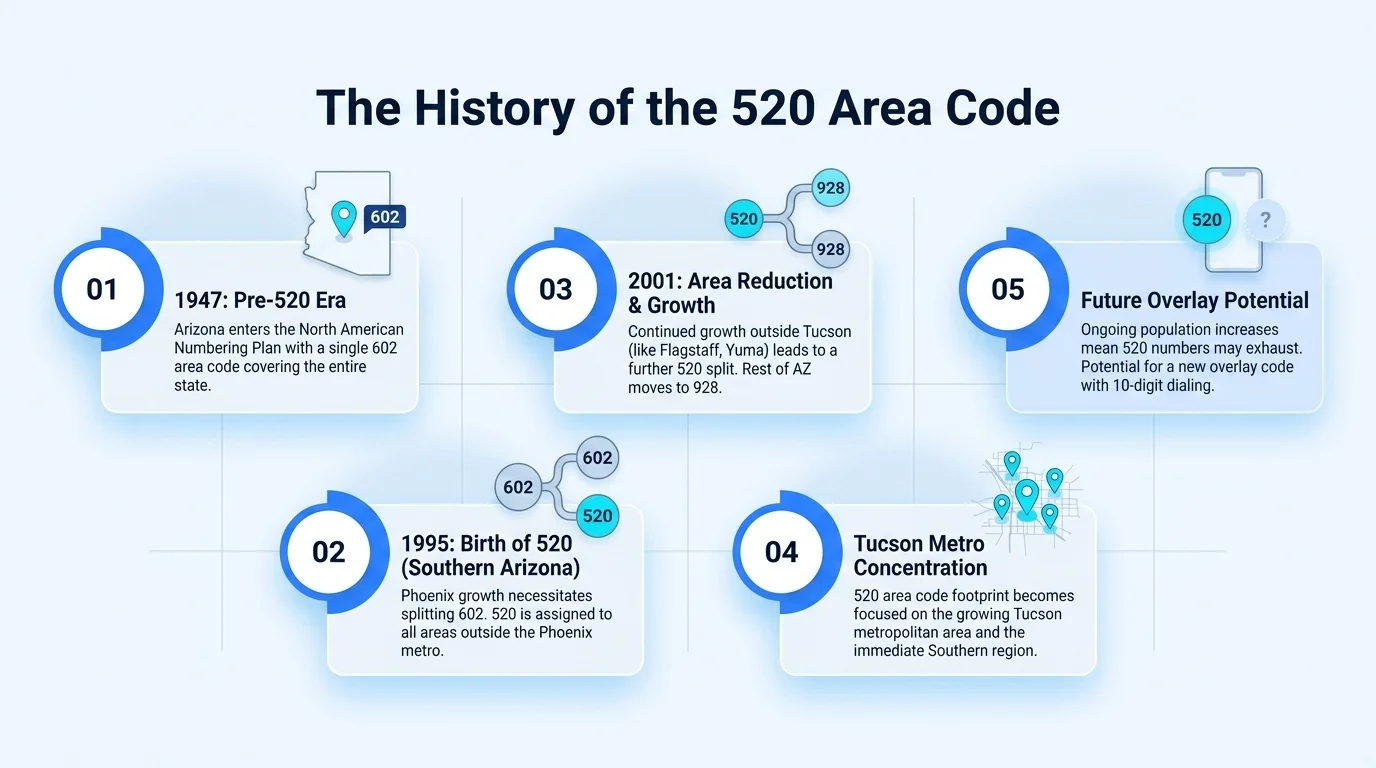
The 520 area code was born in 1995 from one of Arizona's most significant telecommunications decisions. Before 1995, the entire state of Arizona operated under a single area code — 602 — which had been in place since the original 1947 North American Numbering Plan. As the Phoenix metro exploded in population through the 1980s and 1990s, the supply of available 602 numbers declined rapidly.
Rather than introduce an overlay, regulators divided Arizona geographically. The 602 code retained the Phoenix metro, and the new 520 area codetook responsibility for everything else — including Tucson, Flagstaff, Yuma, and the entire southern border corridor. That division gave Tucson its own regional identity for the first time in decades.
How 928 Further Defined the 520 Territory
Just six years after its creation, the 520 area code faced its own number supply pressures. In 2001, the northern and western regions of 520 — including Flagstaff, Yuma, Prescott, Lake Havasu City, and the Navajo Nation — were split into the new 928 area code. This refinement left 520 focused almost entirely on the Tucson metro and the southern Arizona border corridor, giving the code the tighter geographic identity it holds today. According to NANPA records, the 520 code continues to have a stable number supply following the 928 split, sustaining its current single-code structure without the need for an overlay.
520 and the Rise of the Tucson Economy
Since 2001, Tucson has evolved significantly as an economic center. The University of Arizona's technology transfer programs, Raytheon's continued expansion, Davis-Monthan's strategic importance, and a growing cluster of bioscience and semiconductor companies have all lifted the 520 area code region into a recognized Sunbelt innovation market. The cities of Marana, Oro Valley, and Sahuarita continue to absorb population overflow from both Tucson and Phoenix, making southern Arizona one of the more dynamic growth stories in the American Southwest.
How to Get a Virtual Phone Number from CallMama
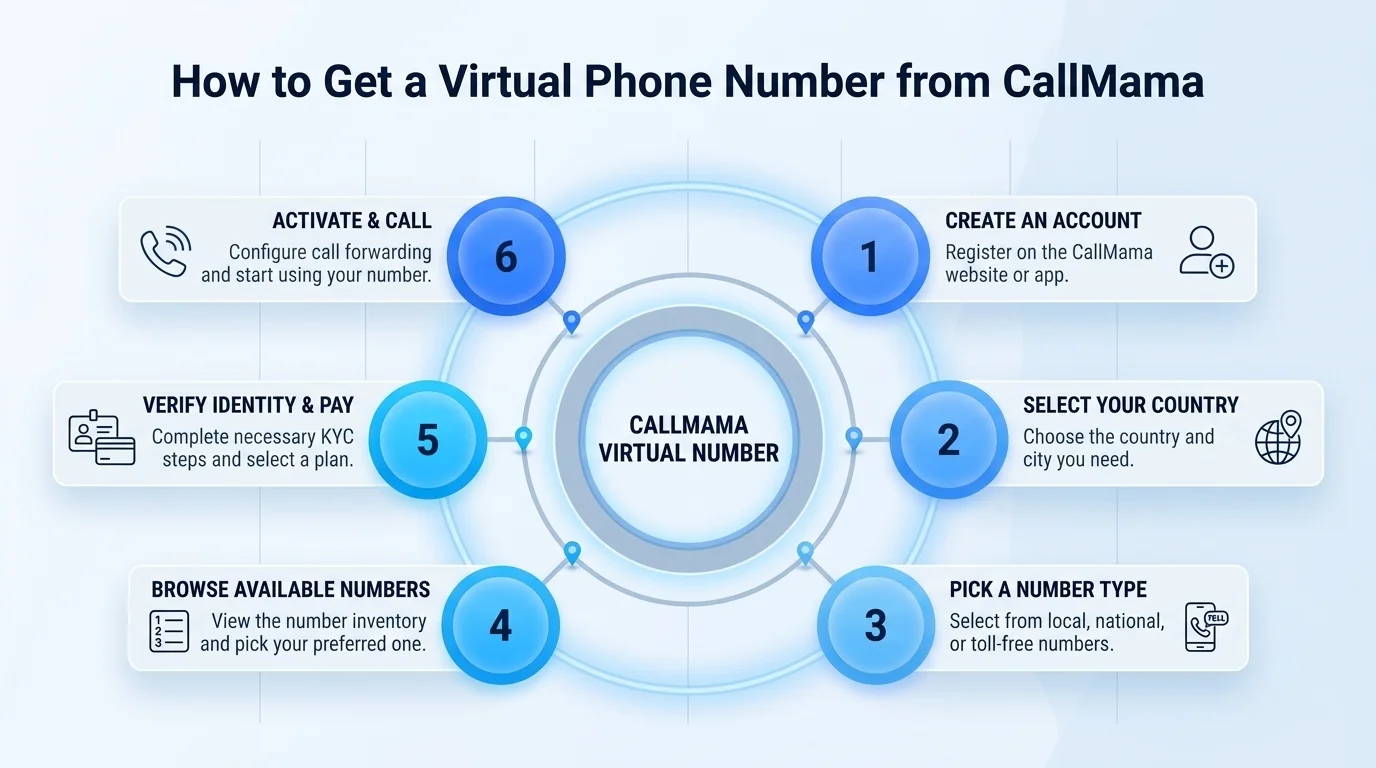
CallMama makes it simple to get a virtual 520 phone number without relocating to Arizona — all you need is a smartphone and a few minutes. With instant activation, competitive pricing, and reliable call quality, CallMama is one of the most accessible platforms for establishing a genuine Tucson and southern Arizona presence from anywhere in the world.
Visit callmama.com or Download the App
Head to callmama.com or download the CallMama app from the App Store or Google Play — no Arizona address or local carrier account required.
Create a Free Account
Sign up using your email address. Setup takes under two minutes with no upfront payment required to begin.
Choose a Plan That Fits Your Needs
Select from monthly or pay-as-you-go options that scale with your call volume, team size, and business requirements.
Select Your 520 Virtual Number
Filter by United States and Arizona, then browse available area code 520 numbers and pick the one that best fits your brand or identity.
Activate and Start Calling Immediately
Complete payment and your number activates instantly — configure call forwarding, voicemail, or SMS, then make and receive calls on any device from anywhere in the world.
Why Businesses Choose the 520 Area Code
The 520 area code region offers a business environment that very few U.S. calling zones can match in terms of diversity and strategic position. Tucson supports a major defense and aerospace economy through Raytheon and Davis-Monthan Air Force Base. The University of Arizona's 47,000+ students and research output drive a steady pipeline of bioscience, engineering, and technology startup activity. The cross-border economy through Nogales moves billions of dollars in produce and manufactured goods annually between Arizona and Sonora, Mexico.
A local 520 phone number signals to Tucson clients, defense contractors, university research partners, and border trade businesses that your operation understands and serves the southern Arizona region — not a generic national company calling from out of state. Local prefixes consistently outperform unfamiliar codes in call answer rates, a dynamic that is especially pronounced in Tucson's community-oriented business culture.
For businesses serving the binational market between Arizona and Sonora, a 520 phone number is particularly powerful. Nogales-based trade companies, border healthcare services, and cross-border logistics firms all benefit from the local presence a 520 prefix projects to both American and Mexican clients operating in this unique economic corridor.
520 Area Code Scam Calls: Stay Protected
Like all active U.S. prefixes, 520 numbers are occasionally spoofed by scammers trying to appear local to the Tucson and southern Arizona area. Common schemes include utility fraud targeting Tucson Electric Power or Southwest Gas customers, IRS impersonation calls, Medicare fraud targeting the region's large retiree population in Green Valley and Oro Valley, and border-related scams exploiting anxiety about immigration and cross-border issues.
Here is how to protect yourself:
- Let unknown calls go to voicemail. Legitimate businesses and government agencies always leave a message — immediate hang-ups signal a spoofed call.
- Verify before acting. If a caller claims to represent a utility, government agency, or financial institution, hang up and call the organization directly using its official number.
- Enable STIR/SHAKEN filtering through your wireless carrier to reduce spoofed call delivery to your line.
- Report suspicious calls at reportfraud.ftc.gov or through your carrier's built-in spam reporting tool to help protect the broader southern Arizona community.
The vast majority of calls from the 520 area code originate from genuine Tucson residents, businesses, university departments, military personnel, and border community institutions every day. A moment of caution protects you without cutting you off from the legitimate connections that make this prefix valuable.
Conclusion
The 520 area code has defined southern Arizona's telecommunications identity since 1995, connecting Tucson's urban economy, the defense communities of Sierra Vista, the cross-border trade hub in Nogales, and the historic landscapes of Cochise County under a single, stable prefix. It observes Mountain Standard Time year-round — Arizona's distinctive no-DST policy — and serves one of the most strategically interesting regional economies in the American Southwest. Understanding the 520 area code gives you a real advantage when engaging with southern Arizona businesses, verifying incoming calls, or building a credible Tucson presence. The combination of university talent, defense industry, border trade, and Sunbelt growth makes area code 520 a genuinely dynamic regional identifier.
Getting a 520 phone number has never been more straightforward, and the opportunity it creates across Tucson, Sierra Vista, and the border corridor is real and growing. Southern Arizona's economy continues to diversify and expand, and local businesses consistently respond far better to familiar 520 prefixes than to out-of-state numbers. A virtual area code 520 number gives you that local credibility immediately — no Arizona address, no local carrier, no relocation required. Claim your 520 phone number today and start connecting authentically with one of the Southwest's most distinctive and opportunity-rich regional markets.
Download the CallMama App
Your southern Arizona presence is ready to activate — get a virtual 520 number, connect it to any device, and start building trust with Tucson, Sierra Vista, and Nogales clients today.
