Introduction
The 512 area code is the telephone prefix for Austin, Texas — one of the fastest-growing metropolitan regions in the United States. Understanding the 512 area code helps residents, remote workers, and businesses identify where calls are coming from and how to establish a local number in this market. This guide covers the cities it serves, the full history, Central Time zone details, scam call patterns, and step-by-step instructions for getting a virtual 512 phone number without setting foot in Texas. Every fact you need about this iconic Austin prefix is right here.
Key Takeaways
- The 512 area code covers Austin, Texas and surrounding communities including Round Rock, Cedar Park, Georgetown, San Marcos, Kyle, and Buda.
- The 512 area code operates in the Central Time Zone — CST (UTC-6) in winter and CDT (UTC-5) during daylight saving time.
- Area code 512 dates to 1947 as one of the original NANP codes and once covered all of Texas before successive splits reduced its footprint to the Austin metro.
- Scammers spoof 512 numbers to appear as local Austin callers — always verify unexpected calls before sharing personal or financial information.
- You can get a virtual 512 phone number through a VoIP provider in minutes — no Austin address or Texas residency required.
What Is the 512 Area Code?
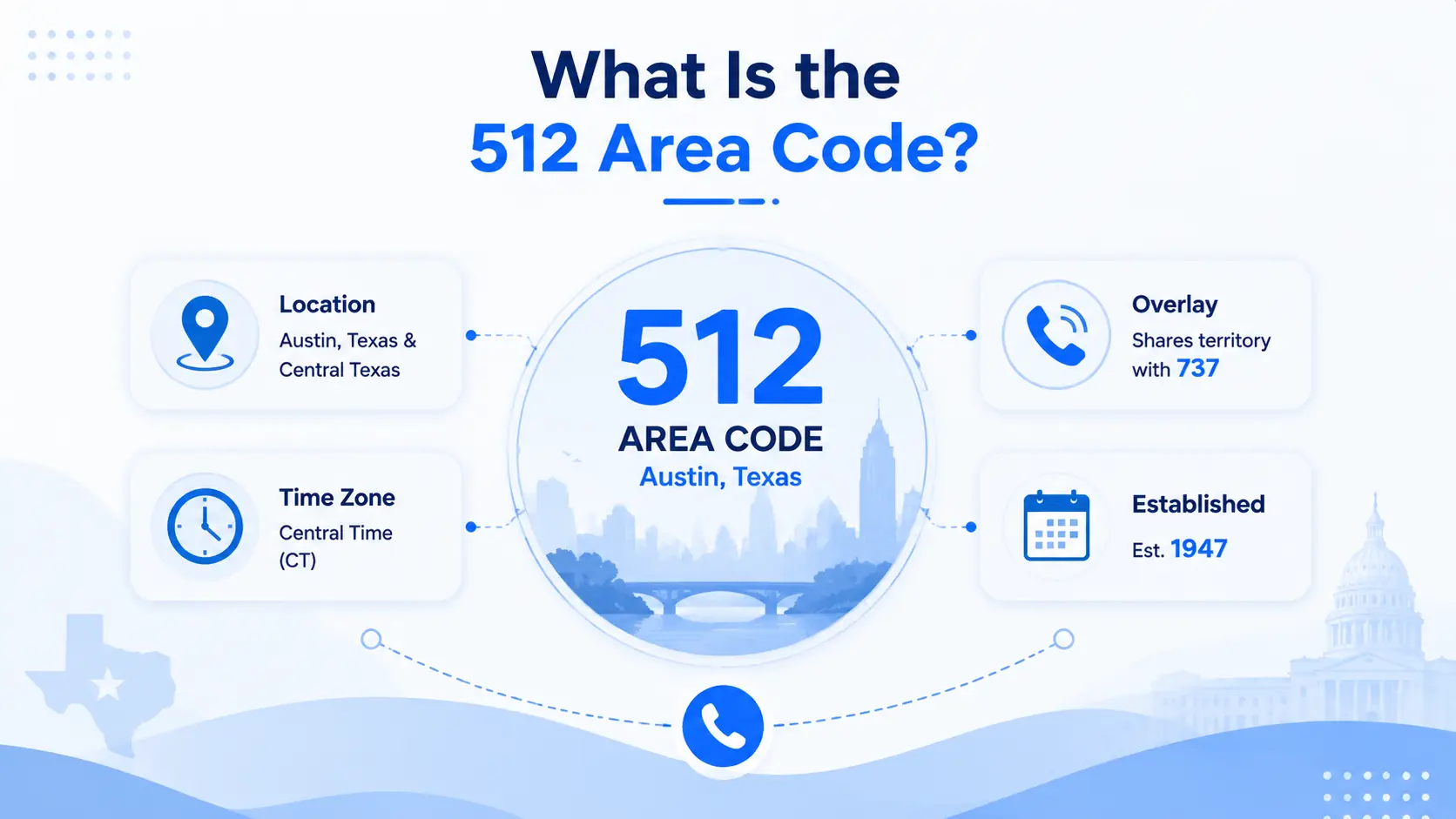
The 512 area code is a North American telephone prefix assigned to Austin, Texas and the Central Texas communities surrounding the state capital. It is one of the most commercially dynamic area codes in the country — Austin's tech sector, live music culture, and rapidly expanding university population have made 512 synonymous with innovation, growth, and opportunity across the tech industry.
The 512 area code shares its territory with the 737 overlay code, which was introduced in 2015 when available 512 numbers began running low due to Austin's explosive population and business growth. Both codes serve the same Austin metro communities — which one a subscriber carries depends on when they signed up for service. Because of this overlay, all local calls within the Austin metro now require ten-digit dialing, including the area code, even between neighbors on the same street.
Where Is the 512 Located?
The 512 area code covers Austin and a broad region of surrounding Central Texas communities spread across multiple counties. The coverage area is most concentrated in Travis County but extends into neighboring Williamson County to the north and Hays County to the south, encompassing some of the fastest-growing suburban markets in the entire United States.
Travis County — The Heart of 512 Territory
Travis County is the primary home of the 512 area code. Austin's city limits — including downtown, South Congress, East Austin, the University of Texas campus, and the tech-dense Domain corridor — all fall within this prefix. Major employers in the 512 territory include Dell Technologies, Apple, Tesla, Google, Meta, and dozens of high-growth startups that have earned Austin the nickname "Silicon Hills."
Williamson and Hays Counties
Beyond Travis County, the 512 prefix extends into Williamson County — covering Round Rock, Cedar Park, and Georgetown — and Hays County — covering San Marcos, Kyle, and Buda. These communities have consistently ranked among the fastest-growing in the United States, adding to the commercial reach and prestige of the Austin-area prefix.
Major Cities in the 512 Region
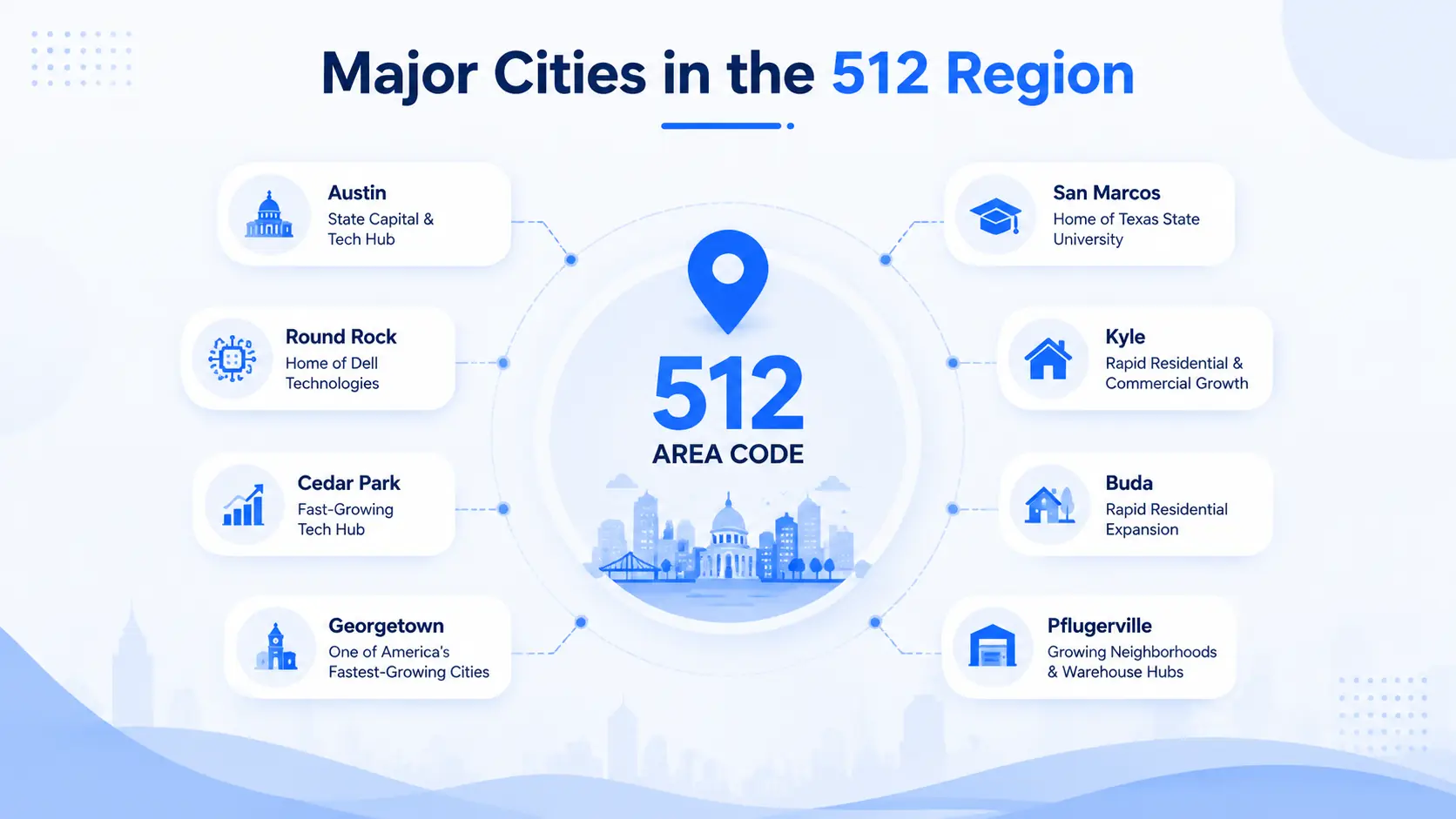
The cities within the 512 region form a powerful mix of state government, technology, higher education, and fast-moving suburban growth that continues to attract residents and businesses from across the country.
- Austin — State capital of Texas, home of UT Austin, and the tech hub widely known as Silicon Hills
- Round Rock — Major suburb north of Austin and headquarters of Dell Technologies
- Cedar Park — One of the fastest-growing Texas cities with a strong tech and logistics workforce
- Georgetown — Historic city consistently ranked among the fastest-growing small cities in the United States
- San Marcos — Home of Texas State University and a key community between Austin and San Antonio
- Kyle — Fast-expanding Hays County city with major residential and commercial growth
- Buda — Small Hays County community experiencing rapid residential expansion
- Pflugerville — Eastern suburb with large residential neighborhoods and growing warehouse districts
Businesses targeting customers in these communities frequently seek local numbers to establish a credible regional presence and improve answer rates before committing to a physical Austin office. For a look at how another growing metro handles similar demand, see the 239 area code guide.
Serving Austin Customers? A Local 512 Number Gets Answered.
A virtual 512 phone number positions your business as a local presence in one of the country's fastest-growing markets — from anywhere in the world.
History of the 512 Area Code
The Original 1947 Texas Code
Area code 512 is one of the original codes established by AT&T in 1947 under the North American Numbering Plan (NANP). At launch, a single prefix covered the entire state of Texas. The total number of telephone subscribers at the time was manageable enough for one code to handle all of Texas comfortably — including what would eventually become today's Austin metro and many surrounding regions.
A Decade of Splits
As Texas grew into one of the most populous states in the country, the original code came under sustained pressure. A major split in 1983 created area code 214 for Dallas and northeast Texas. Additional splits through the 1980s and 1990s carved out codes for Houston (713, then 281), San Antonio (210), and the Panhandle region (806). Each split trimmed the 512 area code's footprint further, ultimately concentrating it on Austin and the surrounding Central Texas counties that define it today.
By the early 2010s, Austin's own explosive growth — fueled by tech relocations, university expansion, and sustained in-migration from coastal cities — began exhausting available 512 number pools. In 2015, NANPA introduced the 737 overlay as a solution, preserving all existing 512 numbers while making fresh numbers available to new subscribers across the same Austin metro geography.
512 Time Zone Details
The 512 prefix falls entirely within the Central Time Zone. During standard time (November through March), the region observes Central Standard Time (CST) at UTC-6. From the second Sunday in March through the first Sunday in November, it shifts to Central Daylight Time (CDT) at UTC-5. Texas observes daylight saving time, so this change applies across all Austin-area communities each year.
For callers reaching Austin from other time zones:
- From Eastern Time (ET): Austin is 1 hour behind — a 9 AM New York call reaches an Austin contact at 8 AM local time.
- From Mountain Time (MT): Austin is 1 hour ahead — a 2 PM Denver call lands at 3 PM Central.
- From Pacific Time (PT): Austin is 2 hours ahead — reach out before 3 PM Pacific to connect during standard Austin business hours.
Standard business hours across the Austin metro run 9 AM to 5 PM Central, Monday through Friday.
Is the 512 Area Code a Scam?
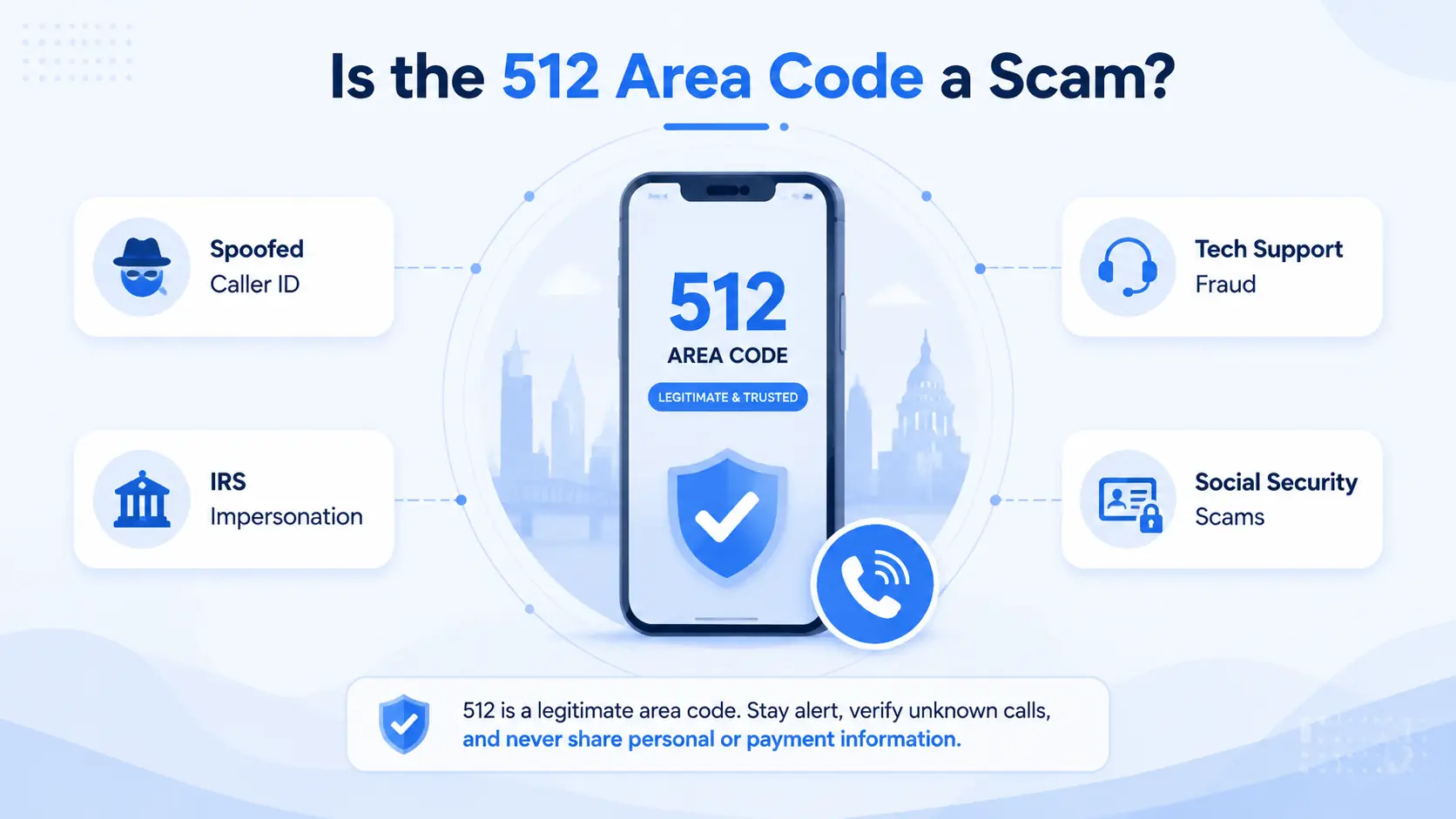
The 512 area code is a fully legitimate telephone prefix assigned by NANPA and regulated under FCC guidelines for US telephone number assignment. The vast majority of 512 calls originate from real Austin-area residents, businesses, students, and institutions going about their daily lives.
That said, scammers do spoof 512 numbers to exploit Austin's credibility — particularly its association with tech companies and state government agencies. Common scam types using spoofed 512 numbers include IRS impersonation calls, Social Security fraud, utility disconnection threats, and fake tech support requests. If you receive an unexpected 512 call requesting payment, passwords, or personal details, hang up immediately and verify the caller through its official website or a publicly listed phone number.
How to Get a Virtual Phone Number from CallMama
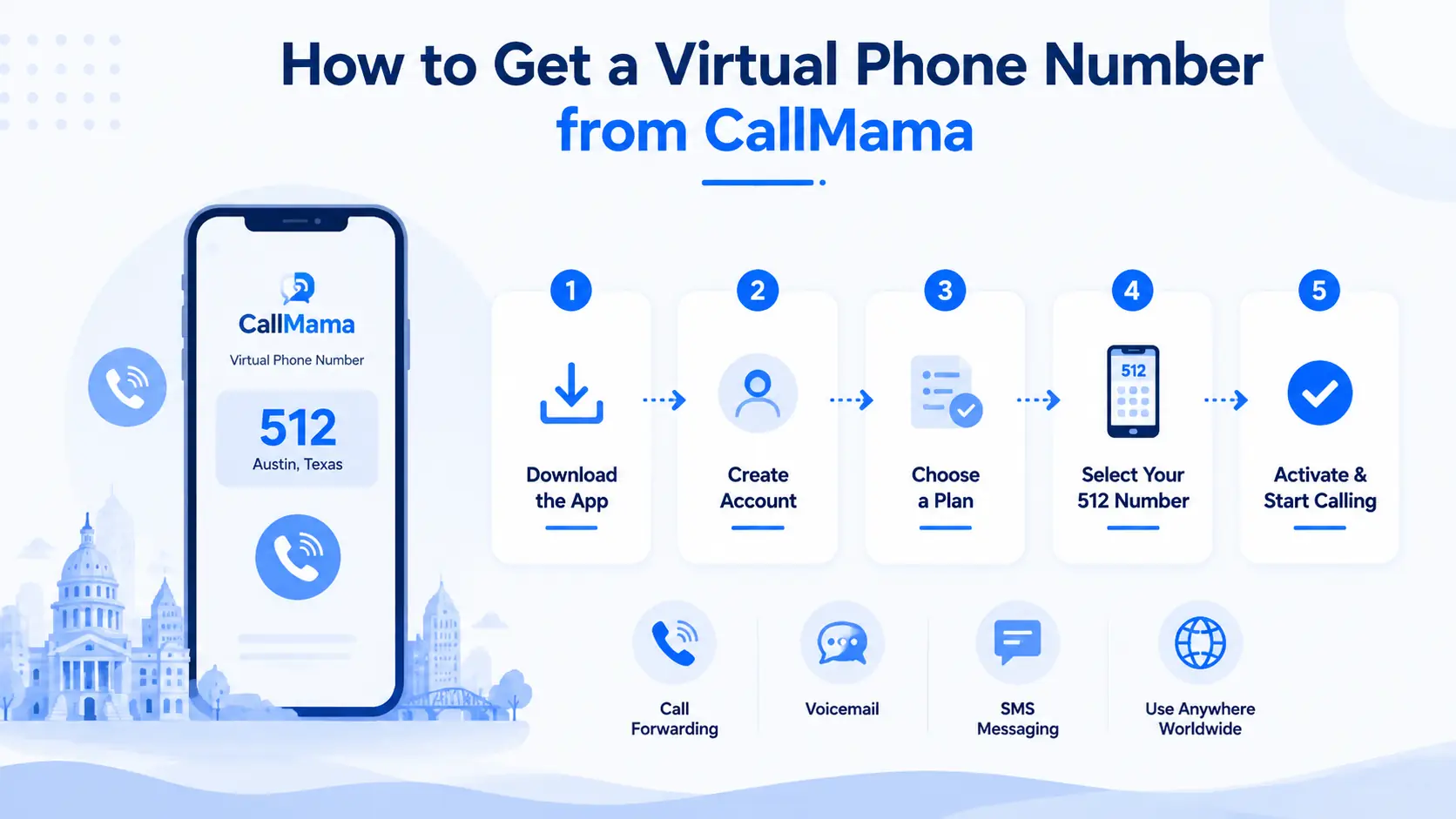
CallMama offers virtual 512 phone numbers across Austin and hundreds of other US area codes — with no Texas address or office required. Getting set up with CallMama takes minutes and works from any smartphone, tablet, or computer worldwide.
- Visit callmama.com or download the CallMama app from the App Store or Google Play.
- Create a free account using your email address — setup takes under two minutes.
- Choose a subscription plan that fits your needs — monthly or pay-as-you-go options available.
- Select your virtual number — choose the United States and enter the 512 area code to browse available numbers.
- Complete payment and your 512 number activates instantly — no waiting period.
- Configure call forwarding, voicemail, and SMS settings from your dashboard.
- Start making and receiving calls right away from any connected device, anywhere in the world.
Why Businesses Choose a 512 Number
For any business targeting Austin's technology sector, university community, or suburban consumer market, a 512 phone number delivers a local signal that out-of-state prefixes cannot match. Studies consistently show that calls from recognized local area codes receive significantly higher answer rates than unknown, toll-free, or out-of-state numbers.
- Higher answer rates: Local Austin codes get picked up far more often than unfamiliar prefixes — a direct impact on your conversion rate.
- Instant Austin presence: No office needed — your virtual 512 number works on any device from any location worldwide.
- Serve Silicon Hills clients: Tap Austin's booming tech sector, university market, and rapidly growing suburban communities with a recognized local prefix.
- Cost-effective growth: Monthly or pay-as-you-go pricing means no hardware costs, no leases, and no Austin address required.
The 512 market continues to expand at one of the fastest rates in the country, driven by tech sector growth, one of the largest public universities in the US, and sustained in-migration from coastal cities. A virtual number in this region gives your business a stake in that growth from day one.
Conclusion
The 512 area code defines Austin, Texas and the surrounding Central Texas communities that have made this region one of the fastest-growing in the United States. Its history stretches back to 1947 as one of North America's original telephone codes, and its current footprint — paired with the 737 overlay — reflects decades of population growth and technology-driven change. From the downtown tech corridor to the rapidly expanding suburbs of Round Rock, Georgetown, and San Marcos, this prefix represents one of the most commercially dynamic regions in the country. Understanding its geography, history, and time zone gives you a confident picture of every 512 area code call you make or receive.
If your business serves Austin-area customers, a virtual 512 phone number is one of the fastest and most cost-effective ways to build local trust and increase answer rates from day one. Virtual numbers activate in minutes, require no Texas address, and work on any device you already own. A local 512 number tells every Austin customer that you are invested in their market — even if your team operates from anywhere in the world. Take that step today and start every Austin conversation with the credibility that a 512 area code number delivers.
Austin Customers Pick Up Local Numbers First.
A virtual 512 number from CallMama activates instantly — no Texas address, no contract, and no hardware required.
