Introduction
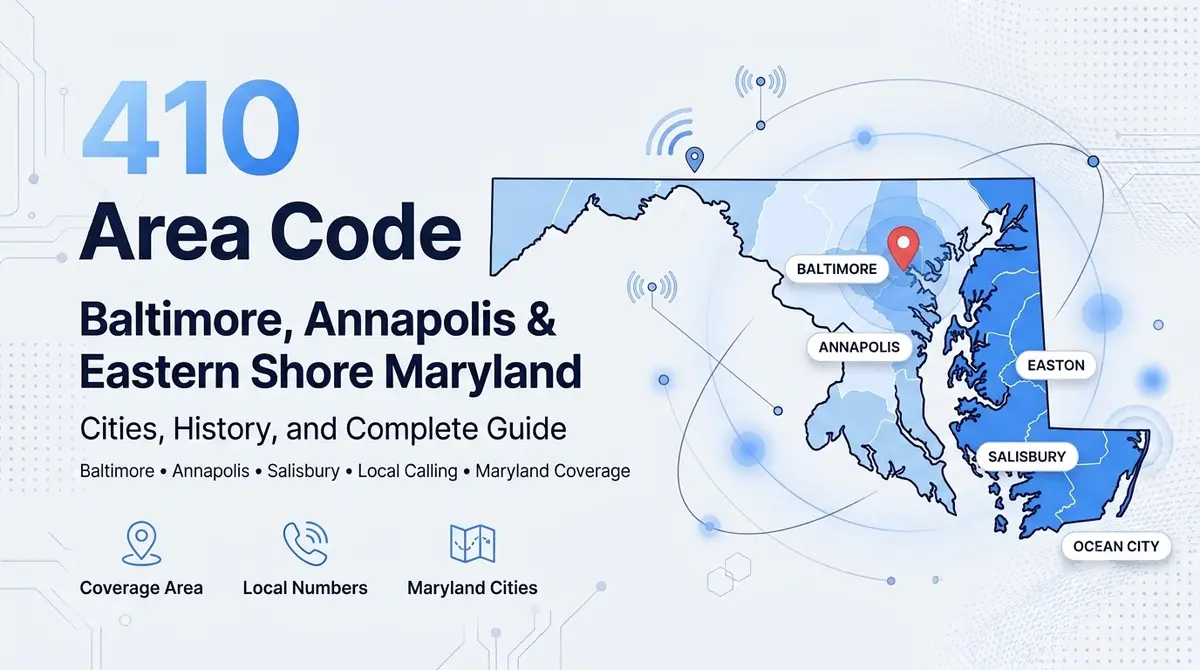
The 410 area code is Baltimore's original telephone prefix, connecting Maryland's largest city, the state capital Annapolis, Columbia, and all nine Eastern Shore counties across a 20-plus-county footprint that stretches from the Pennsylvania border to the Atlantic coast. Understanding the 410 area code matters whether you received a call from an unfamiliar Maryland number, are expanding a business into the Baltimore metro, or need a 410 phone number of your own. This guide covers the 410's full geographic reach, the rare three-code overlay system that makes it unique, Eastern Time dialing rules, scam awareness, and how to get a virtual Baltimore number in minutes. From Fort McHenry — birthplace of the national anthem — to one of the East Coast's busiest ports, the 410 is the area code that connects it all.
Key Takeaways
- The 410 area code launched on October 6, 1991, when Maryland's original 301 code split — the first time eastern Maryland had its own telephone prefix.
- The 410 footprint covers Baltimore City and County, Annapolis (the state capital), Columbia, and all nine Eastern Shore counties including Ocean City and Salisbury.
- The 410 region is one of the rare US territories served by THREE area codes at once: 410 (original), 443 (overlay since 1997), and 667 (overlay since 2012).
- All 410 numbers operate on Eastern Time — the same zone as Washington D.C., Philadelphia, and New York City.
- A virtual 410 phone number is available to anyone nationwide — no Maryland address or SIM card required, activation in minutes.
What Is the 410 Area Code?
The 410 area code is the geographic telephone prefix for eastern Maryland under the North American Numbering Plan (NANP). It covers Baltimore City and County at its core, then extends into Anne Arundel County (home to Annapolis and the BWI Airport corridor), Howard County (Columbia), Carroll County, and most of Harford and Cecil counties in the northeast. The entire Eastern Shore — all nine counties east of the Chesapeake Bay — also falls within the 410 footprint.
The same geographic region is also served by overlay codes 443 and 667. All three area codes cover the same territory: there is no geographic difference between them. A new phone line activated in Baltimore today might carry a 410, 443, or 667 prefix depending purely on which number pool had available inventory at the time of activation.
Quick Facts — 410 Area Code
| Detail | Info |
|---|---|
| State | Maryland (eastern region) |
| Year Created | October 6, 1991 |
| Split From | 301 — original statewide Maryland code |
| Overlay Codes | 443 (since July 1, 1997) and 667 (since March 24, 2012) |
| Time Zone | Eastern Time (EST / EDT) |
| Major City | Baltimore |
| State Capital | Annapolis (also in 410) |
| Dialing Format | 10-digit mandatory |
Baltimore and the Cities in the 410 Footprint
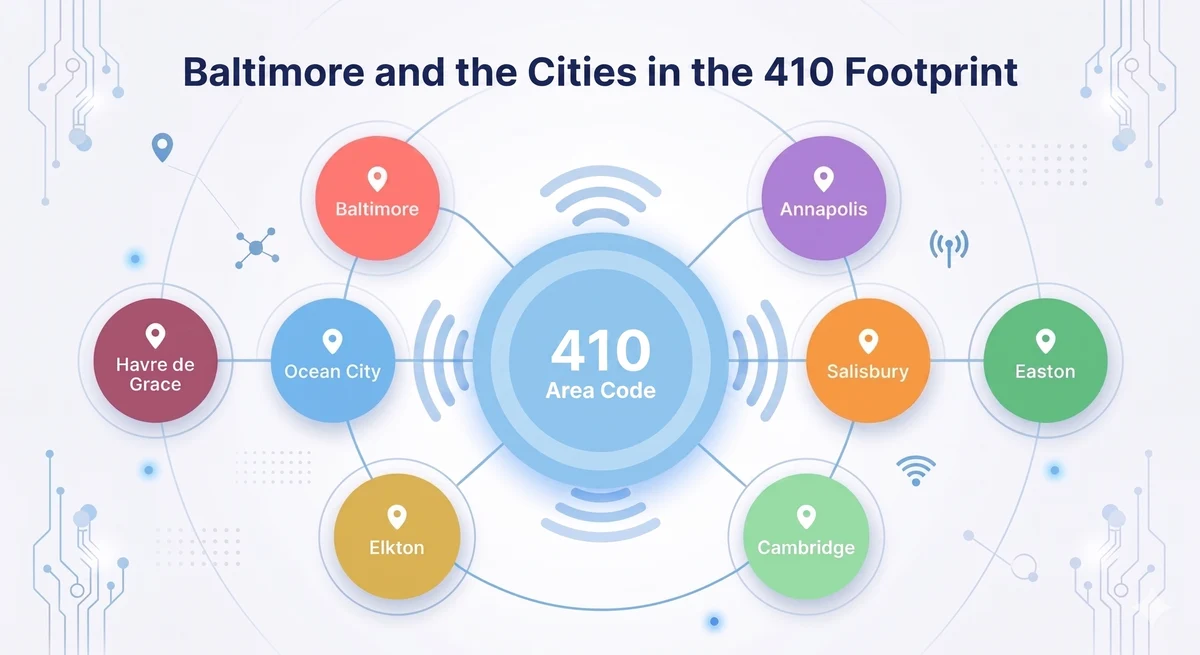
Baltimore anchors the 410 region with a metropolitan economy exceeding $213 billion. The city is home to Johns Hopkins University and Health System — one of the world's leading medical research institutions — alongside T. Rowe Price, Under Armour, and the Port of Baltimore, which generated roughly $70 billion in economic impact in 2026. Baltimore also holds the distinction of birthplace of the national anthem: Francis Scott Key wrote "The Star-Spangled Banner" during the 1814 Battle of Baltimore at Fort McHenry, which still stands as a national monument in the 410 footprint.
Annapolis, south of Baltimore on the Chesapeake Bay, is Maryland's state capital and home to the United States Naval Academy. The Maryland State House in Annapolis is the oldest state capitol in continuous legislative use in the country. Both the Academy and the statehouse bring a steady flow of federal and state government activity to the 410 region.
Key Cities in the 410 Service Area
| City | County | Notable For |
|---|---|---|
| Baltimore | Baltimore City / County | Johns Hopkins, Port of Baltimore, Fort McHenry |
| Annapolis | Anne Arundel | State capital; U.S. Naval Academy |
| Columbia | Howard | Planned community; biotech corridor |
| Towson | Baltimore County | Baltimore County seat; suburban hub |
| Glen Burnie | Anne Arundel | BWI Airport area; growing suburb |
| Ellicott City | Howard | Historic mill town; Howard County seat |
| Salisbury | Wicomico | Eastern Shore commercial center |
| Ocean City | Worcester | Maryland's premier beach resort |
| Westminster | Carroll | Carroll County seat; agricultural region |
| Bel Air | Harford | Harford County seat; growing commuter city |
The Eastern Shore communities — separated from the rest of Maryland by the Chesapeake Bay and connected via the Bay Bridge — give the 410 footprint a geographic range unlike most US area codes. Ocean City alone draws millions of summer visitors each year, and the Shore's agricultural and seafood industries anchor Maryland's rural economy.
The 410 Area Code Timeline: From 301 to Three Overlays
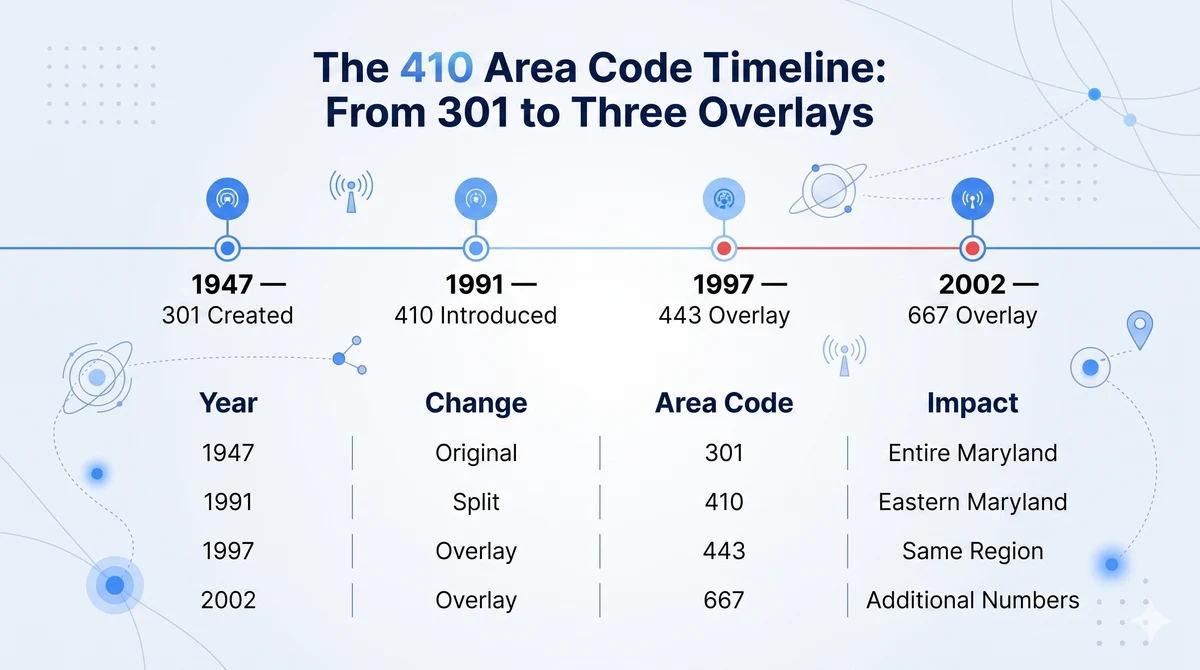
Maryland entered the national telephone network in 1947 with a single area code: 301. For over four decades, 301 handled every phone line in the state — from Baltimore to Cumberland to Ocean City. By the late 1980s, fax machines, pagers, and rapid suburban growth were pushing the 301 number pool toward exhaustion, especially in the Baltimore metro.
The solution was a geographic split. On October 6, 1991, eastern Maryland received the new 410 area code. Western Maryland — including the Washington D.C. suburbs around Montgomery and Prince George's counties — retained 301. The fix seemed permanent at the time; it lasted fewer than six years.
The cell phone boom of the 1990s drove 410 toward exhaustion faster than anyone anticipated. Rather than split again — which would force thousands of Baltimore subscribers to change their numbers — regulators chose an all-services overlay. On July 1, 1997, area code 443 launched over the exact same 410 territory, allowing new lines to receive either prefix without disrupting existing 410 numbers. According to telecom records, a second overlay — 667 — became necessary by 2011 and launched on March 24, 2012, making Baltimore's region one of only a few in the US with three simultaneous area codes.
The 410 Area Code Timeline
- 1947: Area code 301 is assigned to all of Maryland as the state's sole telephone prefix under the original North American Numbering Plan.
- October 6, 1991: The 410 area code launches, splitting from 301. Eastern Maryland — including Baltimore, Annapolis, and the Eastern Shore — receives the new prefix.
- July 1, 1997: Area code 443 launches as the first all-services overlay for the 410 territory. Ten-digit dialing becomes mandatory within the region.
- March 24, 2012: Area code 667 launches as the second all-services overlay, making the 410/443/667 region one of the few in the US with three simultaneous codes.
- ~2030: NANPA projections suggest a fourth area code will not be needed until approximately 2030, based on current consumption rates.
410 vs. 443 vs. 667 — Maryland's Rare Three-Code System
Most US metro areas have one overlay at most. The Baltimore region has two — a rarity that confuses many residents and callers. Here is exactly what you need to know about all three:
- All three codes — 410, 443, and 667 — serve the identical geographic territory: eastern Maryland from Baltimore to the Eastern Shore.
- There is no difference in quality, service, or prestige between the three codes from a technical standpoint.
- New phone lines activated since 2012 could carry any of the three prefixes; the provider assigns from whichever pool has inventory.
- All existing 410 numbers remained unchanged through both overlays — no subscriber ever had to change their number.
- Because of the two overlays, 10-digit dialing has been mandatory for all local calls in the region since 1997.
From a business perspective, 410 numbers carry a subtle prestige: they are the original prefix, dating to 1991, and are associated with long-established Baltimore businesses and institutions. As 410 inventory shrinks further relative to 443 and 667, securing a genuine 410 prefix becomes more valuable for companies wanting to signal local roots.
Get a Genuine Baltimore 410 Number — Instantly
Virtual 410 phone numbers activate in minutes — no Maryland address, no SIM card, no hardware. Present a local Baltimore caller ID from any device, anywhere.
Eastern Time and How to Dial 410
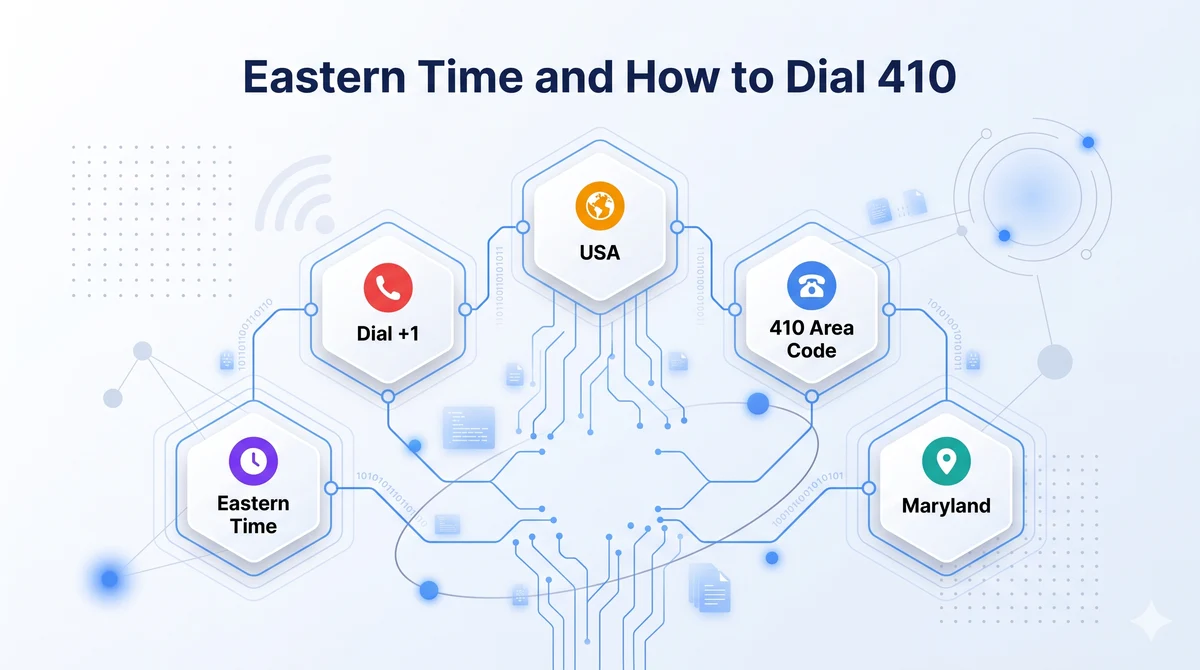
All 410 area code numbers run on Eastern Time — the same zone as Washington D.C., Philadelphia, and New York City (home of the 332 area code and other Manhattan prefixes). Maryland observes:
- Eastern Standard Time (EST): UTC−5, from the first Sunday of November to the second Sunday of March.
- Eastern Daylight Time (EDT): UTC−4, from the second Sunday of March to the first Sunday of November.
Callers from the Central Time zone — including Chicago and Nashville — are one hour behind Maryland. West Coast callers are three hours behind. Since all three area codes (410, 443, 667) share the same territory, no time adjustment is needed when calling between Baltimore numbers regardless of which prefix they carry.
Dialing a 410 Number
- From within the 410/443/667 region: Dial all 10 digits — 410-XXX-XXXX. Seven-digit local dialing has not worked since the 443 overlay in 1997.
- From anywhere else in the US or Canada: Dial the full 10-digit number directly — no special prefix needed.
- From outside North America: Dial +1-410-XXX-XXXX, or 00-1-410-XXX-XXXX on international landlines.
How to Get a Virtual Phone Number from CallMama
CallMama offers virtual phone numbers that activate instantly — no Maryland mailing address, no physical SIM card, and no long-term contract required. Whether you need a 410 line for business credibility, personal use, or staying connected with Baltimore contacts, the entire process takes under five minutes.
Why a 410 Number Gives Your Baltimore Business an Edge
A local 410 area code on your caller ID tells every Maryland contact that you are part of their community — not a distant call center or out-of-state vendor. Research consistently shows local numbers generate significantly higher answer rates than toll-free or unfamiliar out-of-state prefixes.
Businesses targeting the Baltimore metro — from Johns Hopkins procurement contacts to Annapolis government agencies, Columbia biotech firms, or Eastern Shore tourism operators — gain immediate credibility with a 410 prefix. A genuine 201 area code or any other local prefix achieves the same in its own market; in Maryland, the 410 is that anchor.
Business Advantages of a Virtual 410 Line
- Local presence without relocation: Remote teams and out-of-state companies serve the Maryland market without opening a Baltimore office.
- Higher answer rates: Maryland customers are far more likely to pick up a call from a familiar 410 number than an unfamiliar toll-free prefix.
- Flexible routing: Forward your 410 line to any phone, home office, or team member — never miss a bid from a Baltimore government agency or a Johns Hopkins procurement contact.
- Original prefix prestige: As overlay codes 443 and 667 fill more new lines, a genuine 410 number increasingly signals an established, long-standing Maryland presence.
- Scalable features: Add call recording, analytics, voicemail transcription, and multi-user routing as your Maryland business grows.
Virtual 410 vs. Traditional Maryland Landline
| Feature | Virtual 410 Line | Traditional Landline |
|---|---|---|
| Maryland address required | No | Yes |
| Setup time | Minutes | Days to weeks |
| Works on mobile | Yes | No |
| Call forwarding | Built-in | Add-on cost |
| Month-to-month flexibility | Yes | Often contract-locked |
Baltimore Scam Calls — What 410 Recipients Should Know
The 410 area code is a legitimate Maryland telephone prefix. Scammers, however, use neighbor-spoofing technology to display a familiar Baltimore-area number on your caller ID — making the call appear local when it originates far away. Complaints in the 410 region rose 50% between February and March 2026, with December 2025 recording the highest complaint volume.
Most Common Scam Types Targeting 410 Callers
- Baltimore Gas and Electric impersonation: Callers claim your service will be shut off within hours unless you pay immediately by gift card or wire transfer — BGE never operates this way.
- Social Security Administration threats: Fake SSA officers claim your benefits are suspended and demand payment over the phone. The real SSA sends mail first.
- IRS impersonation: Callers threaten arrest for unpaid taxes. The IRS contacts you by mail, not by phone, for initial contact.
- Grandparent / family emergency scams: Scammers pose as a distressed grandchild or family member who needs urgent cash for bail or medical expenses.
- Utility reconnection scams: Callers demand same-day payment via gift card to avoid a disconnection that is not actually pending.
How to Verify and Report a Suspicious 410 Call
Do not share personal information, payment details, or Social Security numbers with any unexpected caller. Hang up and contact the agency directly using the official number from their website — never use a number the caller provides. Report scam calls to the Federal Trade Commission's FTC fraud report service or to the Baltimore County Police Department's Financial Crimes Unit at (410) 887-2190. The presence of scams does not make the 410 area code itself unsafe — the vast majority of 410 calls are from legitimate Maryland residents, businesses, and institutions.
Conclusion
The 410 area code has connected Baltimore, Annapolis, Columbia, and Maryland's Eastern Shore since October 1991 — a region that produced the national anthem at Fort McHenry, anchors one of the East Coast's busiest ports, and hosts world-class institutions from Johns Hopkins to the U.S. Naval Academy. It sits within a unique three-code system alongside 443 and 667, all three requiring 10-digit dialing for every local call. Whether you're researching an incoming 410 phone number or building a Baltimore business presence from anywhere in the country, the 410's geography, history, and scam landscape are now fully clear. Eastern Time, a diverse Chesapeake footprint, and the prestige of Maryland's original eastern prefix make the 410 a code worth knowing — and worth having.
Getting a genuine 410 number has never been more accessible, and with original 410 inventory steadily shrinking relative to the newer 443 and 667 pools, acting sooner means better selection. A local Baltimore number on your caller ID changes how Maryland customers perceive your business — trust and familiarity translate directly into answered calls and closed deals. Follow the steps above to activate your virtual 410 number and claim your presence in one of the most historically rich telephone territories on the East Coast. Your Maryland connection starts with the right area code.
Download the App and Get Your Maryland 410 Number
Available on iOS and Android — create your account, pick area code 410, and start calling within minutes. No Maryland address needed.
