Introduction
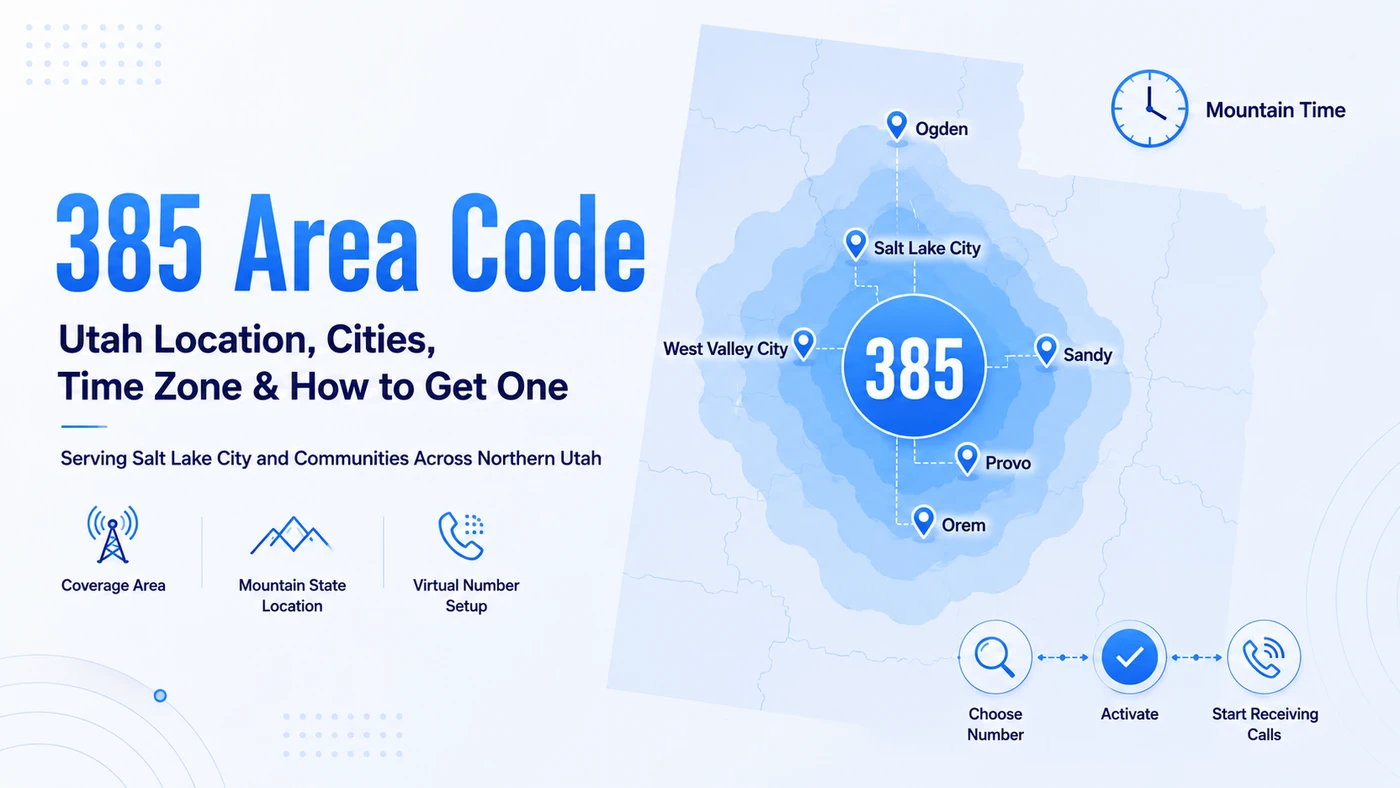
Area code 385 is the second phone code serving Utah's Wasatch Front — the densely populated corridor stretching from Ogden in the north through Salt Lake City to Provo and Lehi in the south. It overlays the historic 801 area code across the same five counties, meaning both codes cover exactly the same geography.
The region they serve together has become one of America's most talked-about economic success stories: Silicon Slopes, Utah's tech corridor, home to Adobe, Qualtrics, Pluralsight, and hundreds of fast-growing startups, with a metropolitan population exceeding 1.2 million in Salt Lake County alone.
The 385 code was born on June 1, 2008, when the original 801 area code — one of only 86 codes created when the North American telephone system launched in 1947 — finally ran out of available numbers.
Whether you have received a call from a 385 number, need to reach Salt Lake City from abroad, or want to build a Utah presence for your business without a physical office, this guide covers everything: history, cities, dialling rules, the 801 overlay, and how to get a 385 number in under 60 seconds.
Key Takeaways
- 385 is Utah's overlay code — it shares the entire Wasatch Front with 801; both codes cover Salt Lake City, Provo, Ogden, and 5 surrounding counties
- Entered service June 1, 2008; 10-digit dialling became mandatory on June 1, 2009 — all local calls require the area code
- Covers Salt Lake, Utah, Davis, Weber, and Morgan counties — 15+ cities including SLC, Provo, Ogden, West Valley City, Sandy, and Lehi
- Mountain Time Zone (MST UTC−7 / MDT UTC−6) — calls to 385 are billed at standard US geographic rates, included in most mobile plans
What Is the 385 Area Code?
Area code 385 is a geographic telephone code assigned by the North American Numbering Plan Administrator (NANPA) to the Wasatch Front region of north-central Utah. It operates as a full overlay alongside area code 801 — both codes serve the same cities, the same counties, and the same population.
When new phone numbers were allocated after June 2008, most were assigned the 385 code, which is why 385 numbers are especially common on smartphones and newer lines, while many older landlines still carry 801 numbers.
Calls to and from 385 numbers are billed at standard US geographic rates — included in virtually all US mobile plans' free-minutes allowance. The code is in the Mountain Time Zone, observing MST (UTC−7) in winter and MDT (UTC−6) during Daylight Saving Time. Standard business hours in the 385 area are 9:00 AM – 5:00 PM Monday to Friday (Mountain Time).
385 Area Code at a Glance
| Detail | Information |
|---|---|
| Area Code | 385 |
| Country | United States |
| State | Utah (UT) |
| Region | Wasatch Front, north-central Utah |
| Primary City | Salt Lake City |
| Counties Covered | Salt Lake, Utah, Davis, Weber, Morgan (plus parts of Summit & Wasatch) |
| Overlay Code | 801 (same geographic coverage) |
| Time Zone | Mountain Time (MST UTC−7 / MDT UTC−6) |
| Dialling Format | 385 XXX XXXX (10 digits — mandatory) |
| International Format | +1 385 XXX XXXX |
| Service Start | June 1, 2008 |
| 10-Digit Mandatory | June 1, 2009 |
| Regulatory Body | NANPA / FCC |
385 Area Code History: From 801 to the 2008 Overlay
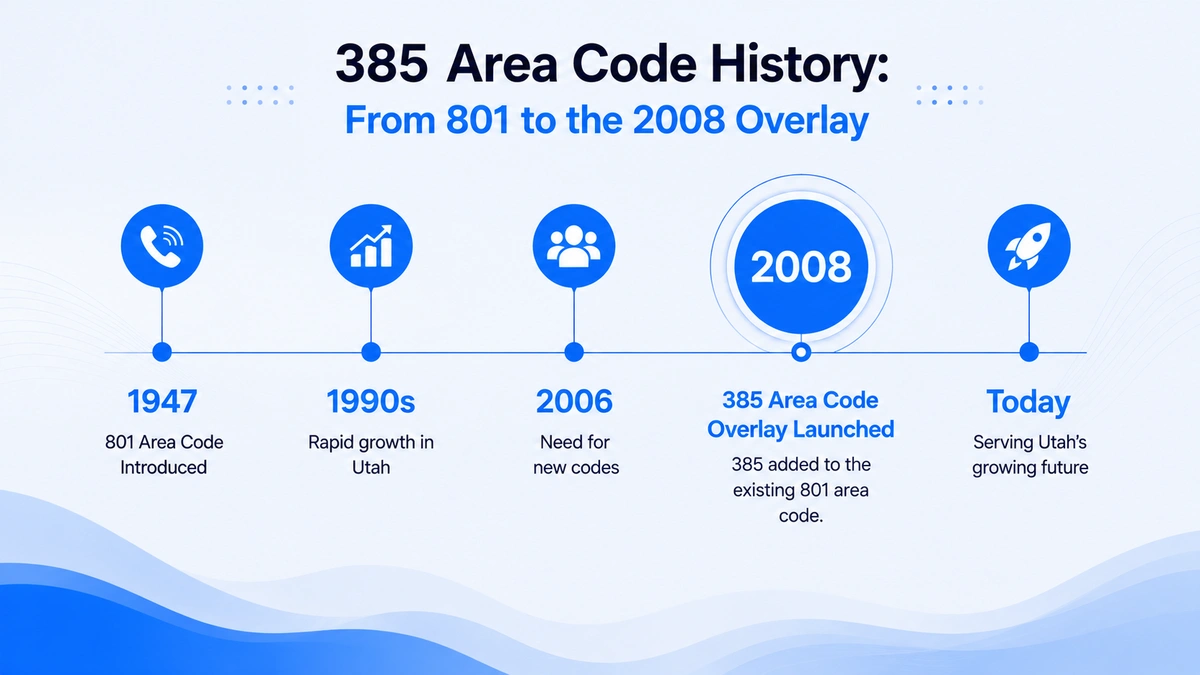
To understand the 385 area code, you need to understand its predecessor. The story begins in 1947 and runs through one of the most dramatic periods of population growth in Utah's history.
1947: Area Code 801 — Utah's Original Code
When AT&T and the Bell System launched the North American Numbering Plan (NANP) in 1947, they assigned just 86 area codes to cover the United States, Canada, and other territories. Utah received area code 801 — a single code covering the entire state. For decades, every phone in Utah, from Salt Lake City to rural Moab, used the 801 prefix.
1997: Area Code 435 Is Created for Rural Utah
By the mid-1990s, the rapid spread of fax machines, pagers, and early mobile phones was exhausting Utah's number supply. On September 21, 1997, the Wasatch Front numbering plan area was geographically reduced: rural and southern Utah was carved off to receive the new 435 area code, while 801 remained for the densely populated northern corridor. This bought time — but Utah's population and tech sector kept growing.
2007–2008: The Decision to Overlay, Not Split
By 2007, conservation measures (including number pooling) were projected to be exhausted by mid-2008. Utah's Public Service Commission (PSC) faced a choice: split the 801 region into two geographic zones, or implement an overlay — a new code covering the same area. The PSC chose the overlay approach. An overlay avoids forcing existing 801 customers to change their numbers, which would have disrupted millions of residents and businesses.
Utah's overlay-not-split decision proved prescient. A decade later, when Idaho faced the same capacity crunch, regulators made an identical call — introducing the 986 overlay for the 208 area code across the entire state in 2018, keeping Idaho's statewide prefix intact while giving new subscribers a second option.
June 1, 2008: Area Code 385 Enters Service
On June 1, 2008, area code 385 entered service with a one-year permissive dialling period, during which callers could use either 7-digit or 10-digit dialling to reach local numbers. On June 1, 2009, 10-digit dialling became mandatory across the entire Wasatch Front — a requirement that remains in effect today. Existing 801 subscribers kept their numbers; new numbers (especially for wireless devices) were predominantly assigned the 385 code.
385 Area Code Timeline
| Year | Event |
|---|---|
| 1947 | Area code 801 assigned to all of Utah as one of 86 original NANP codes |
| September 1997 | 801 geographically split; area code 435 created for rural & southern Utah |
| 2007 | Utah PSC announces 385 as overlay (not split) for the Wasatch Front |
| June 1, 2008 | Area code 385 enters service; permissive dialling period begins |
| June 1, 2009 | 10-digit dialling becomes mandatory throughout the Wasatch Front |
| Today | 385 and 801 co-exist as full overlays; 385 is the primary code for new wireless numbers |
Which Cities and Counties Does the 385 Area Code Cover?
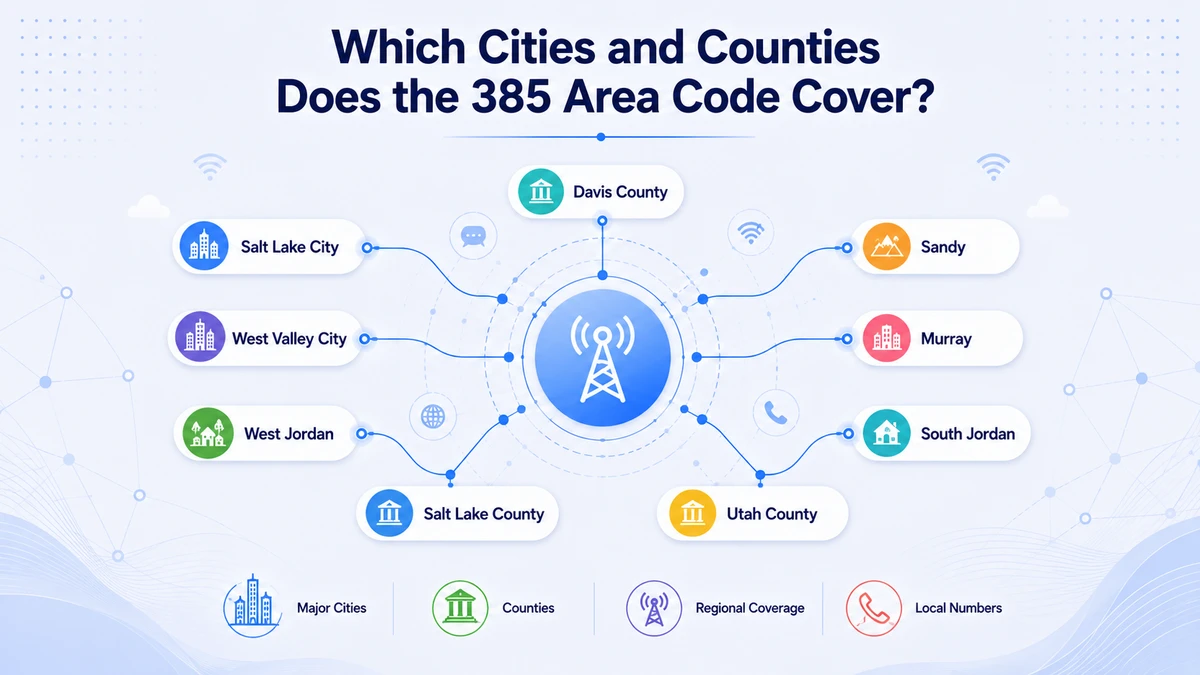
The 385 area code covers the entire Wasatch Front — the urbanised mountain valley corridor that runs north to south through north-central Utah. Because it is an overlay, it covers the exact same territory as 801: five primary counties and more than 15 major cities.
Major Cities in the 385 Area Code
- Salt Lake City — Utah's capital and largest city; home to the state government, University of Utah, and the Silicon Slopes tech hub
- West Valley City — Utah's second-largest city; a major residential and commercial centre southwest of Salt Lake
- Provo — Utah County seat; home to Brigham Young University and a dense concentration of tech start-ups
- West Jordan — fast-growing suburb in Salt Lake County's southwest corner
- Orem — home to Utah Valley University; one of the fastest-growing cities in the US
- Sandy, Millcreek, Taylorsville, Murray, South Jordan, Draper — major Salt Lake County suburbs
- Ogden — Weber County seat; historic rail hub now attracting aerospace and advanced manufacturing
- Layton, Bountiful — prominent Davis County communities
- Lehi, American Fork, Spanish Fork — rapidly growing Utah County cities in the heart of Silicon Slopes
Counties Covered by the 385 Area Code
| County | Key Cities | Notes |
|---|---|---|
| Salt Lake County | Salt Lake City, West Valley City, Sandy, Murray, Draper | Most populous county; state capital; tech and finance hub |
| Utah County | Provo, Orem, Lehi, American Fork, Spanish Fork | BYU campus; Silicon Slopes corridor; fastest-growing county |
| Davis County | Bountiful, Layton, Clearfield | Major residential; close to Hill Air Force Base |
| Weber County | Ogden, Roy, Riverdale | Historic railroad hub; aerospace & advanced manufacturing |
| Morgan County | Morgan | Rural county east of Ogden; small population |
Areas Not Covered by 385
| Area | Area Code |
|---|---|
| St. George, Cedar City, Moab, Logan | 435 |
| Park City, Summit County (most) | 435 |
| Rest of rural/southern Utah | 435 |
Utah's Silicon Slopes: The Economy Behind the 385 Area Code
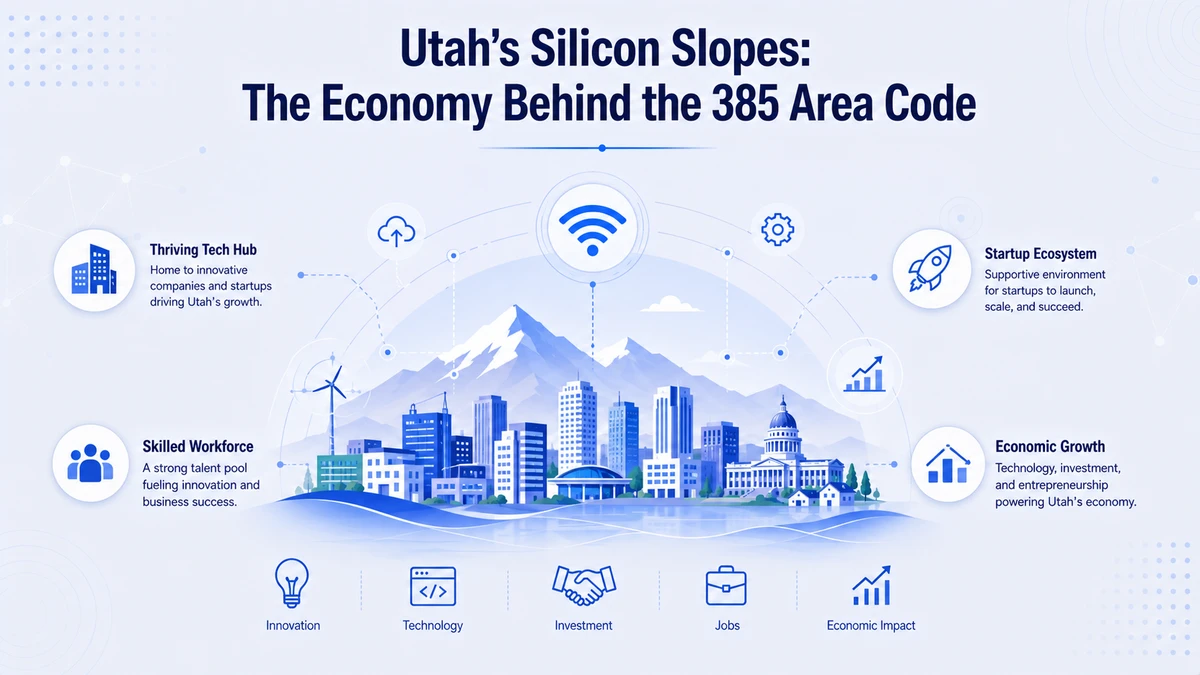
The 385 area code sits at the centre of one of America's most remarkable regional economic stories. Salt Lake County generated approximately $153.85 billion in GDP in 2024 — a figure that reflects not just Utah's traditional industries but a sweeping transformation into a technology, healthcare, and financial services powerhouse. For businesses, a 385 number is a direct line into this booming market.
Silicon Slopes: Utah's Tech Corridor
The stretch of the Wasatch Front between Salt Lake City and Lehi has earned the nickname "Silicon Slopes" for its concentration of major technology companies and start-ups. Adobe has a major campus in Lehi employing thousands. Qualtrics (founded in Provo, now headquartered in Seattle but with deep Utah roots) went public at a $15 billion valuation.
Pluralsight, Domo, and Vivint are all headquartered along the 385 corridor. Goldman Sachs operates one of its largest US offices outside New York in Salt Lake City, with over 2,500 employees. The region routinely ranks among the top US metros for tech job growth and start-up density.
Companies scaling beyond Utah's market frequently look east to comparable institutional hubs. Cleveland's 216 area code hosts its own Fortune 500 cluster — Sherwin-Williams, KeyCorp, and Parker Hannifin — making it a natural expansion target for businesses building a multi-region US presence alongside their Utah base.
Healthcare: Intermountain Health
Intermountain Health — Utah's largest employer, with more than 68,000 staff — is headquartered in Salt Lake City and operates hospitals, clinics, and health centres throughout the 385 region. The University of Utah Health system, anchored by the U of U's academic medical centre, adds further healthcare depth. For businesses serving the healthcare sector, a 385 number provides immediate credibility with the state's dominant institutional buyers.
Finance, Education & Tourism
Zions Bancorporation, one of the 50 largest US banks by assets, is headquartered in Salt Lake City. Extra Space Storage, a Fortune 500 company, also has its headquarters in the 385 region. Higher education anchors the knowledge economy: the University of Utah (35,000+ students) and Brigham Young University in Provo (35,000+ students) supply the region with a highly educated workforce.
Tourism adds a further dimension — Utah's national parks draw millions of visitors annually, and Salt Lake City hosted the 2002 Winter Olympics, a catalyst for lasting infrastructure investment that continues to attract international events and visitors.
385 Area Economy at a Glance
| Sector | Key Players in the 385 Region |
|---|---|
| Technology | Adobe (Lehi campus), Qualtrics, Pluralsight, Domo, Vivint, hundreds of SaaS start-ups |
| Financial Services | Goldman Sachs (2,500+ SLC staff), Zions Bancorporation HQ, Extra Space Storage HQ |
| Healthcare | Intermountain Health (68,000+ staff, Utah's largest employer), University of Utah Health |
| Higher Education | University of Utah (35,000+ students), BYU Provo (35,000+), Utah Valley University |
| Aerospace & Defence | Hill Air Force Base (Layton), Northrop Grumman, Boeing Utah operations |
| Tourism & Events | 2002 Winter Olympic legacy, Sundance Film Festival, Utah national parks gateway |
Make Free Calls to Every 385 & 801 Number
Download the CallMama app and stay connected to Salt Lake City, Provo, Silicon Slopes, and the entire Utah Wasatch Front — crystal-clear calls to any 385 or 801 number, free on iOS and Android.
How to Dial a 385 Area Code Number
Because 385 and 801 are overlay codes, 10-digit dialling is mandatory for all calls in the Wasatch Front — you must always dial the area code, even for calls within the same city. Here is every format you need.
Calling from Within the US
From anywhere in the United States, dial the full 10-digit number: 385 XXX XXXX. The leading "1" (the US country code) is optional on most US phones — modern mobile devices automatically handle it. For example, to call a Salt Lake City number with the local digits 555 1234, dial 385 555 1234 (or 1 385 555 1234 from a landline if required).
Calling from Outside the US
When calling from outside the United States, prefix the number with the US country code +1. The full format is +1 385 XXX XXXX. Use the + symbol on mobile phones (long-press 0), or replace + with your country's international dialling prefix (00 in most countries). For example, to call 385 555 1234 from the UK, dial 00 1 385 555 1234.
Dialling Quick Reference
| Calling From | How to Dial | Example | Time Difference (approx.) |
|---|---|---|---|
| Anywhere in the US | 385 XXX XXXX | 385 555 1234 | Same country; Mountain Time (varies by state) |
| New York / East Coast (ET) | 1 385 XXX XXXX | 1 385 555 1234 | Salt Lake City is 2 hrs behind ET |
| Chicago (CT) | 1 385 XXX XXXX | 1 385 555 1234 | Salt Lake City is 1 hr behind CT |
| UK / Europe (GMT) | 00 1 385 XXX XXXX | 00 1 385 555 1234 | Salt Lake City is 7 hrs behind GMT (winter) |
| India (IST) | 00 1 385 XXX XXXX | 00 1 385 555 1234 | Salt Lake City is 12.5 hrs behind IST (winter) |
| Australia (AEST) | 0011 1 385 XXX XXXX | 0011 1 385 555 1234 | Salt Lake City is 17–18 hrs behind AEST |
Tip: Always save 385 contacts in the full international format +1 385 XXX XXXX — this ensures the number works correctly from any phone, anywhere in the world.
385 vs 801: Understanding the Overlay
New callers to Utah are sometimes confused by the existence of two area codes for the same cities. Here is what the overlay actually means in practice.
What an Overlay Means
An overlay assigns a new area code to the same geographic territory as an existing one, without splitting the region. Both codes exist simultaneously — so a caller in Salt Lake City may have an 801 number while their next-door neighbour has a 385 number.
The only technical requirement an overlay adds is mandatory 10-digit dialling for local calls, because the phone network can no longer know which area code a local number belongs to from the seven digits alone.
| Feature | 385 | 801 |
|---|---|---|
| Geographic coverage | Wasatch Front (SLC, Provo, Ogden + 5 counties) | Same — identical coverage |
| In service since | June 1, 2008 | 1947 (one of the original NANP codes) |
| Call quality | Identical — same network infrastructure | Identical |
| Cost to call | Standard US geographic rate (free in most plans) | Identical |
| Who typically has it | Newer lines, smartphones, virtual numbers post-2008 | Older lines, landlines, pre-2008 numbers |
| Local trust level | Recognised as Utah / Salt Lake City number | Identical — both are trusted local codes |
5 Reasons to Get a 385 Area Code Number
A 385 area code number is a strategic asset for any business targeting Utah's fast-growing Wasatch Front market. Here is why businesses — both inside and outside Utah — choose a 385 number:
- Tap into Silicon Slopes — America's fastest-growing tech corridor: A 385 number puts you inside the same area code as Adobe, Goldman Sachs, Qualtrics, and Intermountain Health. It signals local presence to procurement teams, customers, and partners in one of the US's most dynamic business communities.
- Higher answer rates with a recognised local number: Research consistently shows that people are far more likely to answer a call from a local area code than an 800 number or unfamiliar prefix. A 385 number ensures that calls to Utah customers look and feel local — even when you are calling from another state or country.
- Free to call for most Utah residents: Calls to 01/385 numbers are included in virtually every US mobile carrier plan's free-minutes or unlimited-talk allowance. Unlike 800 numbers, a 385 number costs your customers nothing extra to call — removing a barrier to contact.
- Reach 1.2 million Salt Lake County residents directly: Salt Lake County alone has a population exceeding 1.2 million, with Utah County adding another 700,000+. A 385 number gives you credible access to this combined market of nearly 2 million people without a physical Utah office.
- Use it from anywhere in the world: With a virtual 385 number from Callmama, a business based in New York, London, or Dubai can field Utah calls on any device — smartphone, laptop, or tablet — giving you a genuine Wasatch Front presence with zero local infrastructure.
Get a 385 Area Code Number in Under 60 Seconds
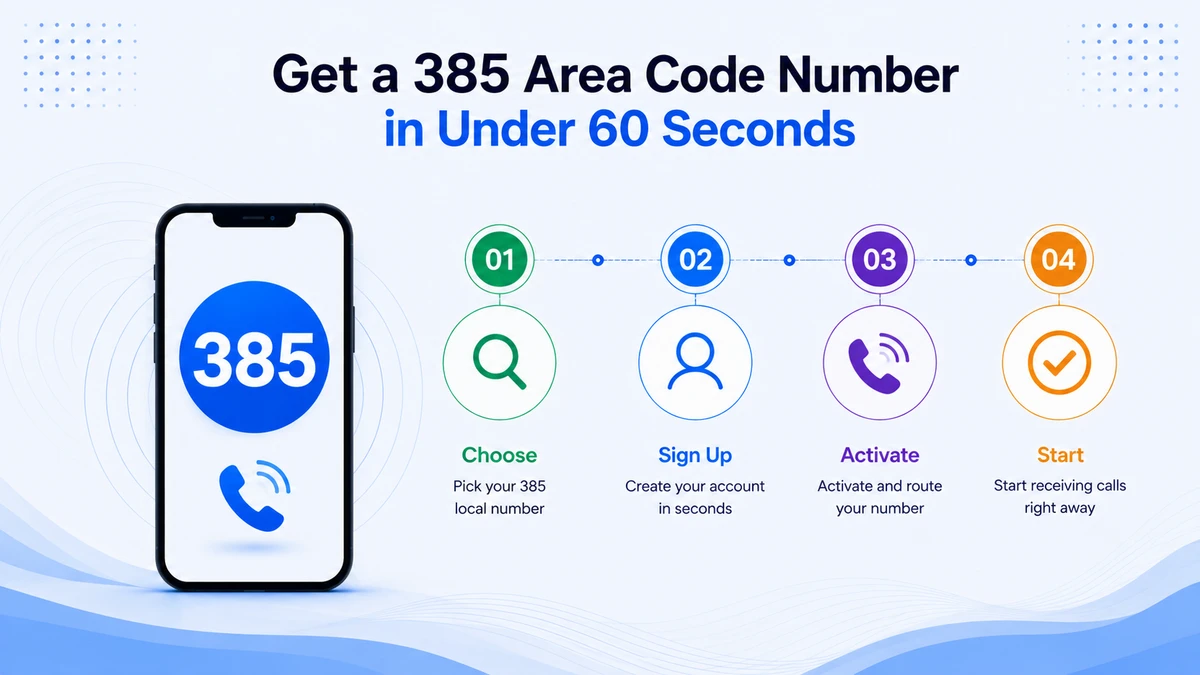
You do not need a Utah address, a physical SIM card, or a long-term contract to get a 385 area code number. With Callmama, the entire process — from sign-up to a live, working 385 number — takes under 60 seconds. Here is how:
- Download the Callmama app — free on iOS (App Store) and Android (Google Play), or use the web browser version. No hardware required.
- Create your account — sign up with your email address and complete a quick verification. No Utah address or state ID needed — sign up from anywhere in the world.
- Search for a 385 number — filter by area code 385 and browse available Salt Lake City and Wasatch Front numbers. Memorable sequences are often available.
- Choose your plan and activate — select a plan that fits your usage. Your 385 number goes live instantly on any device — no waiting, no installation.
Once active, your 385 number works exactly like any other Utah phone number. You can receive and make calls, send and receive texts, set up voicemail, enable call forwarding to any device anywhere in the world, and use the number on multiple devices simultaneously.
What You Get with Every 385 Callmama Number
- Instant activation — live in under 60 seconds, no engineer visit
- Call forwarding — route 385 calls to any device or number globally
- SMS & MMS texting — send and receive texts from your 385 number
- Voicemail to email — receive voicemail transcripts and audio by email
- IVR / auto-attendant — professional call menus for businesses
- Call recording — record calls for quality assurance or compliance
- Multi-device support — use your 385 number on phone, laptop, and tablet simultaneously
- No contract — cancel or change your plan at any time
385 Scam Calls: How to Spot, Report & Block Them
Area code 385 is entirely legitimate — the vast majority of 385 calls come from real Utah residents and businesses. However, scammers can spoof any US area code, including 385, to make their calls appear local and increase the chances of being answered.
Salt Lake City police (SLCPD) have issued public warnings about callers impersonating law enforcement and demanding money over the phone using local-looking numbers. Number spoofing is illegal under the Truth in Caller ID Act and is investigated by the FCC.
Common Scams Using 385 Numbers
| Scam Type | How It Works | Red Flags |
|---|---|---|
| IRS / Tax Threat | Caller claims you owe back taxes and will be arrested unless you pay immediately by gift card or wire transfer | The IRS contacts taxpayers by post first and never demands instant payment by gift card |
| SLCPD / Law Enforcement Impersonation | Caller poses as Salt Lake City police, claims you have an outstanding warrant, and demands payment to avoid arrest | Police never collect fines by phone; hang up and call SLCPD on 801-799-3000 to verify |
| Bank / Credit Card Fraud (Vishing) | Caller poses as Discover, Chase, or another bank, claiming your account has been compromised and asking you to verify card details | Your bank will never ask for your full card number, PIN, or CVV over the phone |
| Robocall / Fake Service Offer | Automated call offering extended warranties, health insurance, or government grants — asks for personal or payment information | Legitimate companies do not cold-call with unsolicited offers requiring immediate payment or personal details |
How to Protect Yourself
- A Utah area code does not mean a Utah caller. Caller ID can be faked. Treat any unsolicited request for personal data or payment with caution, regardless of what number appears on screen.
- Hang up and call back on the verified number. If someone claims to be from the IRS, your bank, or the police, end the call and ring the organisation's official number (from their website or correspondence) — never the number the caller gives you.
- Register with the National Do Not Call Registry. Visit donotcall.gov to register your number for free. This reduces legitimate cold-calling and makes suspicious calls easier to identify.
- Report scam calls to the FTC, the FCC, and if in Utah to the Utah Division of Consumer Protection.
- Use call-blocking apps. Apps such as Hiya, RoboKiller, or your carrier's built-in spam filter (e.g., AT&T Call Protect, T-Mobile Scam Shield) can screen and block known scam numbers before your phone rings.
Report suspicious 385 calls to the FTC at reportfraud.ftc.gov to help investigators shut down scam operations targeting Utah residents.
Conclusion
The 385 area code is more than a telephone prefix — it is the entry point to one of America's fastest-growing and most economically dynamic metropolitan areas.
From the Silicon Slopes tech corridor in Lehi to the financial services towers of downtown Salt Lake City, from the University of Utah's research campus to BYU in Provo, the Wasatch Front covered by 385 (and its partner code 801) is a region of remarkable energy and opportunity.
The code has been stable since its June 2008 launch, overlaying 801 without geographic splits or disruption. For businesses looking to establish a credible Utah presence, a 385 virtual number from Callmama delivers instant local identity — no Utah address, no physical line, no long-term contract.
Setup takes under 60 seconds, every professional calling feature is included from day one, and your number works on any device, anywhere in the world. If the Wasatch Front is your market, the 385 area code is where you start.
Get Your 385 Utah Number Today
No Utah address. No SIM card. No contract. Claim a 385 area code virtual number in minutes and start connecting with Salt Lake City, Silicon Slopes, and the entire Wasatch Front — instantly.