Introduction
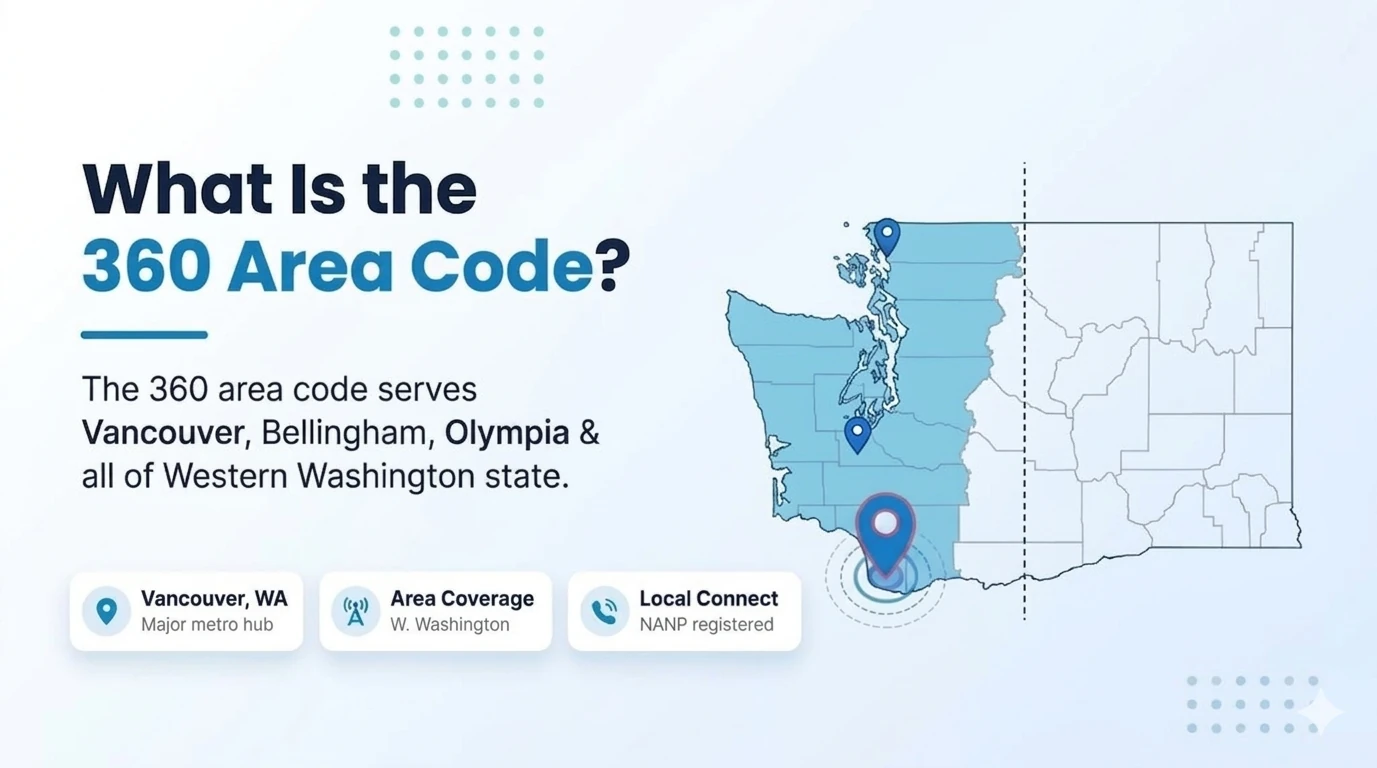
The 360 area code covers a sweeping arc of western Washington state — from the Oregon border in the south to the Canadian border in the north, wrapping around the Seattle metro and reaching deep into the Olympic Peninsula and the Cascade foothills. It serves the state capital, a major port city near the Canadian border, one of the largest cities in Washington that many mistake for its Oregon neighbor, and dozens of smaller communities defined by agriculture, timber, military installations, and Pacific Northwest outdoor culture. This guide covers everything: every county and city in the 360 area code, its Pacific Time Zone, the full history of how it was created, the scam patterns that exploit local trust, and exactly how to get a 360 phone number without needing a Washington address.
Key Takeaways
- The 360 area code covers western Washington state outside the Seattle/Tacoma metro — including Vancouver, Bellingham, Olympia, and the Olympic Peninsula.
- All cities in the 360 region operate in the Pacific Time Zone, running UTC−8 in winter and UTC−7 during Daylight Saving Time.
- Area code 360 was created in 1995 when it split from area code 206, which had served all of western Washington.
- The 564 area code was added as an overlay for the 360 region in 2014 due to continued number exhaustion.
- You do not need a Washington address to own a 360 number — virtual providers activate a local line in under five minutes, with no hardware required.
What Is the 360 Area Code?
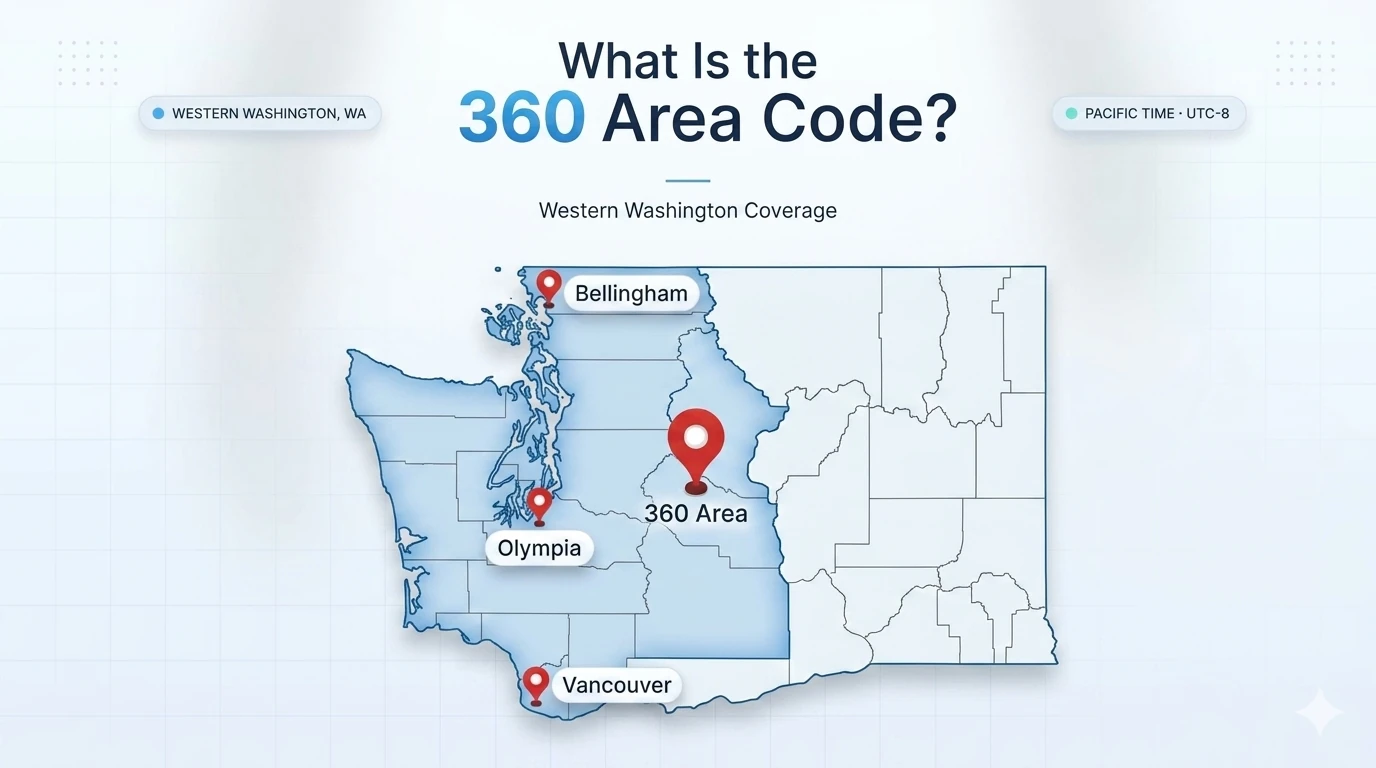
The 360 area code is a NANP (North American Numbering Plan) geographic area code assigned to western Washington state, excluding the Seattle and Tacoma metropolitan areas. It was created on January 15, 1995, when it was split from area code 206, which at the time covered all of Washington west of the Cascades. The 360 footprint stretches from the Columbia River on the Oregon border in the south all the way north to Bellingham and Blaine on the Canadian border, and west across the Olympic Peninsula to the Pacific Ocean coast.
Vancouver, Washington — not to be confused with Vancouver, British Columbia — is the largest city in the 360 region, sitting directly across the Columbia River from Portland, Oregon. Bellingham serves as the northern anchor, a university and port city 20 miles south of the Canadian border. Olympia, the state capital of Washington, sits at the southern tip of Puget Sound within the 360 coverage area. Together, these three cities define the geographic and economic range of the 360 area code: a vast, predominantly rural and mid-sized-city region surrounding the dense Seattle-Tacoma core.
360 Area Code Quick Facts
| Detail | Information |
|---|---|
| Area Code | 360 |
| State | Washington (WA) |
| Region | Western Washington — outside Seattle/Tacoma metro |
| Major Cities | Vancouver, Bellingham, Olympia, Mount Vernon, Longview, Port Angeles, Aberdeen |
| Time Zone | Pacific Time (PST/PDT) |
| UTC Offset | UTC−8 (PST) / UTC−7 (PDT) |
| Established | January 15, 1995 (split from 206) |
| Overlay | 564 (added 2014) |
| Country | United States |
Where Is the 360 Area Code Located?
The 360 area code covers the western portion of Washington state, wrapping around the Seattle-Tacoma corridor served by area codes 206 and 253. Its geographic range is extraordinary — from the Columbia River Gorge border with Oregon in the south, up through the Puget Sound lowlands, across the Olympic Peninsula to the Pacific Coast, and north through the Skagit Valley farmlands to the Canadian border at Blaine.
Counties Covered by the 360 Area Code
| County | Notable For |
|---|---|
| Clark County | Home to Vancouver; largest county in the 360 region; Portland metro cross-river community |
| Whatcom County | Home to Bellingham; Canadian border crossing at Blaine; Western Washington University |
| Thurston County | Home to Olympia, the state capital; Washington state government center |
| Cowlitz County | Home to Longview and Kelso; timber and paper industry; Mount St. Helens proximity |
| Skagit County | Home to Mount Vernon and Anacortes; tulip festival; Skagit Valley agriculture |
| Island County | Home to Oak Harbor; Naval Air Station Whidbey Island; Whidbey and Camano Islands |
| Jefferson County | Home to Port Townsend; Olympic Peninsula gateway; Victorian architecture and arts |
| Clallam County | Home to Port Angeles and Sequim; Olympic National Park; ferry to Victoria, BC |
| Grays Harbor County | Home to Aberdeen and Hoquiam; Pacific Coast fisheries; timber economy |
| Lewis County | Home to Centralia and Chehalis; I-5 corridor between Olympia and Portland |
| Mason County | Home to Shelton; Hood Canal oyster farming; western Puget Sound |
| Pacific County | Home to Raymond and Long Beach; southernmost Pacific Coast county in Washington |
| Wahkiakum County | Home to Cathlamet; Columbia River; smallest county in 360 region |
| San Juan County | Home to Friday Harbor; island archipelago; ferry-only access |
| Skamania County | Home to Stevenson; Columbia River Gorge outdoor recreation |
Major Cities in the 360 Coverage Area
| City | County | Notable For |
|---|---|---|
| Vancouver | Clark | Washington's fourth-largest city; across Columbia River from Portland; tech and retail hub |
| Bellingham | Whatcom | Western Washington University; port city; 20 miles from Canadian border |
| Olympia | Thurston | State capital of Washington; government employment center |
| Longview | Cowlitz | Timber and paper industry; Columbia River port |
| Mount Vernon | Skagit | Skagit Valley agriculture; tulip festival; regional medical center |
| Oak Harbor | Island | Naval Air Station Whidbey Island; largest city on Whidbey Island |
| Port Angeles | Clallam | Olympic National Park gateway; Victoria, BC ferry terminal |
| Aberdeen | Grays Harbor | Pacific Coast timber city; birthplace of Kurt Cobain |
| Centralia | Lewis | I-5 corridor city; historic downtown; outlet shopping |
| Anacortes | Skagit | San Juan Islands ferry hub; oil refinery; Puget Sound gateway |
| Sequim | Clallam | Olympic Peninsula lavender farms; retirement community; rain shadow microclimate |
| Port Townsend | Jefferson | Victorian seaport; arts community; Olympic Peninsula |
For a look at another distinctive regional market, see our 337 area code guide.
What Time Zone Does the 360 Area Code Use?
Every city within the 360 area code operates in the Pacific Time Zone. During Pacific Standard Time — November through mid-March — clocks run at UTC−8. During Pacific Daylight Time — mid-March through November — the region moves to UTC−7. This is the westernmost of the four continental US time zones, making western Washington the last major US region to start the business day.
For businesses and callers coordinating across time zones, the Pacific offset creates important windows. An 8 a.m. call from New York reaches a 360 contact at 5 a.m. — well before business hours. East Coast teams working with Vancouver, Bellingham, or Olympia contacts should target calls between 12 p.m. and 5 p.m. Eastern to align with standard Pacific business hours.
| Caller's Time Zone | Difference from 360 (PT) |
|---|---|
| Mountain (MT) | 360 is 1 hour behind |
| Central (CT) | 360 is 2 hours behind |
| Eastern (ET) | 360 is 3 hours behind |
The History of the 360 Area Code
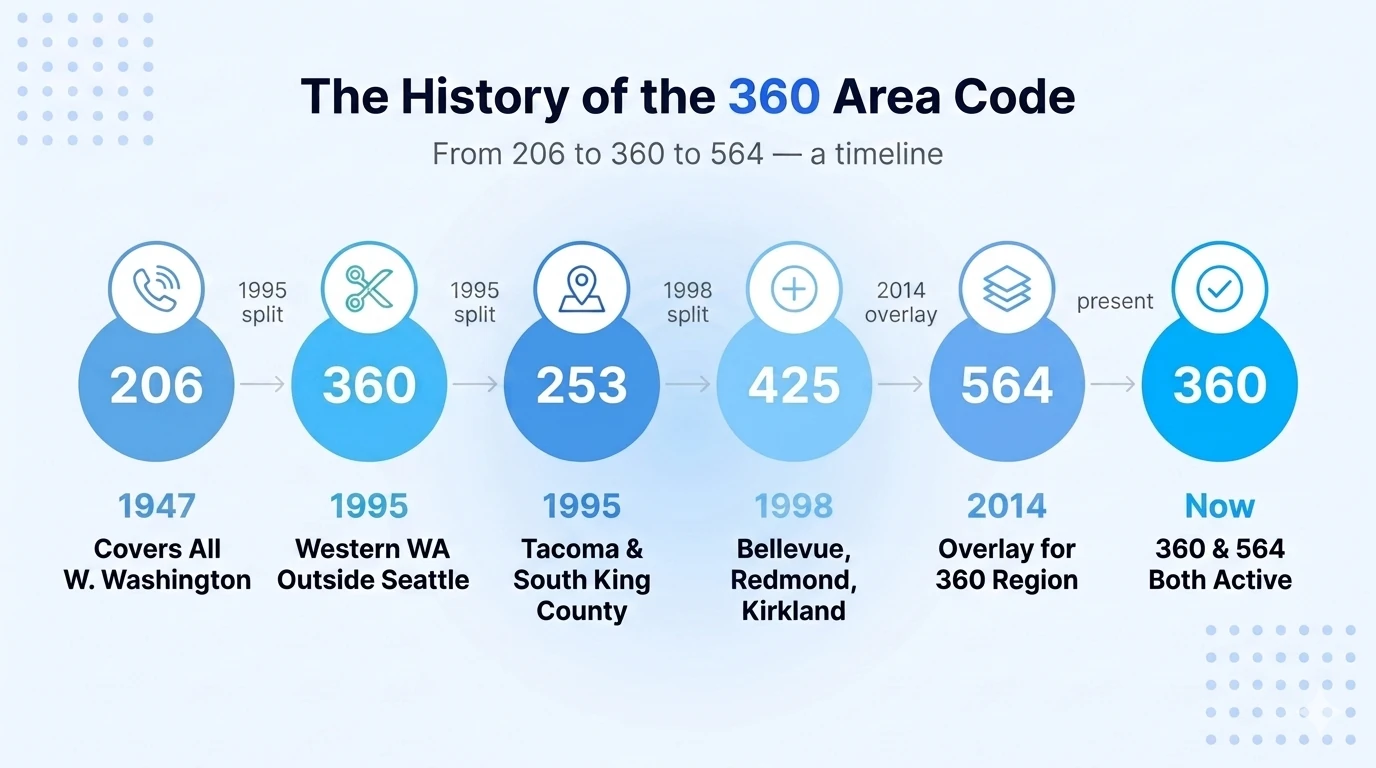
Area code 360 was created on January 15, 1995, when it was split from area code 206. Before 1995, area code 206 served all of western Washington — from the Canadian border to the Oregon border, including Seattle, Tacoma, Olympia, Vancouver, and Bellingham. As Washington's population surged through the 1980s and early 1990s — driven by Boeing, Microsoft, and the broader tech boom — the 206 number pool became exhausted.
The Washington Utilities and Transportation Commission approved a geographic split, assigning the new 360 code to the western Washington regions outside the Seattle-Tacoma core, while 206 was retained for Seattle and King County. By 2014, continued growth in the 360 region exhausted the number pool again. The 564 area code was introduced as an overlay, meaning both 360 and 564 now serve the same geographic region and 10-digit dialing is required for all local calls.
Washington State Area Code Timeline
| Year | Event |
|---|---|
| 1947 | 509 assigned for eastern Washington; 206 covers all of western Washington |
| 1995 | 360 split from 206 to serve western Washington outside Seattle/Tacoma |
| 1995 | 253 created for Tacoma and South King County, split from 206 |
| 1998 | 425 created for Eastside suburbs (Bellevue, Redmond, Kirkland), split from 206 |
| 2014 | 564 overlay added for the 360 region due to continued number exhaustion |
| 2014–present | 360 and 564 both serve western Washington outside Seattle metro |
Need a western Washington local number — without opening an office in Olympia or Vancouver?
A virtual 360 number activates in minutes, works on any device, and positions your brand inside one of the most geographically diverse markets on the West Coast.
Why a Local 360 Number Matters for Your Business
A 360 area code number instantly signals to contacts across western Washington that your business is part of their regional community — not an anonymous national caller. In a market that spans tech-adjacent suburbs of Portland, state government offices in Olympia, military communities on Whidbey Island, agricultural operations in the Skagit Valley, and cross-border commerce with British Columbia, that local signal translates directly into improved answer rates and faster relationship-building.
Industries That Gain the Most from a 360 Presence
- Cross-border trade and logistics — The Bellingham and Blaine area handles significant Canada-US commercial traffic. A 360 number communicates genuine knowledge of Pacific Northwest border commerce to contacts on both sides.
- Government contracting and public sector services — Olympia is the center of Washington state government. Businesses serving state agencies, school districts, and municipal governments benefit significantly from a local 360 number.
- Military and defense services — Naval Air Station Whidbey Island, Joint Base Lewis-McChord border areas, and other installations across western Washington represent large, stable markets for defense contractors, housing, and support services.
- Agriculture and food processing — The Skagit Valley, Whatcom County, and Lewis County produce dairy, berries, tulips, and specialty crops at commercial scale. Vendors and buyers respond better to familiar local numbers.
- Real estate and property management — The Vancouver metro (Clark County) has been one of the fastest-growing real estate markets in the Pacific Northwest for over a decade, driven by Portland-area workers seeking lower housing costs across the Columbia River.
- Healthcare and senior services — Olympia, Bellingham, and the Olympic Peninsula have large healthcare and retirement service markets. Local numbers drive significantly better response rates for appointment scheduling and care coordination.
Businesses comparing East Coast markets often also review our 413 area code guide.
How to Get a Virtual Phone Number from CallMama
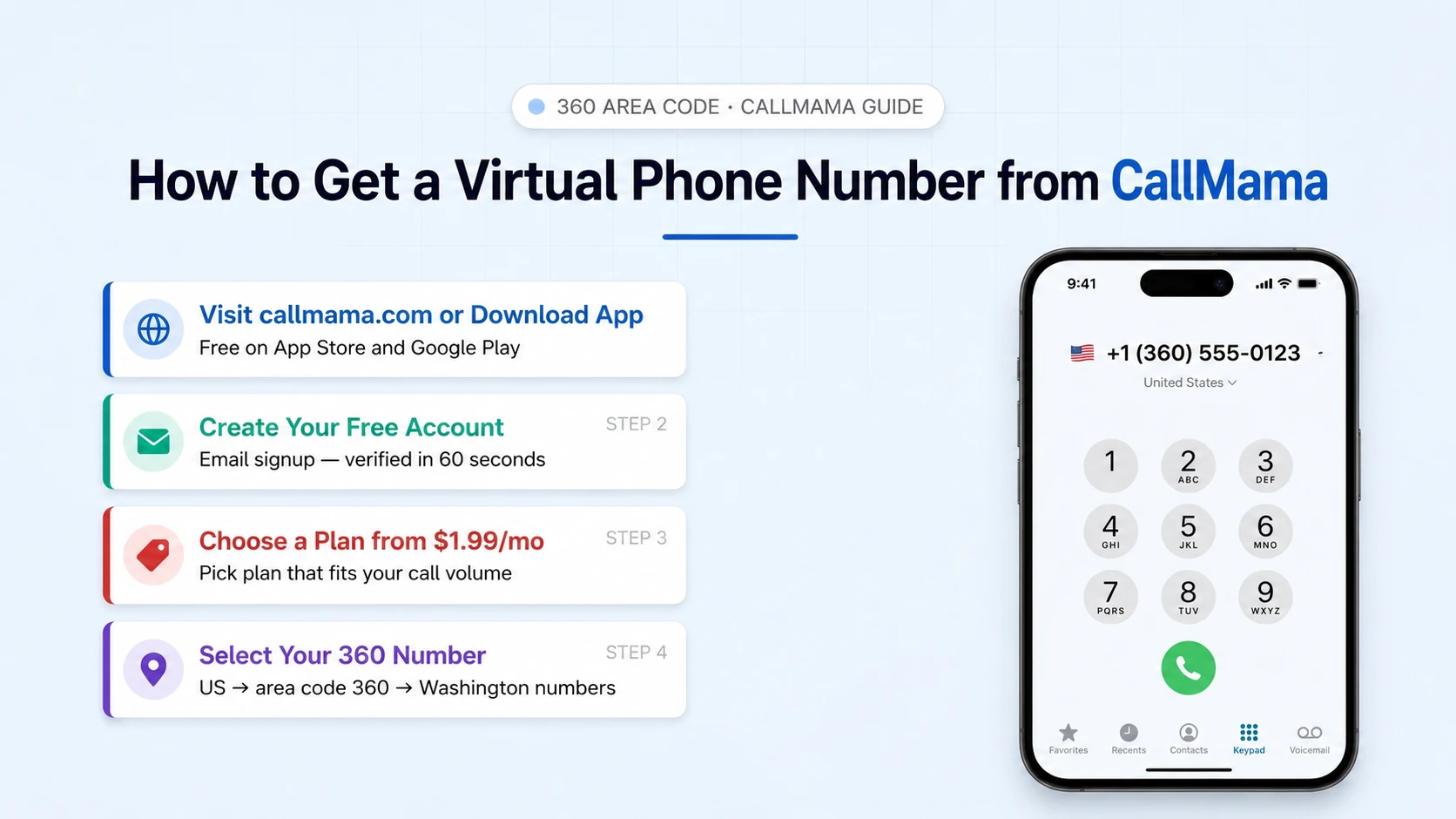
CallMama is a global virtual phone number platform that gives you a real, NANP-registered 360 number without requiring a Washington address, a physical SIM, or any hardware. The platform includes HD voice, two-way SMS, voicemail-to-email transcription, and call forwarding — all starting at $1.99 per month with no hidden fees and no lock-in contract.
- Visit callmama.com or download the app from the App Store or Google Play — it is free to install.
- Create your free account — sign up with your email address. Verification takes under sixty seconds.
- Choose a plan — select the virtual number plan that fits your call volume and budget, starting at $1.99/month.
- Select your number — choose United States as the country, enter 360 as the area code, and browse available Washington numbers.
- Add credit and activate — fund your account and your 360 phone number goes live immediately.
- Configure your settings — set up call forwarding, voicemail routing, and SMS preferences in the dashboard.
- Start making and receiving calls — your number works on any smartphone, tablet, or computer from day one.
Scam Calls and the 360 Area Code
The 360 area code is actively targeted by caller ID spoofing operations. Scammers display local 360 numbers because residents and businesses in western Washington — particularly near the Canadian border — are far more likely to answer a call from a familiar Pacific Northwest prefix than an unknown out-of-state or international line.
Common Scam Types in the 360 Region
| Scam Type | How It Works | Warning Sign |
|---|---|---|
| Canada border crossing fraud | Caller claims there is a problem with your border crossing record requiring immediate payment | CBSA and CBP contact you by mail or in-person — never by unsolicited phone call |
| Military impersonation | Caller poses as a military benefits officer requesting personal or banking details | No military installation contacts service members by unsolicited call to request financial data |
| IRS and tax fraud | Caller claims you owe back taxes and threatens arrest unless you pay immediately | The IRS contacts you by mail first — never by surprise phone call |
| Utility shutoff threats | Caller poses as Puget Sound Energy or Pacific Power demanding same-day payment | Real utilities send written notices and never demand immediate phone payment |
| One-ring callback trick | Number rings once and disconnects, hoping curiosity makes you call a premium-rate line back | Never return a call from a number that rang once with no voicemail |
How to Protect Yourself
- Verify independently before acting on any call that creates urgency or demands immediate payment.
- Never share personal, financial, or immigration documents with any unsolicited caller.
- Report scam calls to the Federal Trade Commission's FTC fraud report service.
- Register at donotcall.gov to reduce unwanted telemarketing volume over time.
360 Area Code vs. Neighboring Area Codes
Understanding how 360 relates to surrounding Washington and Oregon codes helps you identify any regional call instantly.
| Area Code | Region | Key Cities |
|---|---|---|
| 360 | Western Washington — outside Seattle/Tacoma | Vancouver, Bellingham, Olympia, Longview, Mount Vernon |
| 564 | Western Washington (overlay for 360) | Same geography as 360 — introduced 2014 |
| 206 | Seattle and King County | Seattle, Shoreline, Burien, Mercer Island |
| 253 | Tacoma and South King/Pierce County | Tacoma, Auburn, Federal Way, Kent, Puyallup |
| 425 | Eastside Seattle suburbs | Bellevue, Redmond, Kirkland, Bothell, Renton |
| 509 | Eastern Washington | Spokane, Yakima, Tri-Cities, Wenatchee |
| 503 | Portland, Oregon metro | Portland, Salem, Eugene |
Calls from 206 come from Seattle. Calls from 253 originate in Tacoma. Calls from 425 are from the Eastside tech corridor. Calls from 509 cross the Cascades from eastern Washington. Calls from 503 come from Portland, Oregon — just across the Columbia River from Vancouver, Washington. A 360 number is uniquely tied to the non-Seattle western Washington identity.
Conclusion
The 360 area code covers one of the most geographically and economically diverse regions in the American West — a sweeping arc of western Washington that runs from the Oregon border to Canada, from the Pacific Coast to the Cascade foothills, encompassing the state capital, a major port and university city, a booming Portland suburb, military installations, agricultural valleys, and island communities accessible only by ferry. This guide has walked you through every county and major city in the 360 region, the Pacific Time Zone it operates in, its 1995 split from area code 206, the 564 overlay added in 2014, the scam patterns that exploit regional trust, and why a 360 phone number delivers genuine local credibility across this vast and varied market.
A virtual 360 number activates in minutes — no Washington address, no hardware, no long-term commitment — and positions your business inside a region defined by Pacific Northwest independence, strong community identity, and a preference for doing business with people who feel like neighbors. Whether you serve government contractors in Olympia, real estate buyers in the Vancouver metro, berry farmers in the Skagit Valley, or military families on Whidbey Island, a 360 area code presence opens the door in a way that an unknown national number simply cannot.
Ready to claim your western Washington presence?
Activate a virtual 360 number in minutes — no Washington address needed, works on any device.
