Introduction
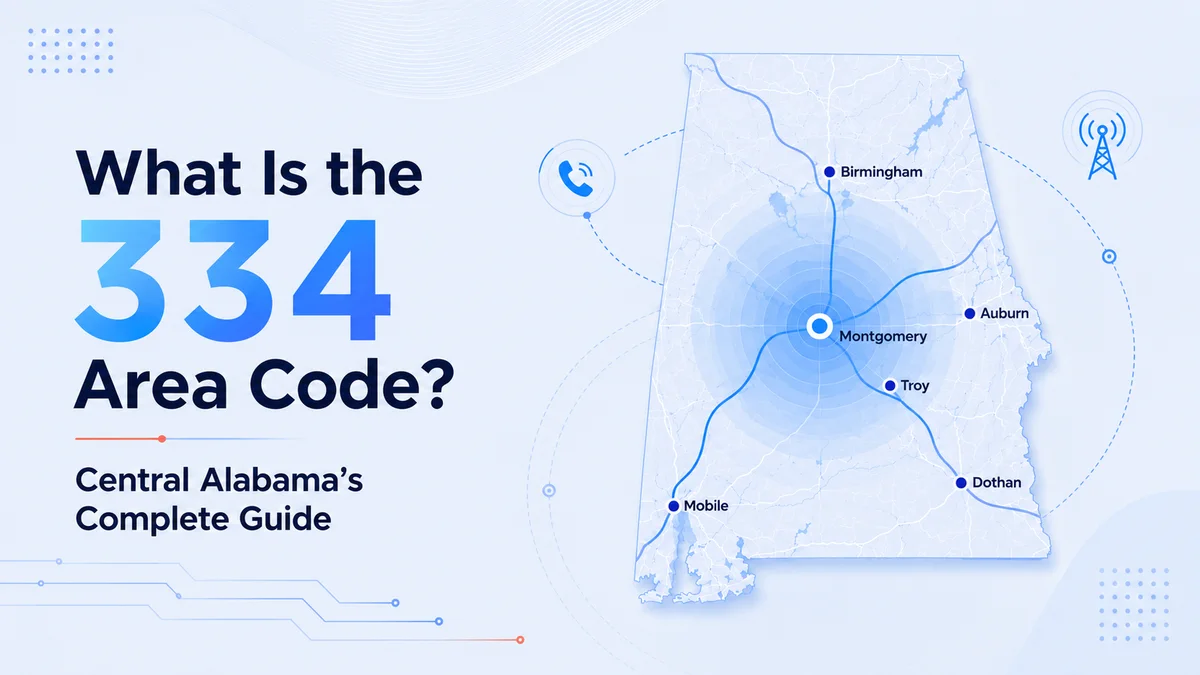
The 334 area code serves central and southeastern Alabama, linking the state capital, a celebrated SEC university city, and communities that shaped the American civil rights movement. Recognizing the 334 area code region matters whether you are returning a call from a Montgomery government office, reaching an Auburn supplier, or deciding whether an unknown number is worth answering. This guide details every major city in the 334 footprint, the complete history of how this prefix came to be, the 2026 overlay change that now requires 10-digit dialing, scam awareness, and a clear path to securing your own 334 phone number. From its 1995 origins to the changes reshaping it today, here is everything you need to know.
Key Takeaways
- The 334 area code launched on January 15, 1995, as Alabama's original 205 code split — and made history as the first interchangeable NPA code ever issued.
- Montgomery (state capital), Auburn, Dothan, Selma, and Phenix City are the largest cities inside the 334 footprint.
- Overlay code 483 launched on February 26, 2026; since January 23, 2026, all local calls within the region require mandatory 10-digit dialing.
- All 334 area code numbers run on Central Time — CST (UTC−6) in winter and CDT (UTC−5) in summer.
- A virtual 334 phone number is available to anyone nationwide — no Alabama address or SIM card required.
What Is the 334 Area Code?
The 334 area code is a geographic telephone prefix assigned to central and southeastern Alabama. It was established on January 15, 1995, when the original statewide code 205 was divided to handle surging demand from fax machines, early mobile networks, and a growing population. Before that split, every telephone in the state — from Birmingham to Mobile — shared the same single area code.
The 334 code also carries a distinction no area code held before it. Under the original 1947 NANP rules, every area code required a 0 or 1 as its middle digit. When regulators updated the rules to allow any digit, 334 became the first-ever interchangeable NPA code — beating Washington State's 360 by a single minute. A 334 phone number therefore carries a quiet but genuine piece of North American telecom history.
Today, 334 covers a broad corridor of the Deep South from Prattville and Montgomery in the center of the state, southeast to Dothan near the Florida line, and east to Phenix City on the Georgia border. Since February 26, 2026, overlay code 483 shares this same territory.
Quick Facts — 334 Area Code
| Detail | Info |
|---|---|
| State | Alabama (central and southeastern region) |
| Year Created | January 15, 1995 |
| Split From | 205 — original Alabama area code (since 1947) |
| Child Split | 251 — Mobile and SW Alabama (2001) |
| Overlay Code | 483 (since February 26, 2026) |
| Time Zone | Central Time (CST / CDT) |
| State Capital | Montgomery |
| Dialing Format | 10-digit mandatory since Jan 23, 2026 |
Where Is the 334 Area Code Located?
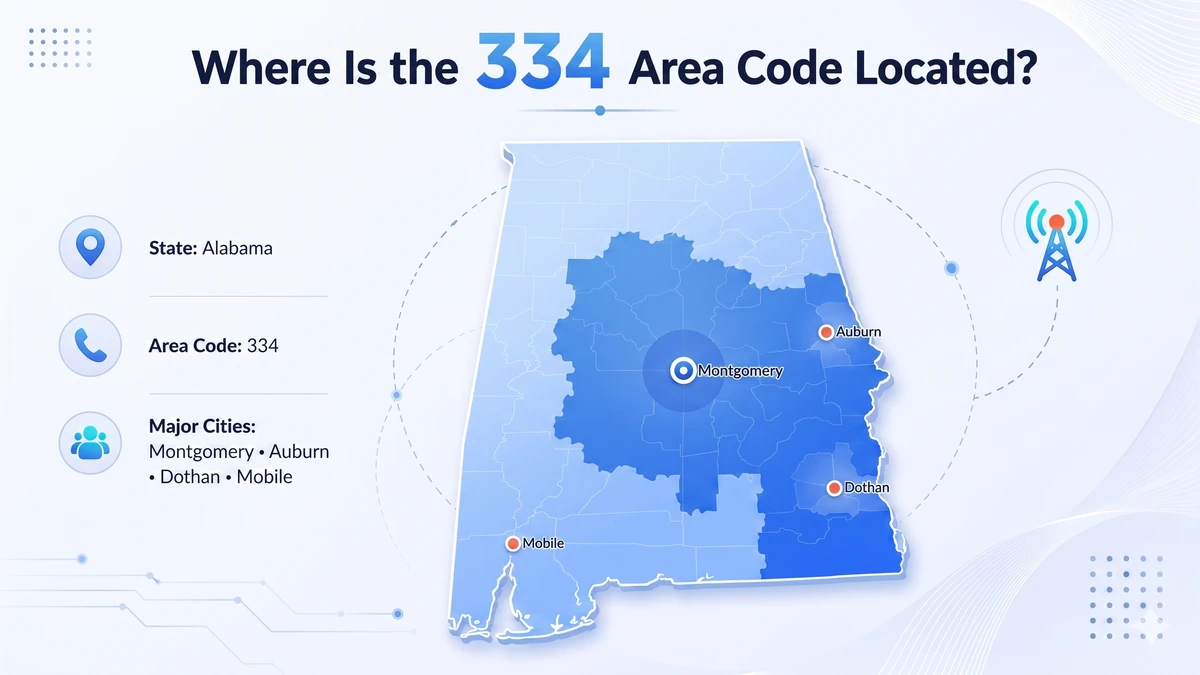
The 334 area code occupies the central and southeastern section of Alabama, bordered by area code 205 to the northwest (Birmingham and Tuscaloosa), area code 256 to the north (Huntsville and Anniston), and area code 251 to the southwest (Mobile and the Gulf Coast). To the east, 334 extends to the Chattahoochee River and the Georgia state line at Phenix City. The southern edge of the territory reaches the Florida border near Dothan.
This territory spans roughly 32 counties of the American Deep South — a landscape of river valleys, pine forests, fertile farmland, and historically significant cities. The region is connected to southeastern US commerce through Interstate 85 between Montgomery and Atlanta, and through the east–west corridor near the Florida Panhandle.
Neighboring Area Codes
| Area Code | Region |
|---|---|
| 205 | Birmingham metro and Tuscaloosa — northwest of the 334 territory |
| 256 | Huntsville and northern Alabama — north of the 334 footprint |
| 251 | Mobile and southwest Alabama — southwest of 334 |
| 706 / 762 | Columbus, Georgia — directly east across the Chattahoochee River |
| 850 | Florida Panhandle — immediately south near Dothan |
Cities and Communities in the 334 Footprint
The 334 region spans a diverse mix of state government centers, college communities, agricultural hubs, and historically significant cities. Here are the communities that define this part of Alabama:
- Montgomery: Alabama's state capital and the largest city in the 334 footprint. Montgomery is home to the state legislature, the Alabama Supreme Court, and the National Memorial for Peace and Justice — the country's first memorial dedicated to victims of racial terror. The city was also the starting point of the landmark 1965 Selma-to-Montgomery marches.
- Auburn and Opelika: Auburn is home to Auburn University, one of the largest universities in the Southeast and a perennial Southeastern Conference powerhouse. Opelika, directly east of Auburn, serves as the Lee County seat and complements the area with a strong manufacturing and retail economy.
- Dothan: Located near the Florida and Georgia borders, Dothan is the commercial hub of southeastern Alabama. Known as the "Peanut Capital of the World," Dothan anchors a major agricultural region and draws tens of thousands of visitors each fall for the National Peanut Festival.
- Selma: One of the most historically significant cities in the 334 region, Selma sits on the Alabama River and gained international recognition during the 1965 voting rights marches across the Edmund Pettus Bridge — an event that helped pass the Voting Rights Act of 1965.
- Phenix City: Located on the Georgia border directly across from Columbus, Phenix City is part of a thriving cross-state metro area with ties to Fort Moore and a growing manufacturing base.
- Troy, Enterprise, Prattville, and Tuskegee: Troy hosts Troy University with a strong national athletics following. Enterprise is famous for the world's only monument honoring an agricultural pest — the boll weevil. Prattville sits northwest of Montgomery with steady residential and commercial growth. Tuskegee is home to the historically Black Tuskegee University and the enduring legacy of the Tuskegee Airmen.
The History of the 334 Area Code
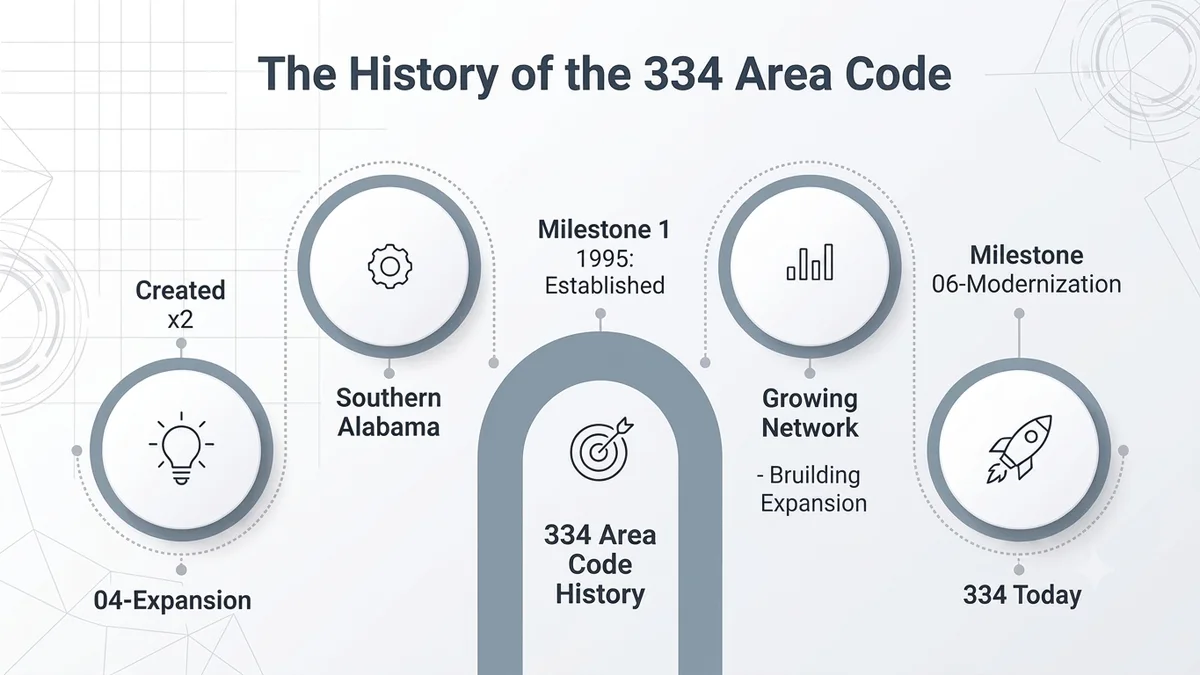
When AT&T and the Bell System mapped North America into telephone regions in 1947, all of Alabama was assigned area code 205. For nearly five decades, 205 handled every phone call in the state — from Huntsville to Mobile. By the early 1990s, fax lines, pagers, and first-generation cellular phones had pushed the 205 number pool close to exhaustion.
Regulators responded by splitting 205 on January 15, 1995. Northern and central Alabama — including Birmingham and Tuscaloosa — kept the 205 prefix. Southern Alabama received the new 334 area code, which at the time also included Mobile and the Gulf Coast. Six years later, in 2001, Mobile and southwest Alabama were separated into area code 251, giving 334 its current central and southeastern Alabama boundaries.
The 334 Area Code Timeline
- 1947 — Alabama Joins NANP as 205: All of Alabama is assigned area code 205 under the original North American Numbering Plan, alongside 85 other regional codes across the US and Canada.
- January 15, 1995 — 334 Created: Alabama's 205 prefix splits. Southern Alabama — including Montgomery, Mobile, Auburn, and Dothan — receives the new 334 code. It becomes the first-ever interchangeable NPA code, beating Washington's 360 by one minute.
- 2001 — 251 Splits from 334: Mobile and southwest Alabama receive their own prefix (251), reducing the 334 footprint to its current central and southeastern Alabama boundaries.
- March 2024 — 483 Overlay Approved: The Alabama Public Service Commission approves area code 483 as an all-services overlay for the 334 territory to address projected number exhaustion.
- January 23, 2026 — Mandatory 10-Digit Dialing: All local calls within the 334/483 region now require the full area code plus 7-digit number. Seven-digit dialing no longer connects.
- February 26, 2026 — 483 Launches: Overlay code 483 goes live across the same 32-county region served by 334. New lines may receive either prefix; all existing 334 numbers remain unchanged.
334 Gets a New Neighbor — Overlay 483
By 2024, central Alabama's phone number inventory was running short. Decades of growth in Montgomery, Auburn, and Dothan — combined with the expansion of mobile phones, VoIP lines, and virtual numbers — had steadily consumed the available 334 pool. The Alabama Public Service Commission stepped in with an all-services overlay solution.
On February 26, 2026, area code 483 went live across the same 32-county region already served by 334. Here is what that means for callers and businesses in central Alabama:
- New phone lines in the region may receive a 483 number instead of a 334 — providers draw from whichever pool has available inventory
- Every existing 334 number stays unchanged; no one had to switch when 483 launched
- All calls within the combined 334/483 region require full 10-digit dialing — area code first, then the 7-digit number
- Callers dialing just 7 digits locally will hear a message that the call cannot be completed as dialed
If you make or receive calls in the 334 footprint, confirm that all saved contacts include the full 10-digit format. This is the most significant change to dialing in central Alabama since the 251 split in 2001.
Claim a Montgomery or Auburn Number from Anywhere
A virtual 334 line gives your business an Alabama identity on caller ID — activate in minutes with no SIM card or Alabama address required.
Central Time and Dialing in the 334 Region
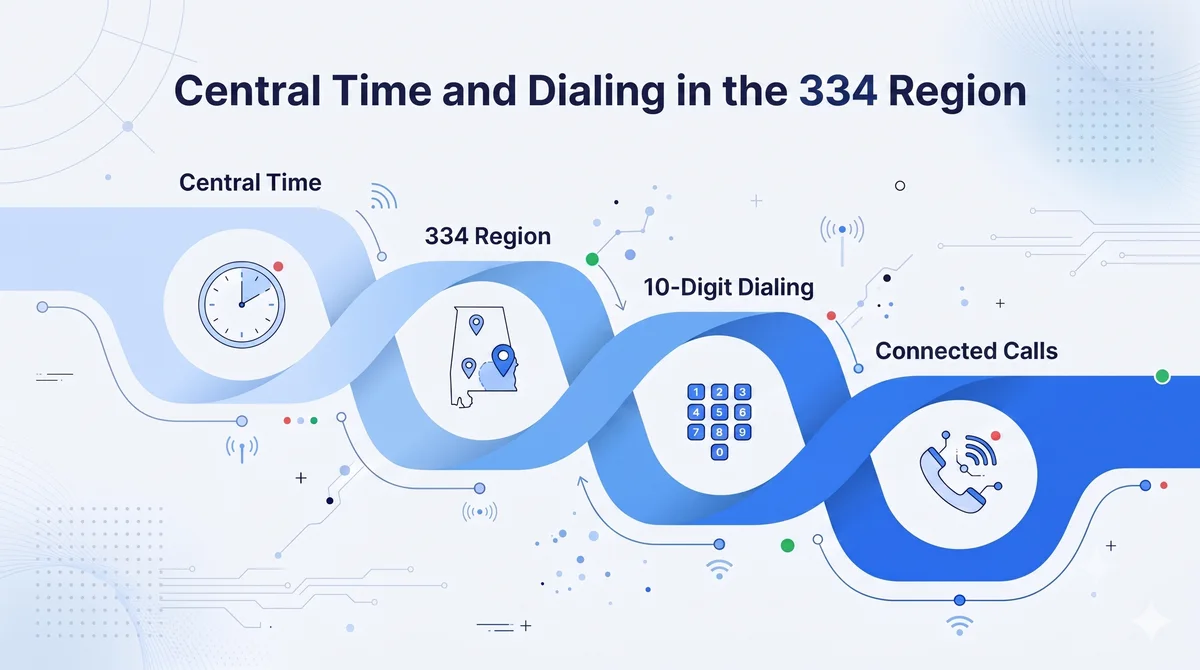
All 334 area code numbers run on Central Time — the same time zone as Chicago, Dallas, and Nashville. Alabama has no county-level time zone exceptions, so every city in the 334 footprint observes the same schedule year-round:
- Central Standard Time (CST): UTC−6, from the first Sunday in November to the second Sunday in March.
- Central Daylight Time (CDT): UTC−5, from the second Sunday in March to the first Sunday in November.
East Coast callers — including those in Atlanta's 404 region — are always one hour ahead of 334 numbers. Callers from Mountain or Pacific time zones are one or two hours behind. Factor in the difference when scheduling calls with Montgomery government offices, Auburn University departments, or Dothan business contacts.
How to Dial a 334 Number
- Within the 334/483 region: Dial all 10 digits — 334-XXX-XXXX. Since January 23, 2026, 7-digit local calls do not connect.
- From anywhere else in the US or Canada: Dial the full 10-digit number directly — no special prefix needed.
- From outside North America: Dial +1-334-XXX-XXXX (or 00-1-334-XXX-XXXX on most international landlines).
How to Get a Virtual Phone Number from CallMama
CallMama makes it simple to get a virtual 334 phone number — no Alabama address, no physical SIM card, and no long-term contract required. Your line goes live in minutes and works on any smartphone, tablet, or computer with an internet connection.
Why a 334 Number Works for Your Business
A local 334 area code instantly signals to Alabama customers that your business is part of their community. People are far more likely to answer a call from a recognizable local prefix than from a toll-free or out-of-state number — and that difference in answer rates compounds directly into revenue.
Businesses that serve Montgomery government contracts, Auburn supply chains, Dothan agricultural buyers, or Selma community organizations gain an immediate edge with a local 334 phone number. A virtual line means no physical Alabama office is required — you handle all calls on your existing device, from anywhere. Businesses expanding across the Southeast can also compare this reach with our 912 area code guide.
What a Virtual 334 Line Includes
- Higher answer rates from southern Alabama customers who recognize the local prefix
- Clean separation between business and personal calls on a single smartphone
- Call forwarding to any location — home office, mobile, or team members in other states
- Voicemail, call analytics, and hold features that scale with your business growth
- Instant local credibility without the cost of a physical Alabama storefront
Virtual vs. Traditional Landline — A Quick Comparison
| Feature | Virtual 334 Line | Traditional Landline |
|---|---|---|
| Alabama address required | No | Yes |
| Setup time | Minutes | Days to weeks |
| Works on mobile | Yes | No |
| Call forwarding | Built-in | Add-on cost |
| Month-to-month flexibility | Yes | Often locked in |
334 Phone Number Scam Alerts — Staying Safe
Not every call displaying a 334 area code on your screen originates from Alabama. Scammers use a technique called neighbor spoofing — displaying a familiar local number to increase the chance you will answer. The actual call may come from another state or an overseas call center entirely.
Common Scam Types Targeting 334 Callers
- Medicare and Medicaid fraud: Callers claim your benefits are at risk or offer free equipment to harvest personal information — the most frequently reported category in the 334 region.
- Health insurance scams: Fake agents offer "new plans" or "enrollment updates" to steal Social Security numbers and payment details.
- IRS and Social Security impersonators: Callers threaten immediate arrest or suspended benefits if you do not pay immediately by phone — no government agency operates this way.
- Auto warranty calls: High-pressure sales claiming your vehicle warranty is expiring, designed to collect credit card information.
- Utility disconnection scams: Callers demand same-day payment to avoid a service cutoff that does not actually exist.
Look Up Unknown Numbers Before Calling Back
If you receive an unexpected call from an unfamiliar 334 number and the caller leaves no message — or a generic automated one — search the number online before returning it. Legitimate businesses and residents in Montgomery, Dothan, or Auburn leave clear messages and provide verifiable contact details.
What to Do If You Suspect a Scam Call
Hang up without sharing any personal information and do not call an unfamiliar number back without verifying it first. Report suspected scam calls to the Federal Trade Commission's FTC fraud report service. No legitimate government agency demands immediate payment by phone, and no real prize organization charges an upfront fee to release winnings.
Conclusion
The 334 area code has connected central and southeastern Alabama since January 15, 1995 — a region that includes the state capital in Montgomery, an SEC powerhouse in Auburn, the agricultural heartland around Dothan, and the historically significant communities of Selma and Tuskegee. It made history as the first interchangeable NPA code ever assigned, and it has evolved through two major changes since: the 2001 split that created 251 for Mobile, and the February 2026 overlay that brought 483 into the same territory with mandatory 10-digit dialing. Whether you received a 334 phone number call you want to identify, or you are establishing an Alabama presence for your business, this guide gives you the full picture.
Activating a virtual southern Alabama line is faster and more affordable than it has ever been. A local prefix builds immediate trust with customers across Montgomery, Auburn, Dothan, and the rest of the 334 region — trust that toll-free or out-of-state numbers simply cannot replicate. Follow the steps above to get started and put an authentic Alabama number to work for you today. The right area code is often the first impression you make, and 334 is one worth making.
Your Southern Alabama Presence Starts Here
Pick a 334 number today and build real local trust with Montgomery, Auburn, and Dothan customers — go live in minutes, no relocation required.
