Introduction
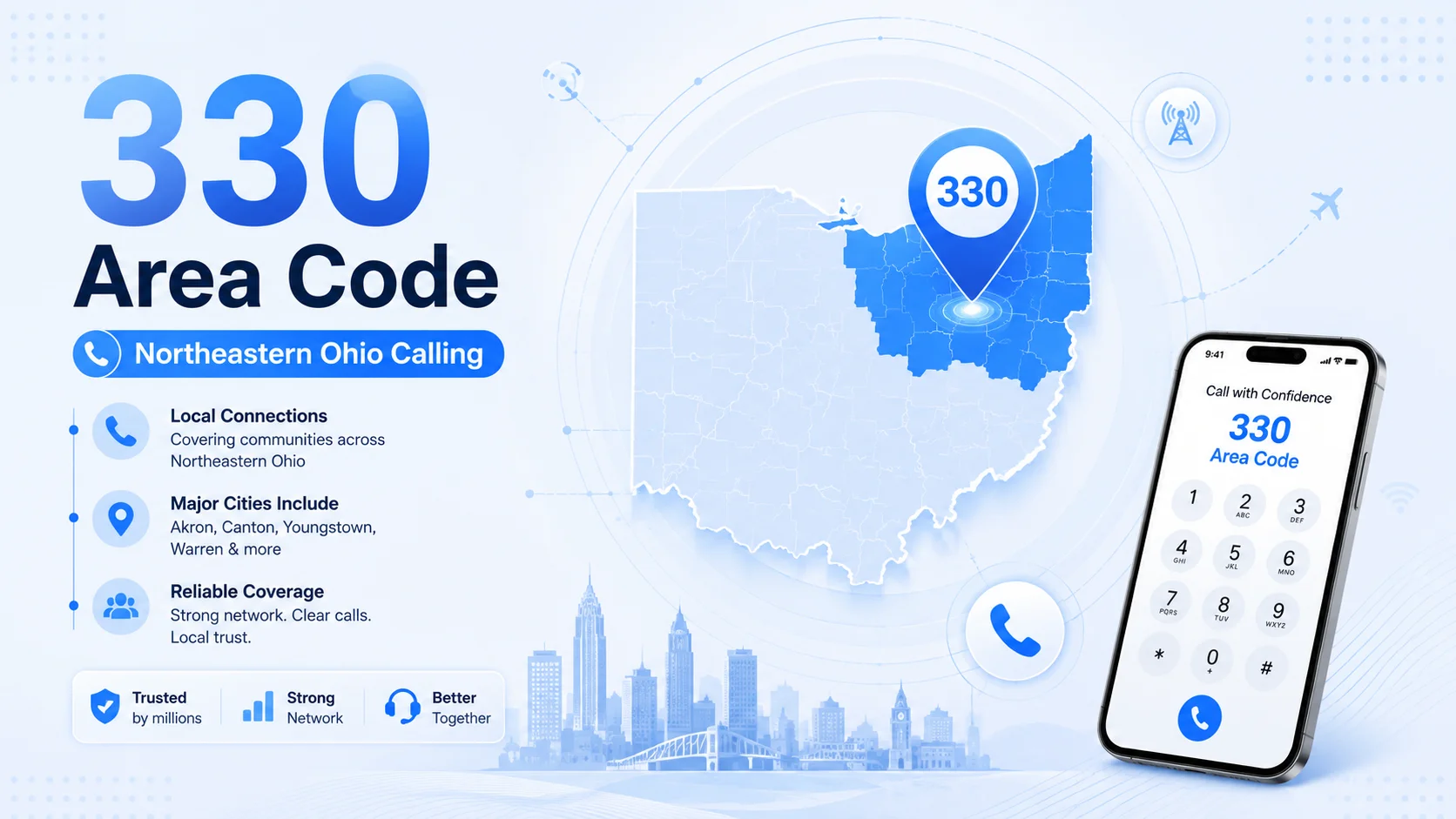
The 330 area code covers northeastern Ohio, connecting Akron, Canton, Youngstown, and dozens of communities across one of the state's most historically significant industrial regions. Knowing your 330 area code matters whether you're verifying an incoming call, targeting Ohio customers for your business, or setting up a local number in a region with deep economic roots. This guide covers which cities the 330 area code serves, its time zone, full history, scam awareness, and how to get a 330 phone number for yourself. Keep reading to get the complete picture on one of Ohio's most dynamic and widely recognized area codes.
Key Takeaways
- The 330 area code covers northeastern Ohio, including Akron, Canton, Youngstown, Warren, Kent, and Medina.
- All 330 communities operate in the Eastern Time Zone — EST (UTC-5) in winter and EDT (UTC-4) in summer.
- Area code 330 was created in 1996 as a geographic split from the 216 area code.
- The 234 area code was added as an overlay in 2009, making 10-digit dialing mandatory across the entire region.
- You can get a 330 phone number through a VoIP service without living in Ohio.
What Is the 330 Area Code and Where Is It Located?
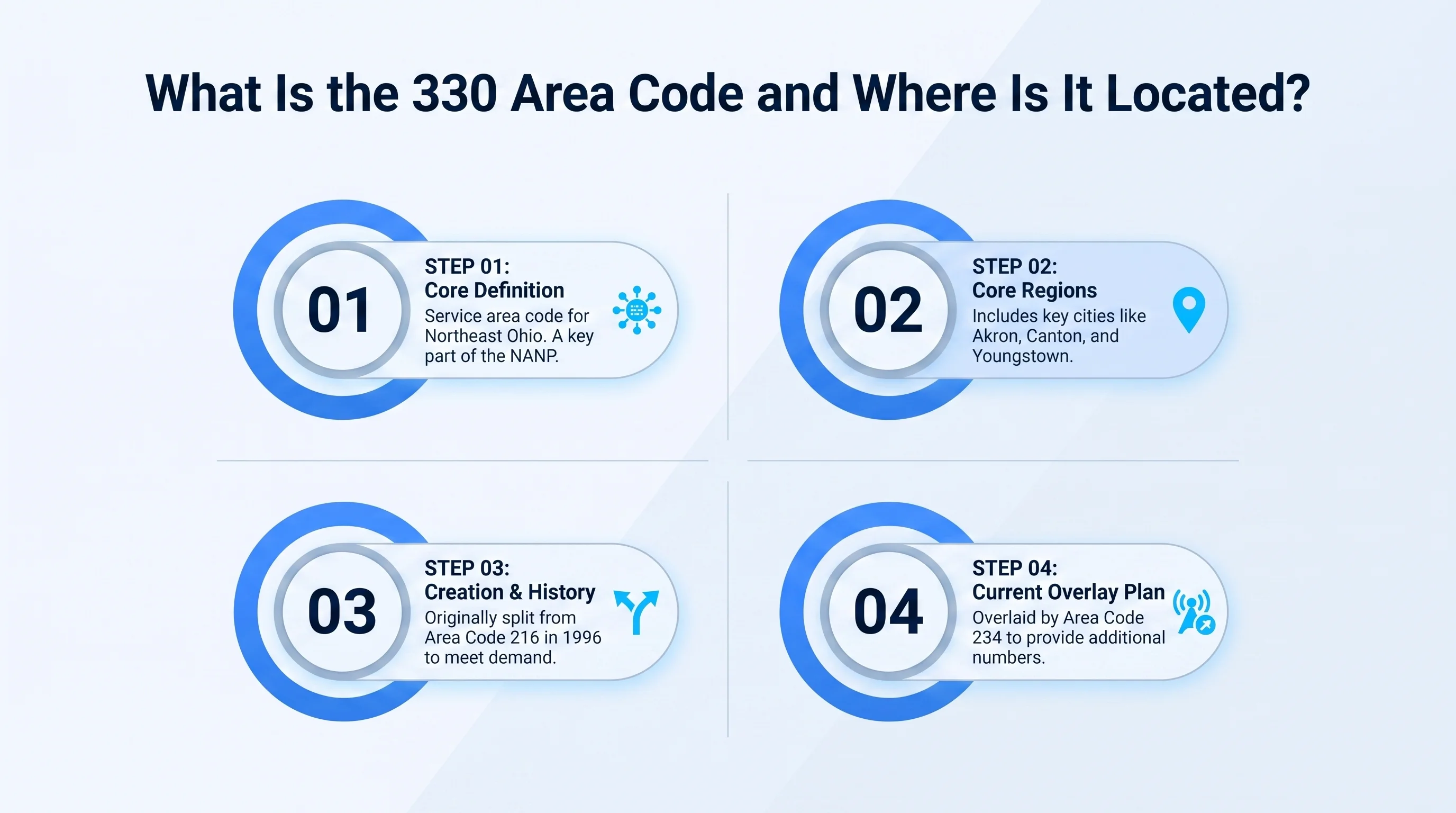
The 330 area code covers a broad stretch of northeastern Ohio, anchored by Akron to the north and extending east through Youngstown toward the Pennsylvania border. It serves a mix of large urban centers, mid-sized industrial cities, and surrounding suburban communities across multiple counties.
Several neighboring area codes border the 330 region. The 216 area code covers Cleveland and the surrounding Cuyahoga County suburbs to the northwest. Area code 440 handles the suburban ring west and south of Cleveland. Area code 740 covers southeastern Ohio to the south. Area code 234 — the official overlay for 330 — covers the exact same geographic territory and was introduced in 2009.
The region carries a powerful industrial identity that still shapes its economy today. Akron earned global recognition as the "Rubber Capital of the World" through tire companies like Goodyear, Firestone, and BFGoodrich. Canton is home to the Pro Football Hall of Fame. Youngstown was one of America's premier steel-producing cities throughout most of the 20th century.
330 Area Code Quick Facts
| Detail | Information |
|---|---|
| Area Code | 330 |
| State | Ohio |
| Region | Northeastern Ohio |
| Time Zone | Eastern Time (EST / EDT) |
| UTC Offset | UTC-5 (standard) / UTC-4 (daylight saving) |
| Established | 1996 |
| Split From | Area code 216 |
| Overlay Code | 234 (introduced 2009) |
What States Use the 330 Area Code?
The 330 area code is exclusive to Ohio. It covers a defined set of counties in the northeastern portion of the state and does not extend into Pennsylvania, West Virginia, or any other neighboring state. All 330 numbers are assigned within the region's established geographic boundaries.
Which Cities Does the 330 Area Code Cover?
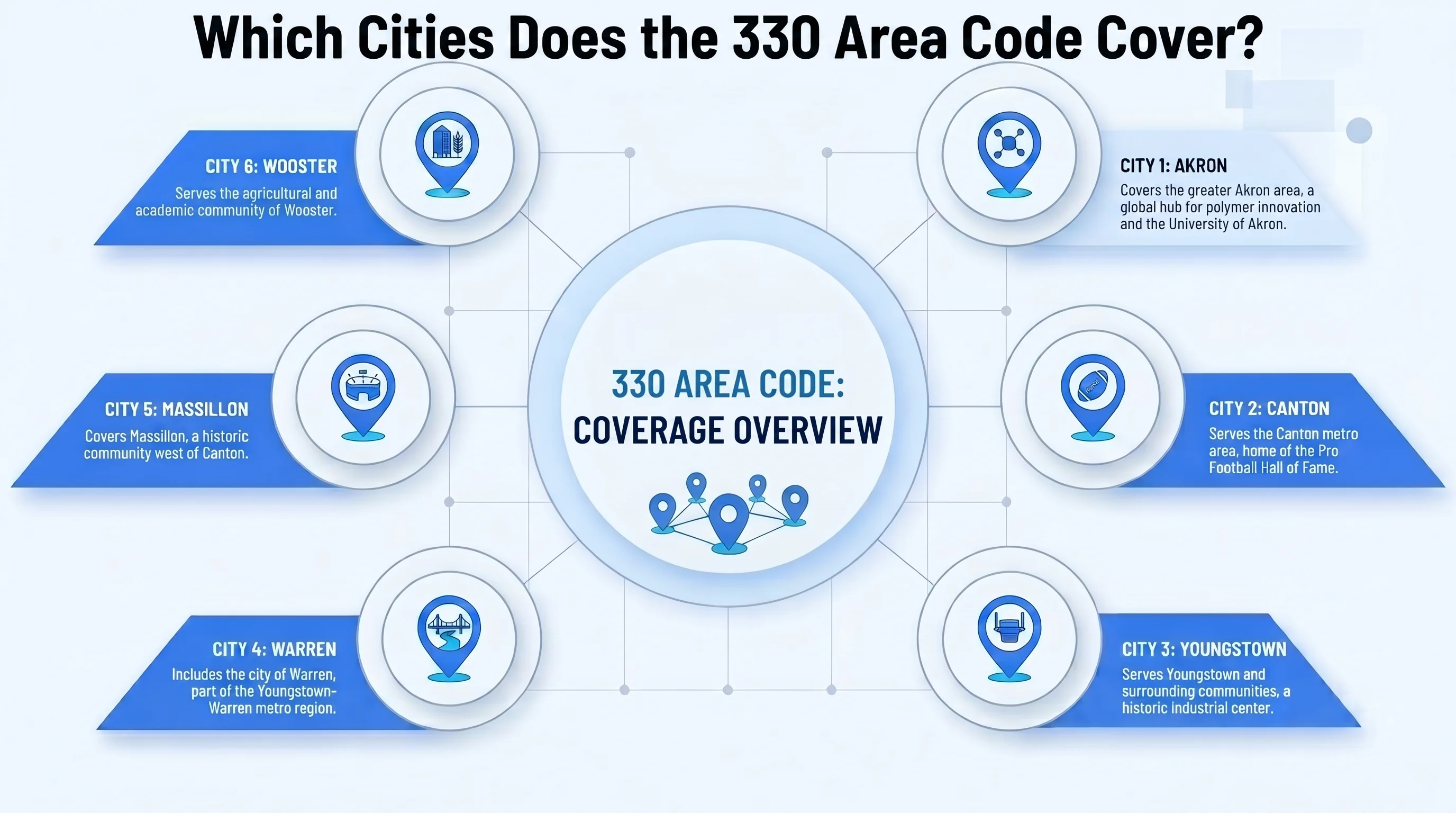
The 330 area code spans a wide range of communities — from major urban centers to mid-sized cities and smaller suburban towns. Here are the most significant communities in the region.
- Akron — The largest city in the 330 zone and the fifth-largest city in Ohio, home to the University of Akron with a modern economy built on healthcare, polymer science research, and higher education after its rubber manufacturing heritage
- Canton — Globally recognized as the home of the Pro Football Hall of Fame, drawing hundreds of thousands of visitors annually with a strong manufacturing base and as the commercial hub of Stark County
- Youngstown — Located in the eastern corner of the 330 region on the Ohio-Pennsylvania border, rebuilding through healthcare, education at Youngstown State University, and community-driven small business investment after its steel era
- Warren — The seat of Trumbull County forming part of the broader Youngstown-Warren metropolitan area with a long history in manufacturing and as an important commercial center for the eastern 330 corridor
- Medina — The county seat of Medina County and one of the fastest-growing suburban communities in northeastern Ohio with a Victorian-era downtown and a strong residential market
- Kent — Home to Kent State University, known for its strong academic programs and the nationally significant events of May 4, 1970, with a vibrant college city arts and entrepreneurship scene
- Massillon — A city in Stark County celebrated for one of the most storied high school football programs in America and a strong small business and manufacturing community
Other notable communities in the region include Barberton, Stow, Wooster, Alliance, Ravenna, and Salem. All calls within the region require 10-digit dialing.
Connect with Northeastern Ohio Today
Targeting Akron manufacturers, Canton businesses, or Youngstown clients? A local 330 phone number instantly signals Ohio credibility — and local-looking numbers get answered far more reliably than out-of-state prefixes.
330 Area Code Time Zone
Every community in the 330 area code operates in the Eastern Time Zone. During standard time, from early November through mid-March, the region runs on Eastern Standard Time (EST) at UTC-5. From mid-March through early November, clocks shift forward to Eastern Daylight Time (EDT) at UTC-4.
This matters when scheduling calls from other parts of the country. Pacific Coast callers are three hours behind — a 9 a.m. California call lands in Akron at noon Eastern. Central Time callers in Chicago are one hour behind. Mountain Time callers are two hours behind the 330 region.
Ohio follows federal daylight saving time rules. Clocks spring forward on the second Sunday in March and fall back on the first Sunday in November each year.
The History of the 330 Area Code
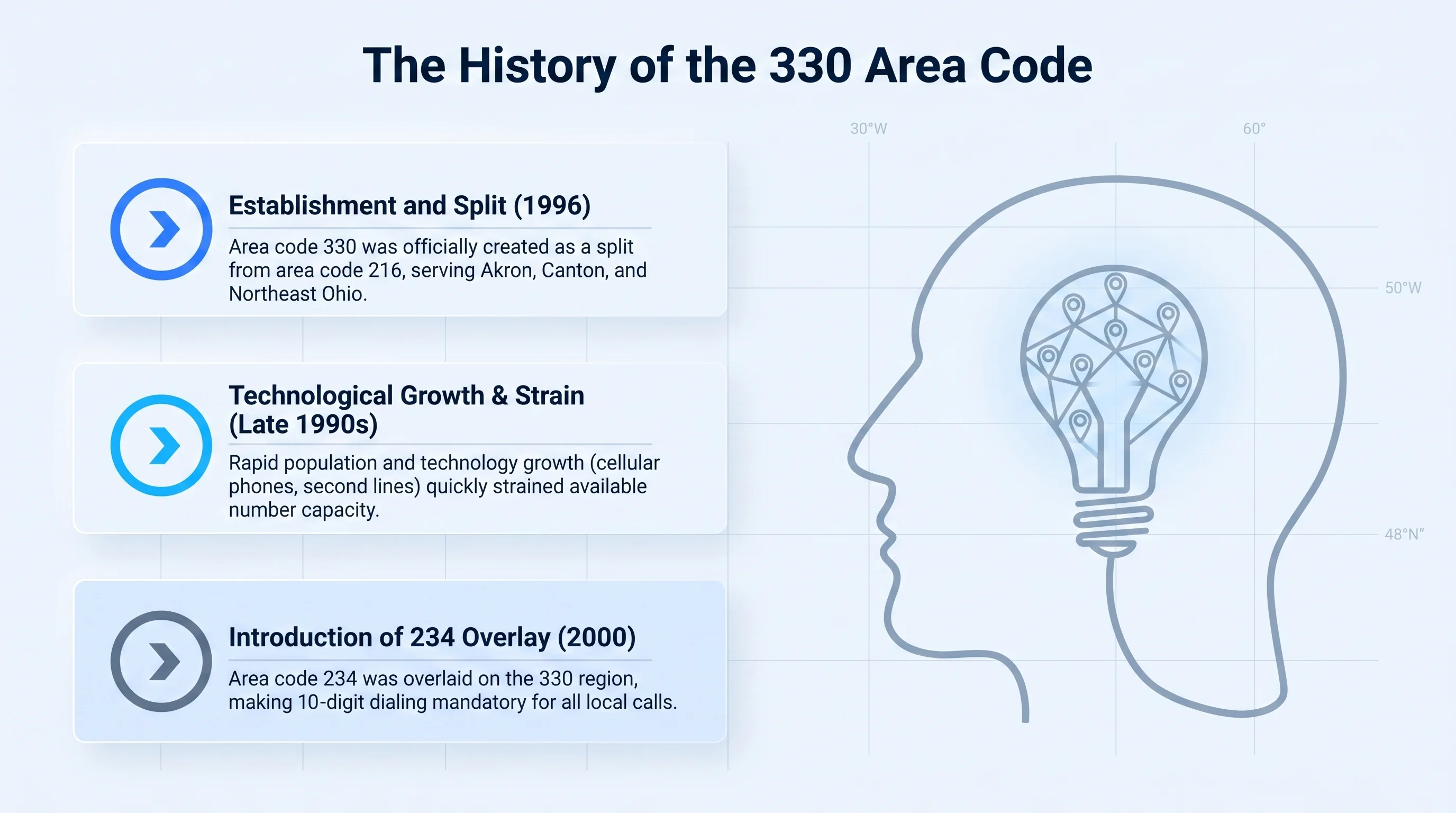
The story of the 330 area code begins with the 216 area code, which originally served all of northeastern and northern Ohio. By the mid-1990s, the rapid growth of mobile phones, fax lines, and internet connections was exhausting the available 216 numbers far faster than the system could manage.
In 1996, area code 330 was carved out of 216 to serve the northeastern Ohio communities outside of Cleveland — including Akron, Canton, and Youngstown. This geographic split gave the region its own dedicated prefix and separated the industrial heartland of northeastern Ohio from the Cleveland metro for the very first time.
The 234 Overlay and 10-Digit Dialing
By 2009, the pool of available 330 numbers had tightened enough to require action. Rather than a geographic split, regulators introduced area code 234 as an overlay — covering the exact same cities and counties as 330. New subscribers began receiving 234 numbers, while all existing 330 lines remained unchanged.
The overlay triggered mandatory 10-digit dialing across the entire service area. Today, area code 330 and 234 operate side by side across the same northeastern Ohio geography, with both codes treated identically by carriers and call recipients throughout the region.
330 Area Code Scam Calls: Stay Protected
Like every active U.S. area code, 330 numbers are exploited by scammers who use caller ID spoofing to display a fake local number and increase answer rates. Common scam types in the 330 region include fake utility disconnect notices, Medicare fraud targeting older residents, and IRS impersonation schemes.
Here are practical steps to protect yourself:
- Let unknown 330 numbers go to voicemail. Legitimate businesses and government agencies always leave a message rather than hanging up.
- Verify before acting. If a caller claims to represent a utility company, bank, or government office, hang up and call the organization's official number directly.
- Use a spam-detection app. Most U.S. carriers support STIR/SHAKEN call authentication, and many apps offer real-time 330 spam screening at no extra cost.
- Report suspicious calls to the FTC at reportfraud.ftc.gov or through your carrier's spam-reporting feature.
Scam calls are not a reflection of the broader region. The overwhelming majority of calls from the 330 area code originate from legitimate Ohio residents, healthcare providers, businesses, and universities operating across northeastern Ohio every day.
How to Get a 330 Phone Number
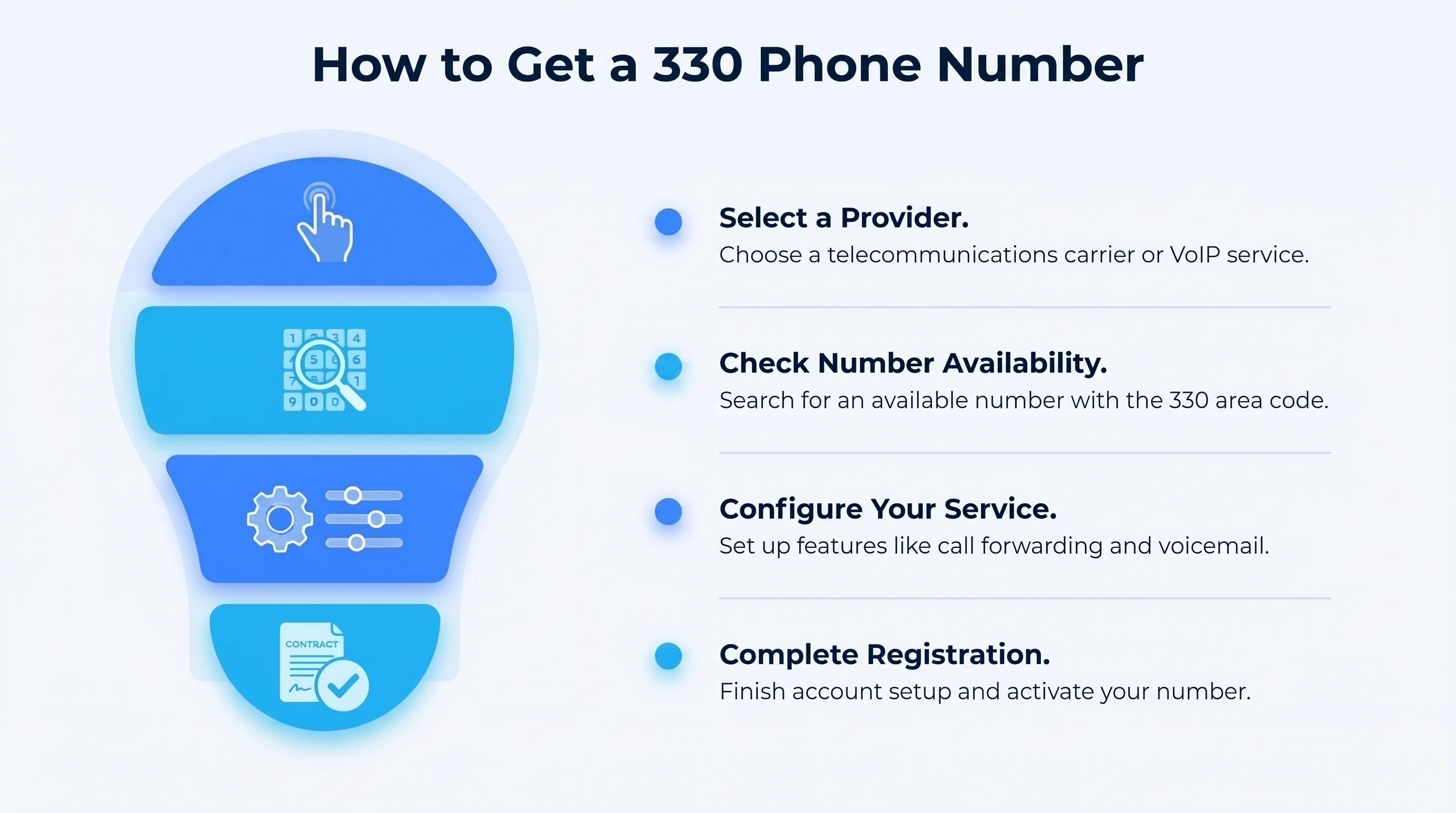
Getting a local 330 phone number is straightforward — no Ohio address, no carrier store, and no long-term commitment required. Modern VoIP platforms and virtual phone apps make it fast from any device.
Choose a VoIP Provider or Virtual Phone App
Select a platform that lets you browse available numbers by area code with no Ohio residency requirement. Virtual apps add a 330 prefix to your existing smartphone instantly — no SIM swap or hardware changes needed.
Pick a Plan and Select Your 330 Number
Most providers offer affordable monthly subscriptions that scale with call volume, team size, and feature needs. Filter available numbers by area code 330 and choose the one that fits your brand or business best.
Activate and Start Calling Immediately
Configure voicemail, call forwarding, and any business call-handling rules. Your 330 number activates right after setup and works on any device — phone, tablet, or computer — from any location in the world.
Who Benefits Most from a 330 Number?
Healthcare providers, manufacturing suppliers, and professional services firms targeting Akron, Canton, or Youngstown clients gain instant credibility with a local 330 prefix. Remote sales teams reaching northeastern Ohio businesses project genuine regional presence from day one. Entrepreneurs and freelancers serving the 330 market build trust with customers who respond to familiar local numbers from their own region. The same pattern holds in other Midwest industrial markets, including the 315 area code covering central New York.
Why Businesses Choose the 330 Area Code
Northeastern Ohio is a region with deep economic roots and a resilient business community. Akron's polymer research sector, Canton's manufacturing economy, and Youngstown's growing healthcare and education hubs represent active markets for businesses of every size.
Having a 330 phone number signals to customers that you are local, invested, and part of the community. Research consistently shows local-looking numbers outperform toll-free and out-of-state numbers in call answer rates — a gap especially significant in close-knit Midwestern communities where local identity directly influences purchasing decisions.
Virtual area code 330 numbers route calls to any device globally. Distributed teams can project a credible northeastern Ohio presence without the cost of a physical Akron or Canton office — making a local 330 number one of the most practical and high-value investments for any business targeting the Ohio manufacturing and healthcare corridor.
For an authoritative overview of how area codes are managed nationally, see the NANPA records on numbering plan administration.
Conclusion
The 330 area code has served northeastern Ohio since 1996, connecting Akron, Canton, Youngstown, and dozens of communities across a region defined by industrial heritage and ongoing economic reinvention. It operates in the Eastern Time Zone, shares its territory with the 234 overlay introduced in 2009, and covers some of the most historically significant cities in the Midwest. Whether you were identifying a caller or researching how to enter the northeastern Ohio market, this guide has given you the complete picture.
Getting a 330 phone number is now faster and simpler than ever with modern virtual platforms that require no Ohio address and no long-term carrier contract. A local number builds immediate trust with Akron businesses, Canton manufacturers, and communities across the 330 area code corridor that respond strongly to regional identity. You do not need to live in northeastern Ohio to project that credibility — a VoIP provider puts any area code 330 number in your hands within minutes. Take the next step and claim your northeastern Ohio number today.
Download the CallMama App
A northeastern Ohio area code speaks before you say a word — grab a virtual 330 number and connect with Akron, Canton, and Youngstown like a true local. No Ohio address required, no long-term commitment.
