Introduction
The 240 area code covers the western and southern regions of Maryland, serving millions of residents across some of the state's fastest-growing cities and counties. Whether you've received an unfamiliar call from a 240 area code number or need to establish a credible local presence for your business, understanding this dialing code gives you a real edge. This guide walks through the full history, every major city and county in the coverage zone, the time zone it operates on, scam awareness tips, and exactly how to get a 240 phone number for personal or professional use. By the end, you'll have everything you need to engage confidently with this vibrant corner of Maryland's communications network.
Key Takeaways
- The 240 area code serves western and southern Maryland, including Rockville, Bethesda, Frederick, Silver Spring, and Gaithersburg.
- It launched on June 1, 1997, as an overlay for the original 301 area code to meet surging phone demand.
- All 240 numbers operate on Eastern Time — UTC-4 (EDT) in summer and UTC-5 (EST) in winter.
- Scammers frequently spoof 240 numbers to appear local; never pay by gift card or wire when pressured by an unknown caller.
- You can get a virtual 240 phone number from anywhere in the world through a modern VoIP app.
What Is the 240 Area Code?
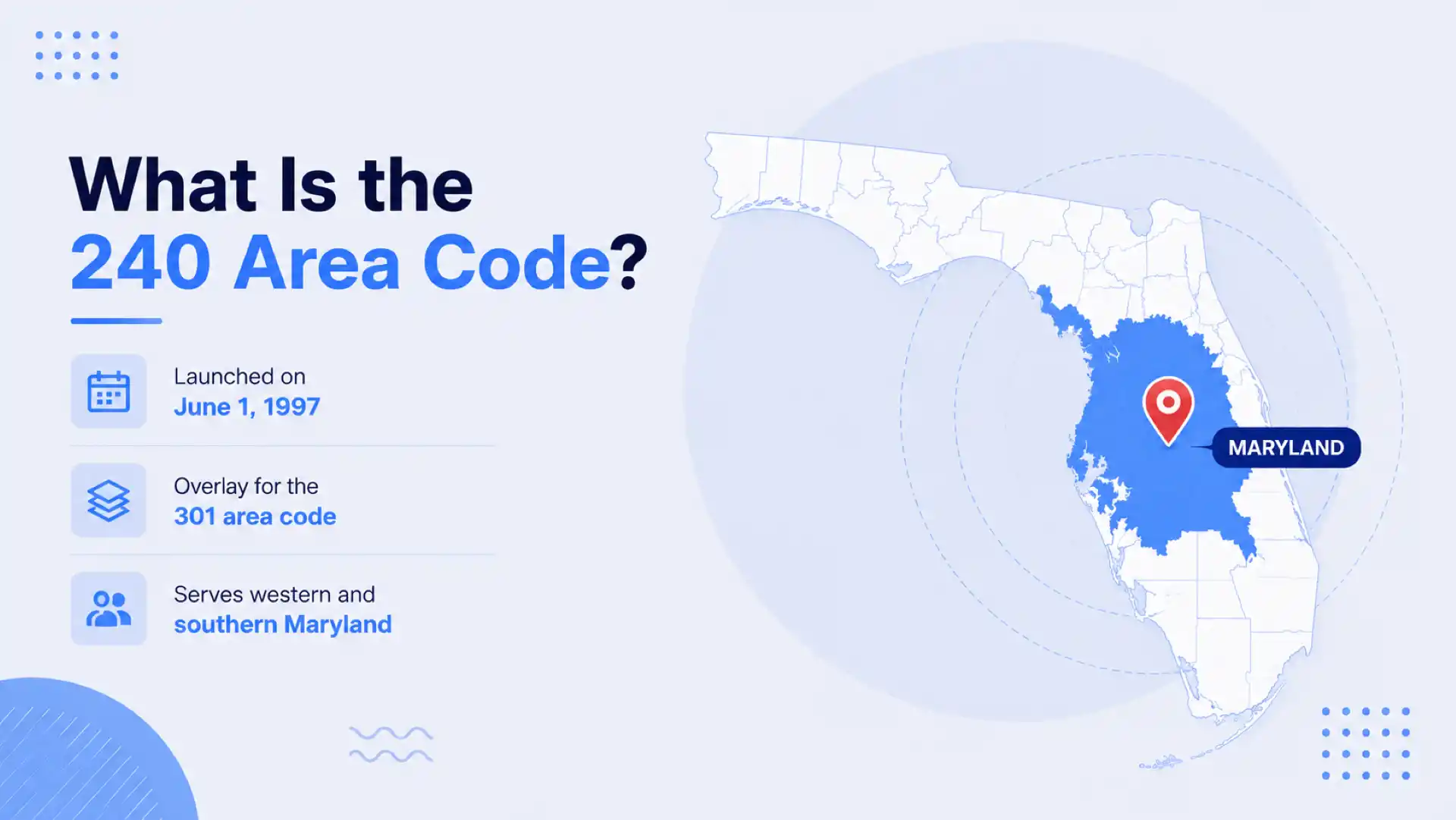
The 240 area code is an official North American Numbering Plan (NANP) code assigned to western and southern Maryland. It launched on June 1, 1997, as an overlay for the 301 area code, which had served all of Maryland since 1947. In an overlay arrangement, two codes share the same geographic territory — so neighbors in Rockville or Gaithersburg may have different area codes depending on when they originally signed up for phone service.
The need for this overlay arose from a wave of phone demand driven by the rapid spread of cell phones and pagers, particularly across the Washington, D.C. suburbs. The existing 301 code was heading toward exhaustion, and the overlay model allowed 301 holders to keep their numbers while new subscribers received fresh 240 digits.
By June 2023, demand had grown enough that regulators added a third overlay — area code 227 — to the same Maryland territory. All three codes now serve the same communities, reflecting just how much this region's communications needs have expanded since the 1990s.
Where Does Area Code 240 Apply in Maryland?
The 240 area code covers a broad stretch of Maryland's western and southern regions. Its service zone spans from the dense Washington, D.C. suburbs in the east to the Appalachian mountain communities of far western Maryland — capturing bustling urban centers and quiet rural towns under a single dialing prefix.
Major Cities in the 240 Coverage Zone
Some of the best-known cities in this service zone include Rockville (the county seat of Montgomery County and a major government hub), Bethesda (a wealthy D.C. suburb internationally recognized for biomedical research), and Gaithersburg (one of Maryland's largest incorporated cities). The region also includes Silver Spring, Frederick (Maryland's second-largest city), Germantown, Waldorf, Hagerstown, Cumberland, College Park, and Greenbelt.
These communities range from dense metropolitan areas just miles from the White House to historic towns tucked into the western Maryland hills. That geographic variety makes this one of Maryland's most commercially significant and diverse dialing zones — much like the way the 202 area code anchors the District itself.
Maryland Counties in This Service Zone
This overlay code spans 13 to 14 Maryland counties. The most prominent include Montgomery County (the state's most populous), Prince George's County (home to the University of Maryland and NASA's Goddard Space Flight Center), Frederick County, Charles County, Howard County, and Allegany County in far western Maryland.
Montgomery and Prince George's counties together form the backbone of the D.C. suburbs, making this a primary dialing zone for millions of residents and tens of thousands of businesses operating across the western half of the state.
Get a Local Maryland Number
A local number gets answered — out-of-state lines get ignored. A virtual 240 number gives you instant credibility with Maryland customers.
Time Zone for 240 Numbers
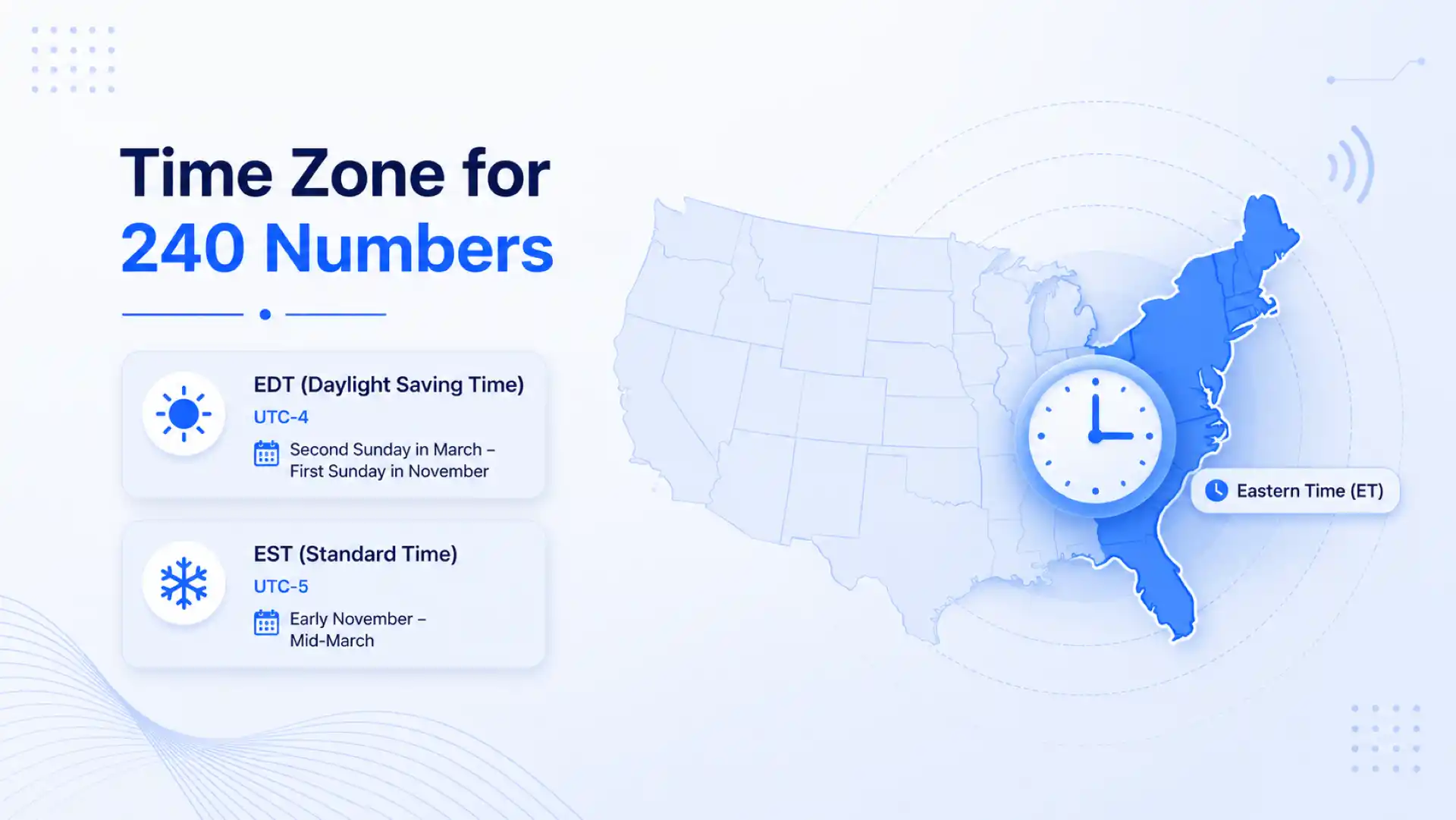
All 240 numbers operate on Eastern Time (ET). During the summer months, Maryland runs on Eastern Daylight Time (EDT) at UTC-4. From early November through mid-March, the state shifts to Eastern Standard Time (EST) at UTC-5. Clocks move forward on the second Sunday in March and back on the first Sunday in November, following the federal Daylight Saving Time schedule.
If you're calling Maryland from the West Coast, there's a three-hour time gap during daylight saving months. Standard business hours in this region fall between 9:00 AM and 5:00 PM ET — meaning 6:00 AM to 2:00 PM in Los Angeles and roughly 2:00 PM to 10:00 PM in London. Keeping this gap in mind helps you reach Maryland contacts at the right time and get more out of every call — a scheduling consideration similar to coordinating with businesses in the 919 area code region of North Carolina.
Are 240 Calls Legitimate or a Scam?
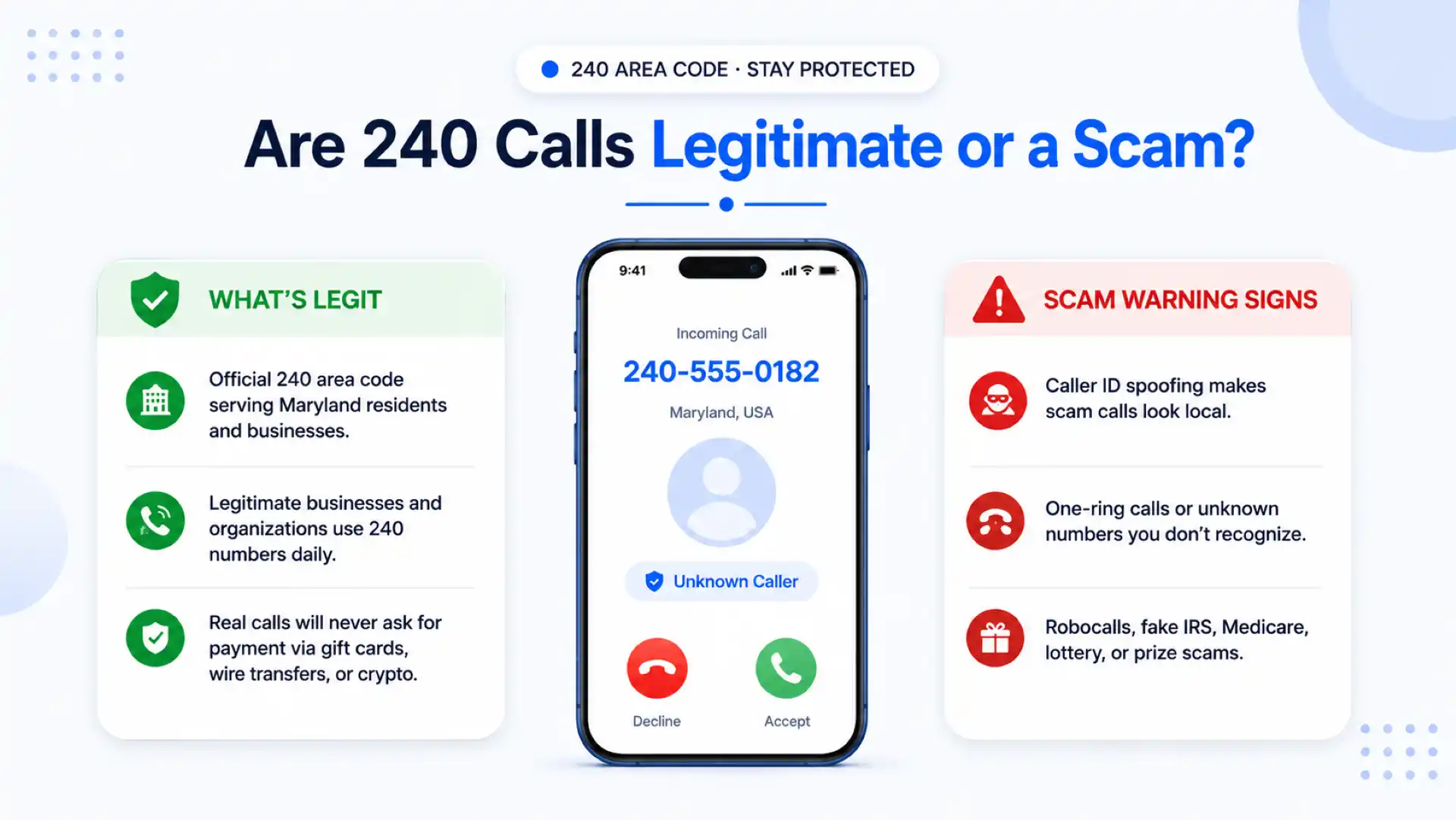
The 240 area code is completely legitimate — an officially recognized NANP code serving verified residents and businesses across Maryland. Scam concerns stem from caller ID spoofing, a technique that lets bad actors disguise their real number and display a familiar-looking local Maryland number instead. Since local calls get answered far more often than unfamiliar out-of-state lines, scammers exploit recognizable codes to maximize their answer rates.
Common Scam Call Types to Watch For
Call-tracking services report that the most frequently spoofed Maryland call types include political robocalls (roughly 15% of all complaints), Medicare and Medicaid solicitations, health insurance pitches, mortgage loan offers, and auto warranty scams. IRS and Social Security Administration impersonators also routinely use local number spoofing to make their schemes appear credible.
How to Protect Yourself
No legitimate organization will ever demand payment by gift card, wire transfer, or cryptocurrency over the phone. If a number rings once and immediately disconnects, do not call back — this is the one-ring scam, designed to connect you to a premium-rate line that charges your carrier account without consent. Verify any suspicious number using a free reverse phone lookup tool, and report persistent offenders to the FTC.
How to Get a 240 Phone Number
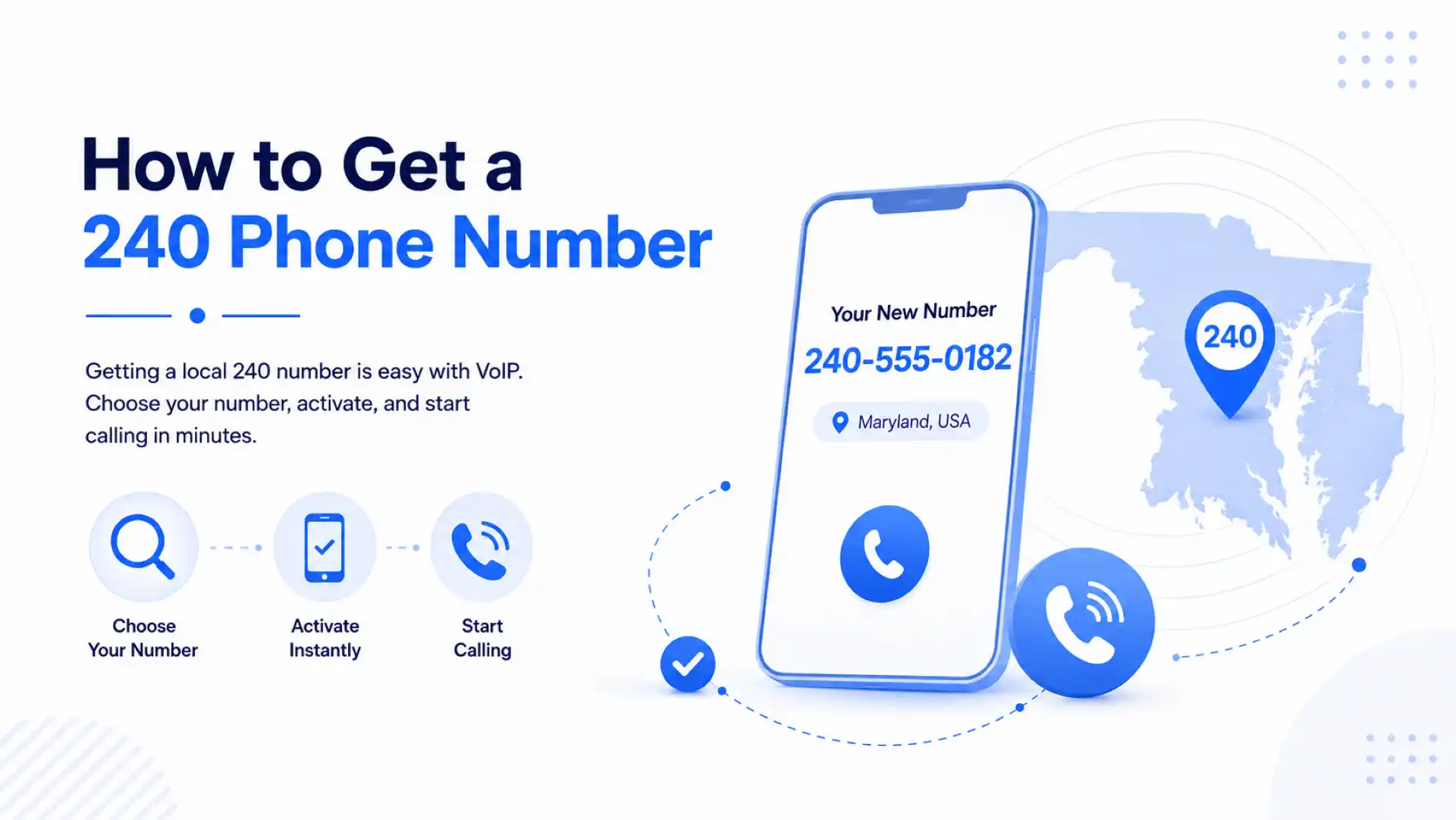
Getting one no longer requires living in Maryland or signing a long-term carrier contract. Modern VoIP (Voice over Internet Protocol) technology allows anyone to get a local Maryland number from anywhere in the world. Most providers let you search available numbers, select one with a 240 prefix, and start making calls within minutes — all through an app on your smartphone or desktop computer.
Once active, your number handles calls and texts just like a standard mobile plan. Many services also support number portability, so you can carry your number to a different provider if needed.
Why Businesses Choose a 240 Phone Number
A local 240 phone number carries real commercial advantages for any business targeting the Maryland market. Research consistently shows that local-looking numbers achieve significantly higher answer rates than toll-free or out-of-state alternatives. A Maryland area code tells customers you're present, accessible, and invested in their community — before a single word is spoken.
The benefits extend beyond answer rates. A consistent local number displayed across your website, Google Business Profile, and business directories strengthens your local SEO signals. Search engines use consistent Name, Address, and Phone (NAP) data as a trust indicator, and a stable Maryland number helps anchor that credibility in local search results.
Real estate agents, healthcare providers, legal professionals, and remote customer service teams across the country use virtual Maryland numbers to build immediate trust with local customers. Even businesses based entirely outside the state rely on them to establish a meaningful presence in Montgomery County and Prince George's County — two of the most active commercial markets in the mid-Atlantic.
Conclusion
The 240 area code connects millions of Marylanders across 13 counties — from the biotech corridors of Bethesda to the mountain communities of Cumberland. This guide has covered its 1997 origins as an overlay for 301, the cities and counties it serves, the Eastern Time Zone it runs on, and the scam awareness steps every caller should know.
For businesses looking to connect with Maryland customers, a virtual 240 number is one of the most cost-effective moves available. It boosts answer rates, builds local trust, and strengthens search visibility — all on a timeline measured in minutes. Claim one today and turn Maryland prospects into loyal, long-term customers.
Download the CallMama App
A Maryland number customers recognize could be the edge your business is missing. Claim a local 240 number in minutes with CallMama.
