Introduction
Few stretches of the American South carry the same mix of natural beauty and economic muscle as the Mississippi Gulf Coast. From the casino resorts lining Biloxi's beachfront to the naval shipyards in Pascagoula and the busy cargo docks of Gulfport, the 228 area code ties together one of the most dynamic coastal regions in the country.
This guide goes beyond the basics. You will find the exact counties and cities the code covers, the time zone, the full story of its 1997 creation, how to dial correctly, and the quickest way to secure your own local 228 phone number — whether you live on the Gulf Coast or target it from across the country.
Key Takeaways
- The 228 area code covers all three Gulf Coast counties in Mississippi — Harrison, Jackson, and Hancock — serving roughly 400,000 residents.
- It was created on March 22, 1997, when it split from the original 601 area code that once covered the entire state.
- The entire region operates on Central Time (CST/CDT) — one hour behind the Eastern Time Zone.
- Scammers do spoof Gulf Coast numbers, so always verify unexpected callers before sharing any personal information.
- You can get a virtual 228 phone number in minutes — no Mississippi address, no SIM card, no carrier contract required.
What Is the 228 Area Code?
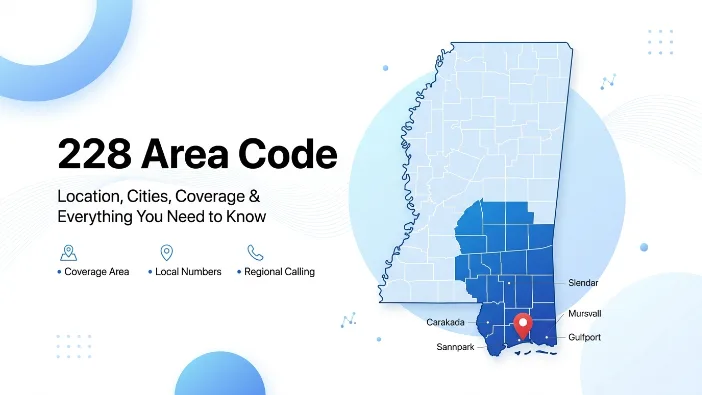
The 228 area code is a North American Numbering Plan (NANP) telephone prefix assigned exclusively to the three southernmost counties of Mississippi — Harrison, Jackson, and Hancock — all of which sit directly on the Gulf of Mexico. It is one of three active codes serving Mississippi, alongside 601 (central and southern inland) and 769 (the 601 overlay).
Every phone number in the Gulf Coast metro begins with 228, making it the shared calling identity for roughly 400,000 residents. From Biloxi's waterfront casino strip to Ingalls Shipbuilding's vast yards in Pascagoula, this prefix connects the entire coastal zone. Here is the code at a glance:
| Attribute | Detail |
|---|---|
| State | Mississippi (MS) |
| Region | Mississippi Gulf Coast |
| Principal city | Biloxi |
| In service since | March 22, 1997 |
| Time zone | Central (CST / CDT) |
| Overlay code | None |
| Population served | ≈ 400,000 |
| Counties covered | Harrison, Jackson, Hancock |
Where Is Area Code 228 Located?
The region hugs the Gulf of Mexico coastline in the far south of Mississippi, stretching roughly 80 miles from the Louisiana border in the west to the Alabama border in the east. Coverage boundaries follow county lines, so both dense urban cores and rural communities share the same 228 prefix. Just across the state line to the east, Mobile and its suburbs dial on the 251 area code, part of the same Gulf Coast corridor.
Counties in the 228 Coverage Zone
- Harrison County — the urban core, home to Biloxi, Gulfport, Long Beach, and Pass Christian
- Jackson County — Pascagoula, Ocean Springs, Gautier, and Moss Point; the industrial anchor of the region
- Hancock County — Bay St. Louis, Waveland, and Diamondhead; the westernmost point in the coverage zone, bordering Louisiana
Major Cities in Area Code 228
Biloxi and Gulfport dominate the region, but a string of distinct communities each add their own character and economic weight:
| City | County | Known For |
|---|---|---|
| Biloxi | Harrison | Casino resorts, Keesler Air Force Base, beach tourism |
| Gulfport | Harrison | Port of Gulfport, retail & commercial hub |
| Pascagoula | Jackson | Ingalls Shipbuilding, industrial manufacturing |
| Ocean Springs | Jackson | Arts community, boutique shops, waterfront dining |
| Bay St. Louis | Hancock | Historic downtown, growing remote-worker destination |
| Long Beach | Harrison | Residential suburb between Biloxi and Gulfport |
| Waveland | Hancock | Westernmost Gulf Coast city, near Louisiana border |
| Pass Christian | Harrison | Antebellum architecture, waterfront community |
Biloxi is also home to Keesler Air Force Base, one of the largest Air Force training installations in the United States — adding a significant military population to the mix and giving the 228 zone a uniquely diverse demographic profile.
Time Zone for the 228 Region
The entire three-county Gulf Coast sits in the Central Time Zone — the same zone as Chicago, Dallas, and New Orleans. That means Central Standard Time (CST, UTC−6) from early November to mid-March, then Central Daylight Time (CDT, UTC−5) while daylight saving time is active.
Calling the Gulf Coast from New York (Eastern Time)? The region is one hour behind. From Los Angeles (Pacific Time), the Gulf Coast is two hours ahead. Standard local business hours run 9 AM to 5 PM Central — keep that in mind when scheduling calls across time zones.
History of Area Code 228
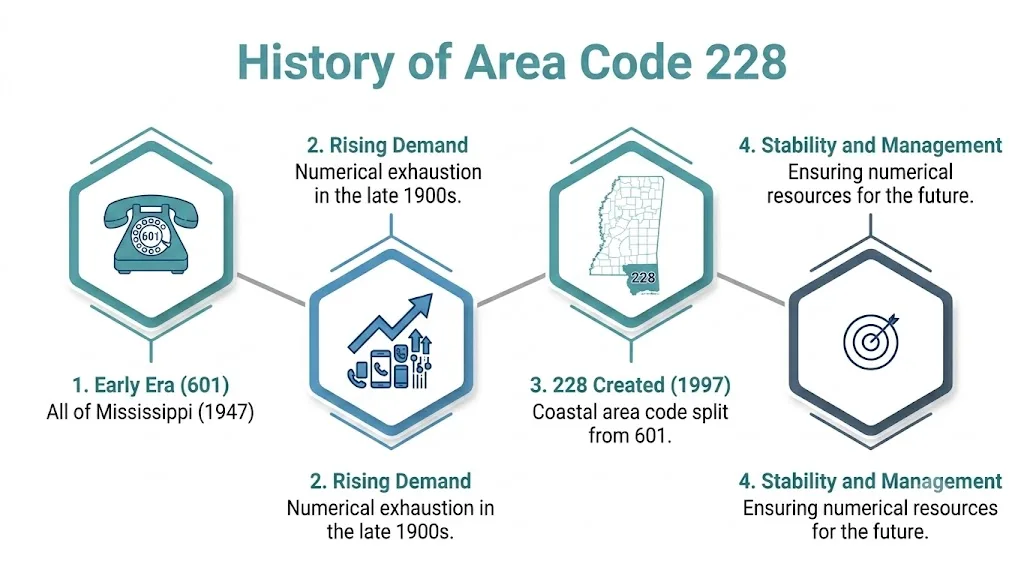
Before 1997, the entire state of Mississippi operated under a single telephone prefix: 601. From Tupelo in the north to Biloxi on the coast, every Mississippi phone number began with those three digits. Through the late 1980s and early 1990s, the Gulf Coast experienced rapid development — casino gambling was legalized in 1990, triggering a construction boom that brought new hotels, businesses, and residents.
At the same time, mobile phones, fax machines, and internet dial-up connections were multiplying the demand for new phone numbers. The 601 number pool began running short on available combinations, and regulators needed to act.
The 1997 Split from Area Code 601
On March 22, 1997, the Mississippi Public Service Commission and the North American Numbering Plan Administrator (NANPA) executed a geographic split. The 601 code retained coverage of central and southern inland Mississippi — including Jackson, the state capital. The three Gulf Coast counties received the newly created 228 area code.
The transition was significant for Gulf Coast businesses, which had to update signage, directories, and marketing materials. Within a few years, however, 228 became a point of regional pride — an identifier that distinguished the coastal strip from the rest of the state. Then came Hurricane Katrina in August 2005, which devastated the Gulf Coast. The subsequent rebuild brought new residents, new businesses, and renewed investment — all of which reinforced the 228 code's role as the calling identity of a resilient and growing region.
How to Dial a 228 Phone Number
The FCC's nationwide 10-digit dialing mandate means every call — local or long-distance — now requires the full prefix plus the seven-digit number. Here is the correct format for each call type:
| Call Type | Format | Example |
|---|---|---|
| Local call (within 228) | Area code + 7-digit number | 228-555-0147 |
| Long-distance (within the US) | 1 + area code + number | 1-228-555-0147 |
| International call to 228 | Exit code + 1 + 228 + number | +1-228-555-0147 |
Quick rule
Local call on the Gulf Coast? Dial 228 + number (e.g., 228-555-0147). Long-distance from elsewhere in the US? Add a 1 in front (1-228-555-0147). Calling from abroad? Use +1-228-XXX-XXXX.
Industries & Economy in the 228 Region
The Gulf Coast counties served by the 228 code run on one of the most economically diverse engines in the American South. Local numbers power communication across every major sector:
- Gaming & tourism: Biloxi's casino strip draws millions of visitors each year, making tourism one of the region's top revenue drivers and employing tens of thousands of workers.
- Military: Keesler Air Force Base in Biloxi is one of the largest Air Force technical training centers in the country, supporting a sizable active-duty, civilian, and contractor workforce.
- Shipbuilding & defense: Ingalls Shipbuilding in Pascagoula is one of the nation's largest employers of shipbuilders, constructing destroyers and amphibious ships for the U.S. Navy.
- Port logistics: The Port of Gulfport handles millions of tons of cargo annually — bananas, hardwood products, and containerized freight — making it a critical link in Gulf Coast supply chains.
- Healthcare: Memorial Hospital at Gulfport and Singing River Health System in Pascagoula are among the region's largest employers, generating significant daily call volume across their networks.
- Higher education: The University of Southern Mississippi's Gulf Park campus in Long Beach and William Carey University in Biloxi add an educational dimension to the local workforce.
Whether you run a law firm, a logistics company, or a remote sales team targeting Mississippi clients, a local 228 number is the credibility signal that gets your calls answered. Pair it with call forwarding, custom caller ID, and two-way SMS for a full local phone presence — regardless of where you actually sit.
How to Get a 228 Phone Number
Getting a local Gulf Coast number no longer requires a Mississippi address or a carrier contract. Here is how the main options compare:
| Method | Best For | Speed | Notes |
|---|---|---|---|
| Virtual phone number | Anyone, anywhere | Under 60 seconds | No SIM, no address, works on any device |
| Traditional carrier | Mississippi residents | 1–5 days | Requires a local address & contract |
| Number porting | Keep your existing number | 3–7 days | Transfer your current number to a new provider |
| Prepaid SIM | Short-term local use | Same day | Limited features, must be physically in the US |
For most users, a virtual phone number is the fastest and most flexible route. Here is the full process:
Download the app or open the website
Sign up for a free account — no credit card needed to get started.
Search for 228
Select the United States, then type "228" to see available Gulf Coast numbers.
Pick your number
Browse live inventory and choose a number that fits your brand or preference.
Choose a plan & activate
Select your plan, confirm, and your new line goes live immediately — ready for calls and texts.
Get Your Local Gulf Coast Number
Sound local across Biloxi, Gulfport, and the Mississippi Gulf Coast from anywhere. Activate a 228 number in under a minute — no SIM, no contract.
Why a Gulf Coast Number Helps Your Business
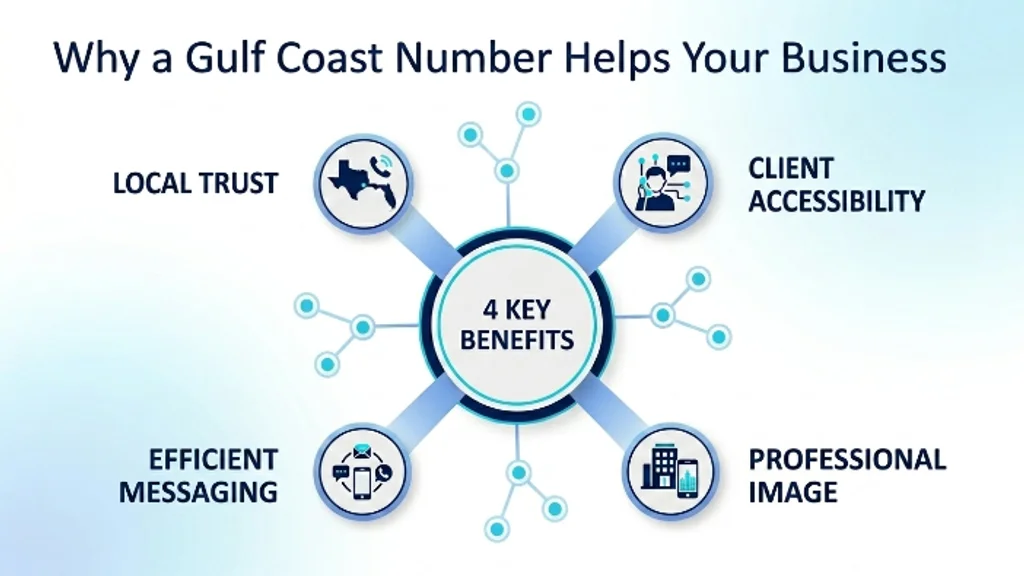
A local area code is one of the most underrated assets a business can own. For companies serving the Mississippi Gulf Coast, a 228 phone number delivers measurable advantages:
- Higher answer rates: People are far more likely to pick up a call from a recognizable 228 number than from an unfamiliar out-of-state or toll-free line.
- Instant local credibility: A Gulf Coast prefix tells customers you are part of their community — not a distant call center they have never heard of.
- Stronger local SEO: A consistent 228 number across your Google Business Profile, website, and directories reinforces your local-pack rankings in Biloxi and Gulfport searches.
- Better marketing ROI: Local numbers on billboards, digital ads, and social profiles convert better because they feel familiar and relevant to the reader.
- Privacy for your personal line: Advertise a dedicated business number while keeping your real cell unlisted and protected from unwanted calls.
- Military & government outreach: In a region with a large military presence at Keesler and a significant government contractor base, a local prefix signals legitimacy and accessibility.
National brands use 228 numbers to enter the Gulf Coast market without a physical office, while local businesses use them to look established and reachable — much like companies build trust with the 985 area code across coastal Louisiana.
Are 228 Calls a Scam? Spotting & Avoiding Fraud
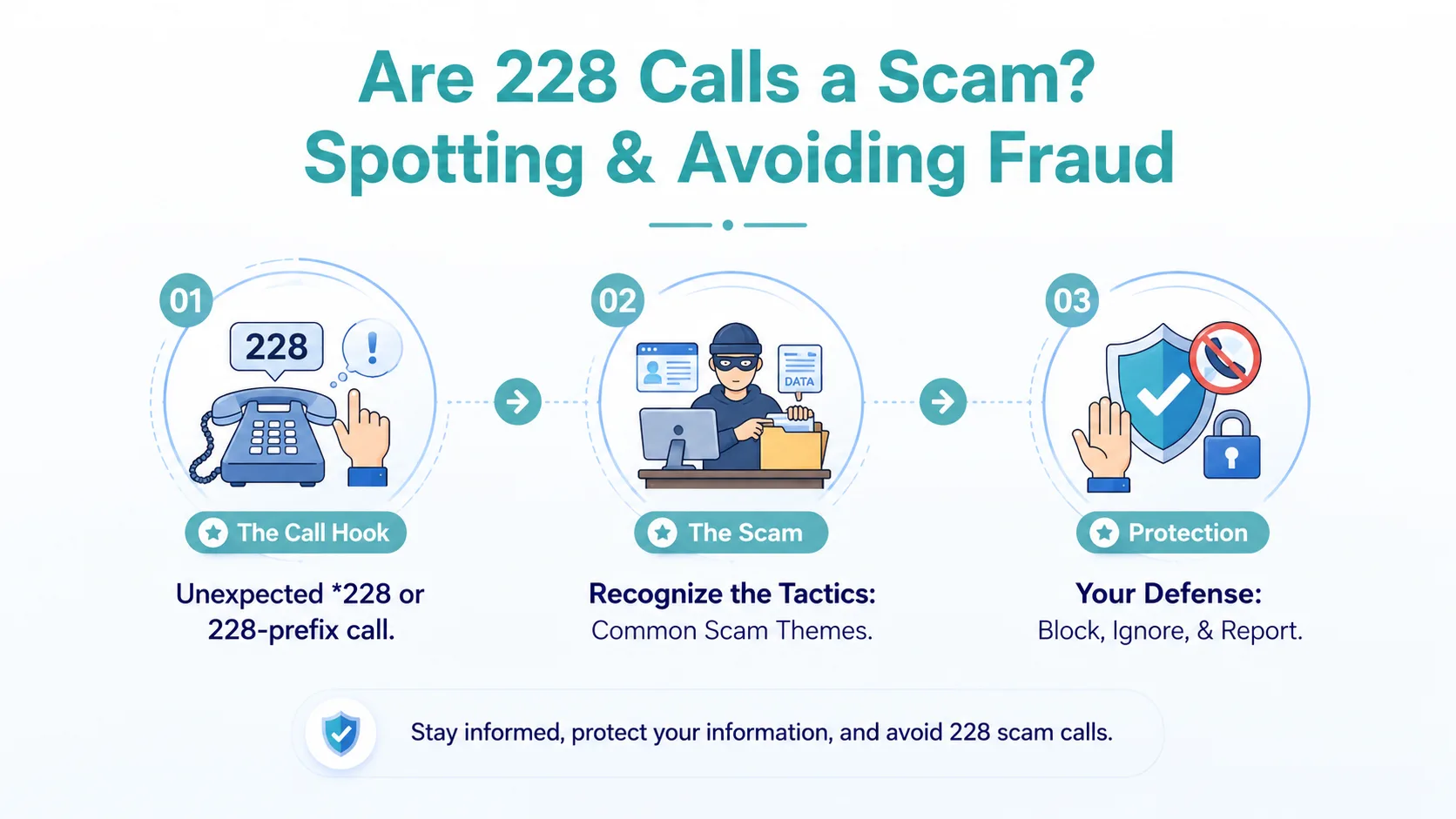
No — 228 is the legitimate calling prefix for the Mississippi Gulf Coast. That said, scammers can spoof any area code, including 228, to make a call appear local. The number displayed on your screen is never proof of who is actually calling.
Protect yourself with a few straightforward habits:
- Never share sensitive details — Social Security numbers, bank account information, or one-time passcodes — with anyone who called you unexpectedly.
- Verify independently. If a caller claims to be your utility company or a government agency, hang up and call the official number from their website or your bill.
- Be wary of urgency. Threats, deadlines, and "act immediately" pressure are classic fraud tactics designed to stop rational thinking.
- Use call-blocking tools like Hiya, Truecaller, or Nomorobo, and register your number with the National Do Not Call Registry.
- Report fraud to the FTC to help protect others in the Gulf Coast region.
Virtual numbers from certified providers are real, NANPA-assigned lines routed through carrier-grade infrastructure that passes STIR/SHAKEN verification — so your outbound calls display a clean, trustworthy caller ID, never a "Spam Likely" warning.
Why Use a Virtual Provider for Your 228 Number
You can get a Gulf Coast number from several providers, but CallMama is built for speed, flexibility, and value:
- Live in under a minute — no SIM swap, no Mississippi address, no carrier visit required.
- Works everywhere — make and receive calls and texts on iOS, Android, and the web portal.
- Smart calling built in — call forwarding, voicemail-to-email, call recording, and custom caller ID included.
- Two-way SMS & MMS — text customers and receive verification codes on your local 228 line.
- Keep it forever — your number stays yours, and you can cancel anytime with no penalty or lock-in.
Ready to claim your spot on the Mississippi Gulf Coast? Get a 228 Biloxi number in minutes, or browse every US area code if you need a different city.
Conclusion
The 228 area code is far more than a dialing prefix — it is the calling identity of the Mississippi Gulf Coast, serving roughly 400,000 people across three counties that have rebuilt, diversified, and continued growing for decades. From Biloxi's casino economy and Keesler Air Force Base to the naval shipyards in Pascagoula and the busy cargo docks of Gulfport, understanding this code's coverage, time zone, and dialing rules helps you communicate more strategically and build a trusted local presence in one of the South's most resilient metros.
The best part? You no longer need to live on the coast to own a piece of it. With a virtual 228 phone number, you can project a strong Gulf Coast presence from anywhere on Earth — activated in under a minute and ready to scale with your business.
Download the CallMama App
Make calls, send texts, and manage your Gulf Coast number from anywhere — on iOS, Android, or the web. No SIM required.
