Introduction
Every city has a phone code. Los Angeles has many. But only one was there from the beginning: area code 213. It is the number LA was born with in 1947, the same year the entire North American Numbering Plan was created. What started as a code for all of California — and even stretching across much of the American West — has been whittled down through decades of splits until it now covers the beating urban heart of the city: Downtown Los Angeles, Koreatown, Westlake, and the dense neighborhoods of Central LA. Whether you are researching a call you received, curious about the city, or want a 213 phone number for Los Angeles, this guide covers everything you need to know about the 213 area code.
Key Takeaways
- The 213 area code covers Downtown Los Angeles, Koreatown, Westlake, and Central LA.
- It is one of the original 86 area codes established on January 1, 1947 — among the oldest in North America.
- 213 once covered all of California; decades of geographic splits reduced it to today's compact urban core.
- The 323 area code split from 213 in June 1998, taking Hollywood, East LA, and South LA.
- The entire region runs on Pacific Time (UTC−8 / UTC−7 daylight saving).
- 10-digit dialing is required for all calls in the LA metro area.
- A 213 number carries genuine prestige — it is LA's original prefix, predating all other LA codes by decades.
The 213: Los Angeles's First Phone Code
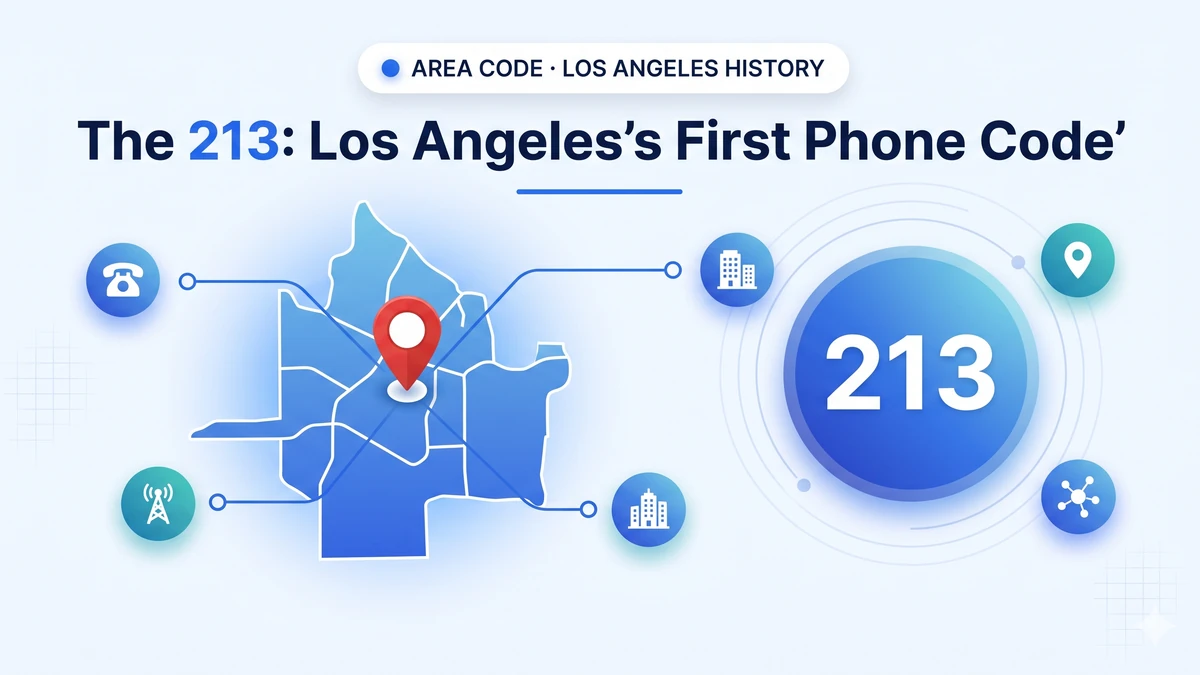
The 213 area code is a geographic telephone area code in the North American Numbering Plan (NANP) assigned to the urban core of Los Angeles, California. Unlike the newer LA codes that were carved out over the years — 310 for the Westside, 323 for Hollywood, 818 for the Valley — 213 is the one that was always there.
It is a standard geographic code. A 213 number is the phone identity of lawyers in the financial district, restaurateurs in Koreatown, artists in the Arts District, families in Pico-Union, and tech workers in the rising South Park neighborhood — all under the one prefix that has represented Los Angeles since telephones first went long-distance.
Where the 213 Sits on the LA Map
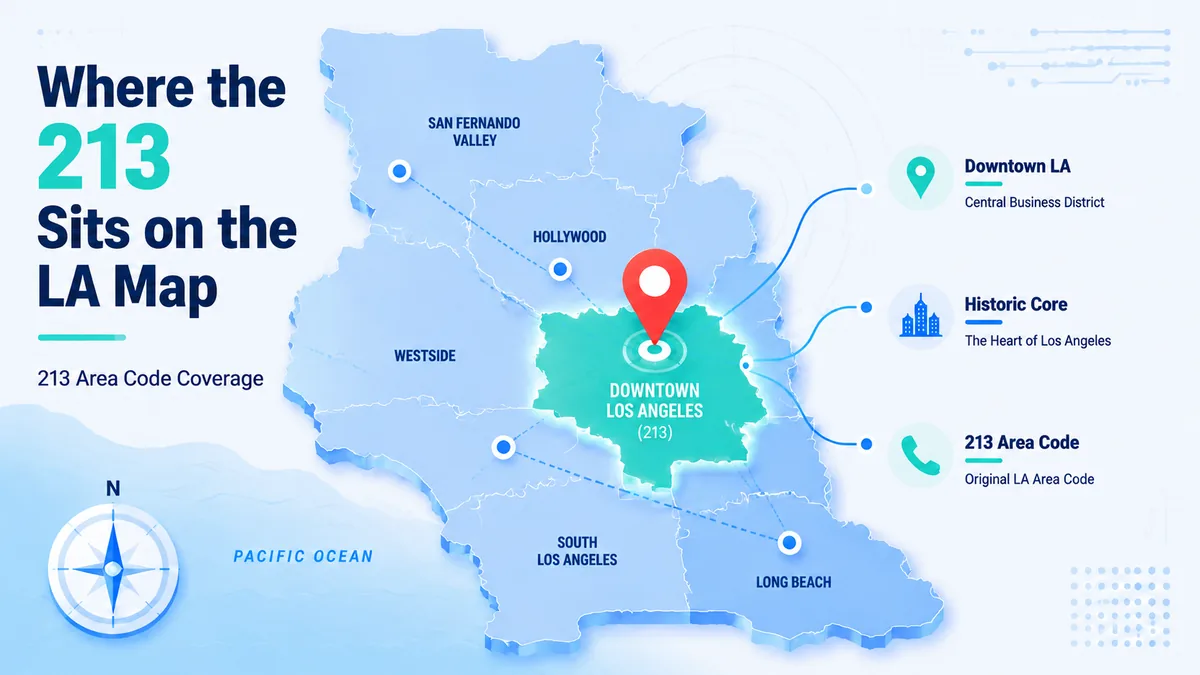
The 213 area code location is best understood as the compact urban core of Los Angeles — a relatively small but extremely dense slice of the city surrounded on all sides by other LA-area codes. It sits west of 562 (Long Beach and Southeast LA), south and east of 323 (Hollywood and East LA), and east of 310 (the Westside).
The 213 territory covers what most people picture when they think of a Los Angeles skyline: glass towers, packed boulevards, historic theaters, and neighborhoods so culturally layered they feel like a city within the city. The entire area sits in the Pacific Time Zone.
Los Angeles Area Codes at a Glance
| Area Code | Region |
|---|---|
| 213 | Downtown LA, Koreatown, Central LA (original code) |
| 323 | Hollywood, East LA, Silver Lake, Inglewood, South LA |
| 310 / 424 | Westside — Beverly Hills, Santa Monica, Malibu |
| 818 / 747 | San Fernando Valley — Burbank, Glendale, Van Nuys |
| 562 | Long Beach and Southeast LA County |
| 626 | San Gabriel Valley — Pasadena, Alhambra, Arcadia |
Neighborhoods the 213 Covers Today
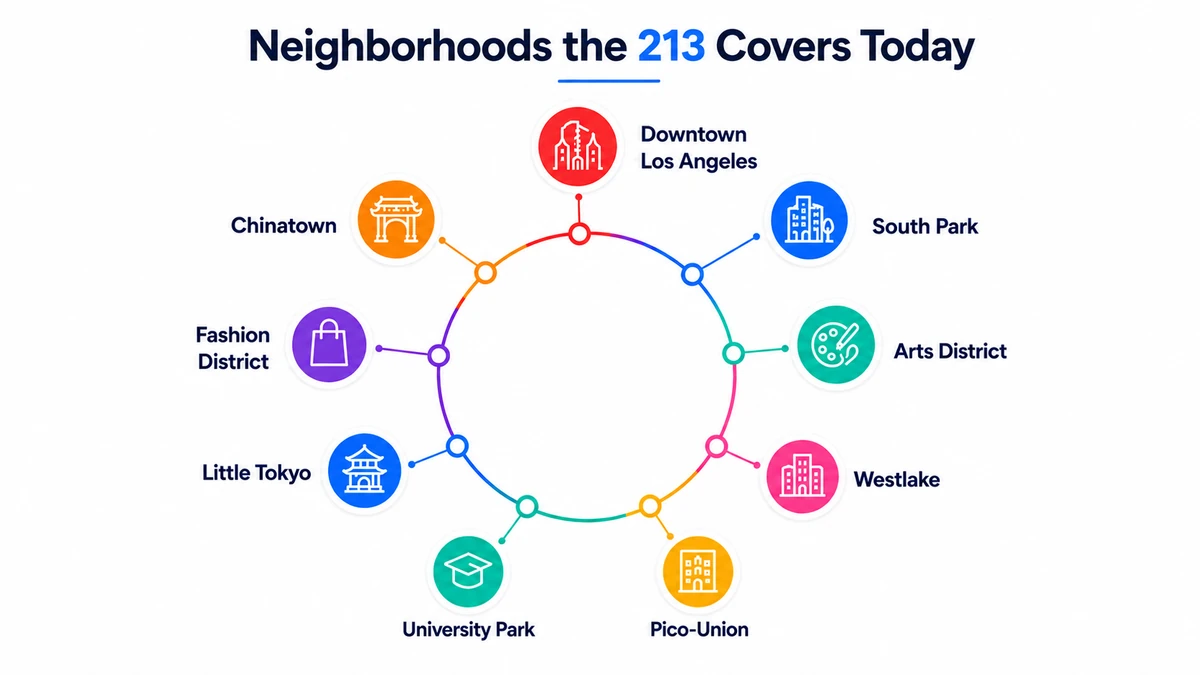
Because the 213 area code now covers a compact territory, it is better understood neighborhood by neighborhood than by geography alone:
- Downtown Los Angeles (DTLA): The financial district, Civic Center, City Hall, Grand Central Market, the Arts District, South Park, Little Tokyo, and the historic Broadway theater corridor. The fastest-growing residential neighborhood in LA, DTLA has transformed into a mixed-use hub with tech companies, hotels, restaurants, and an NBA arena (Crypto.com Arena, home of the Lakers and Clippers).
- Koreatown: One of the most densely populated urban neighborhoods in the United States — and the largest Koreatown in North America, home to Korean-American businesses, restaurants, karaoke bars, spas, and cultural institutions spread across a compact grid west of Downtown. Koreatown's 213 identity is inseparable from its story.
- Westlake: Immediately west of MacArthur Park, Westlake is one of LA's most diverse and densely populated neighborhoods — a gateway for Central American and Mexican immigrant communities with a vibrant street market economy along Alvarado Street.
- Pico-Union: South of Westlake, Pico-Union is a tight-knit neighborhood with a large Guatemalan and Salvadoran population, known for its family-owned restaurants and community resilience.
- Echo Park: On the northern edge of the 213 territory, Echo Park blends lakeside parks, Victorian homes, and a creative scene that has drawn artists and musicians for decades.
- Boyle Heights: East of Downtown across the LA River, Boyle Heights is one of LA's oldest communities — a historic Mexican-American neighborhood with deep roots in the city's labor and civil-rights history.
- Historic South Central: Parts of the northern stretch of South Central LA fall within the 213 territory, rounding out the code's reach into the city's working-class communities.
From All of California to Downtown LA
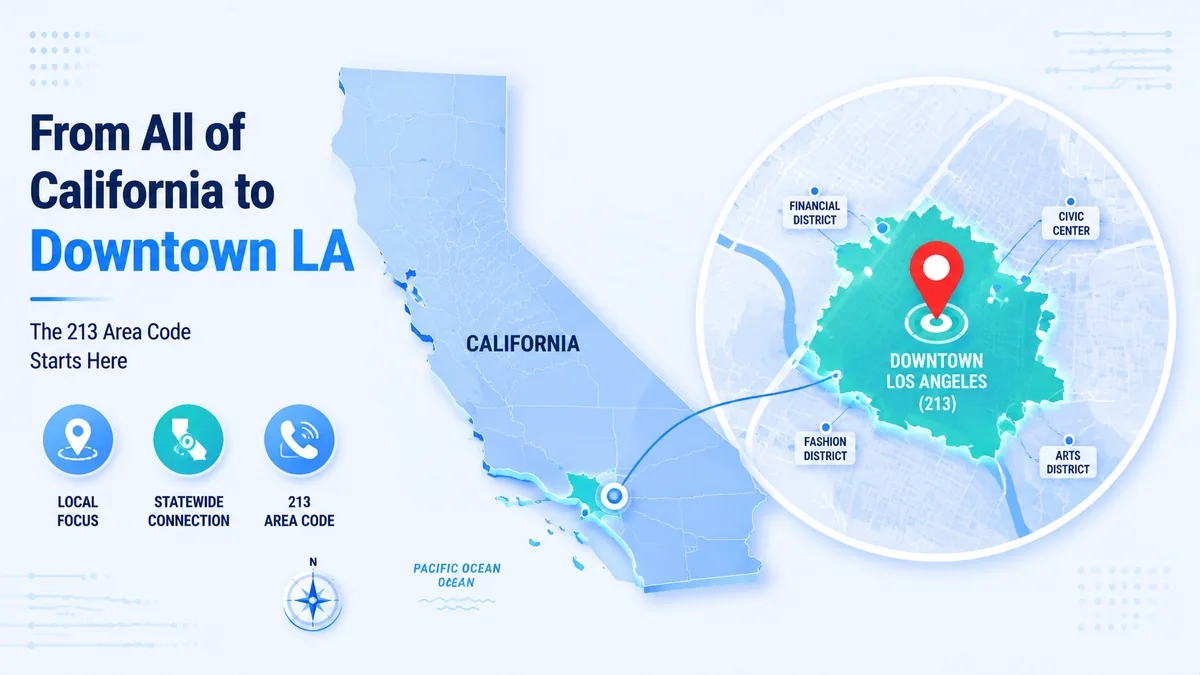
No other California area code has a story quite like the 213. It began as one of the largest geographic codes in history — and ended up as one of the smallest in the region. The journey from statewide to neighborhood-level is a 75-year lesson in how fast a city can grow.
The 213 Timeline
- January 1, 1947 — The original 213: AT&T launches the North American Numbering Plan with 86 area codes. California is assigned 213, covering the entire state. Nevada is initially included in the same code before receiving its own.
- 1951 — California gets a second code: Northern California is split off and given area code 415 (San Francisco and the Bay Area), leaving 213 to cover Southern California and the Central Valley.
- 1984 — San Diego splits: Area code 619 is created for San Diego and the southern counties, shrinking 213's territory to the Los Angeles metropolitan area and much of Southern California.
- 1991 — The Westside leaves: The 310 area code splits from 213 to serve the Westside of LA — Beverly Hills, Santa Monica, Malibu, the South Bay, and Long Beach. 213 retains the core of Los Angeles County.
- June 14, 1998 — Hollywood and East LA depart: Area code 323 is carved out of 213, taking Hollywood, East Los Angeles, Silver Lake, Los Feliz, Inglewood, and South Central. After this split, 213 is reduced to the compact territory it holds today — Downtown LA, Koreatown, and Central Los Angeles.
The result is that the 213 went from covering millions of square miles to a few dozen square miles in the span of 50 years — a reflection not of decline, but of the extraordinary growth of Los Angeles and the surrounding region that demanded new codes to handle the demand.
213 and 323: Two Codes, One City Story
When the 323 split from 213 in 1998, it drew a line through the heart of the City of Los Angeles that locals still navigate today. Understanding the difference between the two codes is key to understanding the modern LA phone landscape.
| Feature | 213 | 323 |
|---|---|---|
| Core neighborhoods | Downtown LA, Koreatown, Westlake, Pico-Union | Hollywood, East LA, Silver Lake, South LA, Inglewood |
| Introduced | January 1, 1947 | June 14, 1998 |
| Type | Original code (never split-from) | Geographic split from 213 |
| Prestige | The original LA area code | Newer, covers Hollywood and creative communities |
| Dialing | 10-digit | 10-digit |
Just as New Yorkers distinguish between a 212 (Manhattan) and a 718 (outer boroughs), LA insiders read meaning into 213 vs. 323. The 213 signals Downtown — finance, law, city government, and the urban core. The 323 signals Hollywood and the creative economy. Both are legitimate and respected, but the 213 carries the weight of history that no newer code can match.
Pacific Time and 10-Digit Dialing in LA
The entire 213 region runs on Pacific Time (PT):
- Pacific Standard Time (PST): UTC−8, from the first Sunday in November to the second Sunday in March.
- Pacific Daylight Time (PDT): UTC−7, from the second Sunday in March to the first Sunday in November.
How to Dial a 213 Number
- Within the US or Canada: Dial all 10 digits — 213-XXX-XXXX. The LA metro area has so many overlapping area codes that 10-digit dialing is mandatory throughout the region, including for calls within the same area code.
- From outside the US: Dial your international exit code, the US country code, then the number — +1-213-XXX-XXXX.
When scheduling calls with a 213 contact, remember LA is on Pacific Time — 3 hours behind New York, 8 hours behind London. To send a text, enter the full 10-digit number.
Downtown LA's Rising Urban Economy
The territory served by the 213 area code is in the middle of one of the most dramatic urban revivals in US history. For decades, Downtown LA was largely abandoned after business hours. Over the last two decades, it has become one of the fastest-growing residential and commercial districts in the country:
- Finance and law: The financial district along Figueroa Street and Bunker Hill is home to major banks, law firms, and corporate headquarters — a dense professional core that generates enormous call traffic under the 213 prefix.
- Government and civic: Los Angeles City Hall, the LA County courthouse complex, the LAPD headquarters, and federal buildings all operate under 213 numbers — the code is literally the number for city government.
- Tech and creative industry: The Arts District east of Downtown has become a hub for tech startups, creative agencies, and co-working spaces. Crypto.com Arena, home of the Lakers, Clippers, and Kings, anchors the South Park entertainment district.
- Hospitality and food: Grand Central Market, the Broad museum, the revitalized Broadway corridor, and hundreds of new restaurants and hotels have made DTLA a destination — and all operate under the 213 code.
- Koreatown's economy: Koreatown alone has a GDP larger than many midsize US cities, with thousands of Korean-owned businesses — restaurants, spas, beauty suppliers, medical offices — anchoring one of LA's most commercially vibrant corridors.
- Residential growth: DTLA's resident population has grown dramatically since the early 2000s, filling converted lofts, new high-rises, and adaptive-reuse buildings across the entire 213 territory.
Virtual 213 Numbers vs. Traditional Lines
If you want a 213 phone number for your business, the modern choice is clear: a virtual number gives you the same local LA presence as a physical landline, without the hardware, contracts, or requirement to maintain a Downtown office.
Flexibility and Reach
- Traditional landline: Tied to a physical address in Central or Downtown LA. You have to be in the office to answer — difficult for distributed teams or remote workers.
- Virtual number: Lives in the cloud and rings on your phone, laptop, or tablet anywhere in the world. Answer a Downtown LA client while you are in New York — or Tokyo.
Cost and Setup
- Traditional landline: Installation fees, hardware costs, long-term contracts, and a physical Los Angeles address required.
- Virtual number: No hardware, no contracts, low monthly subscription, and providers like Callmama can provision a genuine 213 number in minutes.
Why a 213 Number Stands Out in Los Angeles
In a city with six active area codes, the 213 is the one that reads as original. A 213 number signals that you are based in the city's core — not in a suburb, not in the Valley, not on the Westside. For certain businesses, that specificity is exactly the right signal.
Credibility With LA's Urban Core Clients
Law firms, financial services companies, government contractors, and businesses serving Koreatown or Downtown demographics all benefit from a 213 number. Clients in these sectors recognize 213 as the code for the city's professional and civic heart — not a generic toll- free or out-of-area number.
The Prestige of the Original Code
Among LA insiders, a 213 number carries an understated cachet that newer codes do not. It is the area code that predates Hollywood's rise as an entertainment capital, that ran through the 1984 Olympics, and that still anchors the skyline. For brands that want to signal deep LA roots, 213 communicates authenticity that the 818 area code or 424 simply cannot.
Local Presence Without a Physical Office
A virtual 213 phone number lets any business — anywhere in the world — establish an instant, credible presence in Downtown Los Angeles without signing a lease on Figueroa Street. For international companies expanding to the US West Coast or remote teams serving the LA market, it is the most cost-effective way to land a local identity.
How to Get a 213 Number — Step by Step
Getting a 213 phone number takes only minutes — not days or weeks. Here is the process:
Get the App or Create Your Account
Get the app from the Apple App Store or Google Play, or sign up on our website. Create your account with just an email address — no credit card needed to browse numbers.
Search for Available 213 Numbers
Open the number selection screen and enter "213" to browse available Downtown LA numbers. Select from standard numbers or use the advanced search for memorable or vanity patterns.
Select Your Number
Choose the number that fits your brand. A vanity number with a memorable sequence can reinforce your business identity and make it easier for LA clients to recall.
Choose a Plan
Pick a plan that matches your needs — from a single line for solo operators to a full- featured business plan with team dashboards and call analytics. All plans include unlimited incoming calls and SMS.
Activate and Start Calling
Finish registration and your new 213 number goes live instantly. Make and receive calls and texts from any device, anywhere in the world.
Get Your Los Angeles 213 Number Today
Sound like you're calling from Downtown LA — from anywhere in the world. Activate a virtual 213 number in minutes with no contracts, no hardware, and no LA office required.
More From Your 213 Line
A virtual 213 phone number is more than a local line — it is a full cloud communication platform built for how modern LA businesses operate.
Built for Businesses Serving the LA Urban Core
- Instant local presence: Show a Downtown LA area code to every caller — instantly recognizable to LA clients.
- Call forwarding: Route incoming 213 calls to any device so you never miss a client in the city.
- Two-way SMS: Text clients for appointments, follow-ups, and support — all from your 213 number.
- IVR auto-attendant: A professional "Press 1 for Sales" greeting, even for a solo operator.
- Voicemail to email: Receive voicemail transcriptions straight to your inbox.
- Call recording: Record calls for compliance and training, with STIR/SHAKEN caller verification.
- Team dashboard: Manage the number across your team with shared call history, notes, and contacts.
213 Virtual Number vs. Traditional Landline
| Feature | Virtual 213 Number | Traditional Landline |
|---|---|---|
| Setup time | Minutes | Days to weeks |
| LA address required | No | Yes |
| Works on mobile | Yes — any device | Desk phone only |
| SMS capable | Yes | No |
| Call recording | Included | Expensive add-on |
| Contract required | No | Yes |
| Monthly cost | Low flat subscription | High (hardware + service + lines) |
Is a 213 Call Legitimate? Spotting Fakes
The 213 area code is not a scam. It is a legitimate Los Angeles code serving millions of real residents, businesses, and government offices in Central and Downtown LA. But because a 213 number reads as a trusted local LA call, it is a common target for "neighbor spoofing" — where scammers fake the caller ID to make their call look like it comes from a familiar local number, increasing the odds you will pick up.
Common Scam Patterns Tied to 213 Numbers
- Government impersonation: Callers claiming to be the LAPD, LA County courts, the IRS, or Social Security — threatening arrest, fines, or benefit suspension unless you pay immediately.
- Utility cut-off scams: Fake calls claiming your LADWP (Department of Water and Power) service will be disconnected unless you pay in gift cards or wire transfer.
- Business email compromise follow-ups: Scammers who already have your email address call from a 213 number pretending to confirm a fraudulent invoice or wire transfer.
- Robocalls about car warranties, health plans, or mortgages that use spoofed 213 numbers to appear local.
- Fake lottery or prize calls claiming you won a draw tied to an LA event and asking for a processing fee.
How to Protect Yourself
- Never trust caller ID alone — any 213 number can be spoofed. Hang up and call back on the official number you look up independently.
- No legitimate government agency demands immediate payment by gift card, wire transfer, or cryptocurrency — ever.
- Let unknown 213 numbers go to voicemail — real callers leave messages; scammers usually do not.
- Use call-blocking apps — many carriers and third-party apps flag known spam numbers before they ring through.
Suspected 213 scam calls can be reported to the FTC at reportfraud.ftc.gov to help investigators shut down spoofing operations targeting Downtown LA residents.
For businesses using a 213 number through Callmama, outbound calls are verified with STIR/SHAKEN authentication — so your legitimate calls are not mistakenly labeled "Scam Likely" on a client's caller ID.
The Last Word on Area Code 213
The 213 is unlike any other area code in Los Angeles. It is the original — the prefix that was there before Hollywood became Hollywood, before the freeways carved up the basin, before LA became one of the most recognized cities on earth. Today it covers a compact but extraordinarily dense slice of the city: Downtown LA's glass towers and arts institutions, Koreatown's restaurant corridors and cultural energy, Westlake's immigrant communities, and Echo Park's creative neighborhoods.
If you want a foothold in the heart of Los Angeles — in the city that gave this code its name — you do not need an office on Figueroa. A virtual 213 phone number gives you a genuine Downtown LA presence in minutes, on any device, from anywhere in the world.
Download the Callmama App
Turn your phone into a complete Los Angeles business line. Call, text, and manage your 213 number from iOS, Android, or the web — from anywhere on the planet.
