Introduction
The 844 area code is a toll-free telephone prefix used by businesses across the United States, Canada, and more than 20 countries in the North American Numbering Plan — free to call for every customer who dials it.
Unlike geographic codes tied to specific cities or states, the 844 area code has no fixed location; any business from a solo startup to a national enterprise can use it to project a professional, nationwide presence.
This guide covers exactly how the 844 system works, who relies on it most, what scam risks to watch for, and how to get your own 844 phone number through a modern virtual provider. Whether you just received a call from an 844 number or want to upgrade your business communication, all the answers are right here.
Key Takeaways
- The 844 area code is a toll-free prefix — callers pay nothing; the business owning the number absorbs all call costs.
- It covers the entire United States, Canada, and 20+ other NANP countries — with no geographic boundary whatsoever.
- The prefix launched on December 7, 2013, to expand the toll-free pool as older codes like 800 and 888 neared exhaustion.
- Scammers exploit toll-free numbers to appear credible — knowing the warning signs protects your personal information.
Understanding the 844 Area Code: Toll-Free, Not Geographic
In the North American Numbering Plan, area codes identify either a geographic region or a billing arrangement. The 844 area code belongs firmly in the second category — it is a service code, not a location code. When you dial any 844 number, the call is completely free to you; the business that owns the number pays all inbound call costs to its carrier.
The FCC officially designates seven prefixes as toll-free: 800, 833, 844, 855, 866, 877, and 888. Each works identically for callers — no charge from any US or Canadian phone. The 844 area code is one of the newer additions to this family, opened in 2013 specifically to extend the supply of available numbers as the older pools approached saturation.
Because an 844 number carries no geographic identity, it can be held by any business, anywhere in North America. A contractor in rural Montana and a bank headquartered in New York City can both operate under the same 844 number system — and both project the same nationwide credibility to every caller who dials in.
Who Uses 844 Numbers and Why
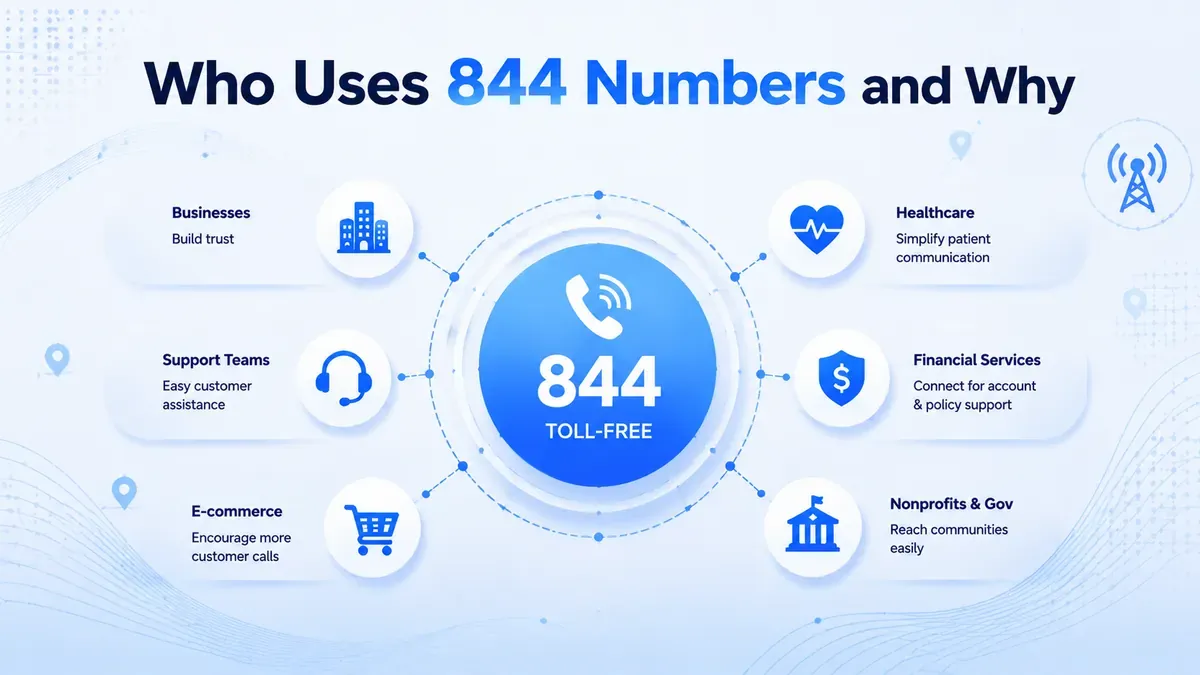
The 844 area code appears on inbound lines for organizations of every size and sector. Customer service centers use it so callers can reach support without paying long-distance fees. Healthcare providers, insurance companies, and financial institutions list 844 numbers on billing statements and policy documents because they are easy to remember and cost the caller nothing to dial.
Small businesses and startups use the 844 phone number to compete with larger brands on equal footing. A sole proprietor can answer calls on a mobile phone while presenting a polished, national-brand number to the public. Nonprofits, government agencies, and crisis helplines also favor 844 numbers because they remove every cost barrier for people who need assistance most.
One practical advantage over older toll-free codes: the 844 number pool is far less exhausted, making it easier — and often cheaper — to secure a memorable vanity number like 1-844-TAX-HELP or 1-844-FAST-FIX for instant brand recall.
How an 844 Toll-Free Number Works
When you dial an 844 area code number, your carrier queries a centralized database managed by Somos, Inc. — the FCC-authorized administrator for the toll-free number registry. That database returns the routing instructions the business has configured, and your call is forwarded to the designated endpoint: a mobile phone, a VoIP system, a landline, or a cloud call center.
The business pays per-minute rates to its carrier for all inbound calls, similar to outbound long-distance charges. These rates vary by provider and plan, but they are low enough to make an 844 number cost-effective even for a sole proprietor. Most virtual providers bundle these costs into predictable flat monthly plans.
Many 844 numbers also support two-way SMS and MMS messaging, provided the business has text-enabled the line through its provider. This lets companies run text-based customer service, send appointment reminders, and accept orders by message — all through the same toll-free line customers already know.
Toll-free calling builds trust fast — your customers call more when the call is free.
Get a professional 844 number active today, with SMS, call forwarding, and voicemail included.
The History Behind Toll-Free Codes — Where 844 Fits In
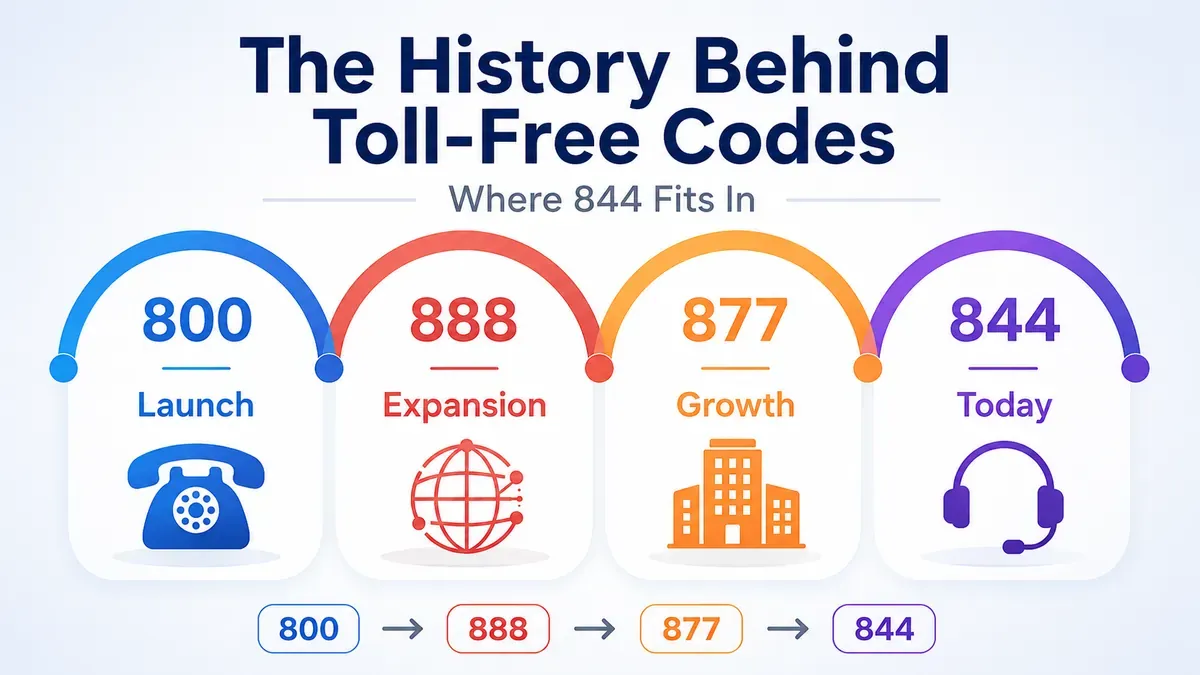
Toll-free calling in the US began in 1966, when AT&T introduced the 800 prefix. Businesses adopted it immediately, and decades of growth steadily exhausted the supply, forcing regulators to release new prefixes one by one:
- 800 — 1966: The original toll-free code, now largely exhausted and commanding premium prices.
- 888 — 1996: Added as demand outpaced the 800 pool; well-recognized and widely trusted today.
- 877 — 1998: Introduced to keep pace with internet-era business growth.
- 866 — 2000: Expanded supply further during the dot-com boom.
- 855 — 2010: Added as mobile adoption drove a new wave of toll-free demand.
- 844 — December 7, 2013: The FCC opens the 844 area code for assignment, giving businesses a fresh, healthy pool of numbers to choose from.
- 833 — June 3, 2017: The newest addition — compare how it stacks up in our guide to the 833 area code.
Today, the 844 area code sits in a strong middle position — well-established enough to be trusted by callers, and still available enough to offer excellent number choices for new businesses.
844 vs. Other Toll-Free Codes — 800, 833, 855, 877, and 888
All toll-free prefixes deliver the same experience to the caller: free calls from the US and Canada. The real differences are availability, cost, and brand perception.
| Prefix | Launched | Availability | Perception |
|---|---|---|---|
| 800 | 1966 | Very scarce | Highest recognition |
| 888 | 1996 | Limited | Well-known, trusted |
| 877 | 1998 | Moderate | Recognized, professional |
| 866 | 2000 | Moderate | Standard business line |
| 855 | 2010 | Good | Modern, widely used |
| 844 | 2013 | Very good | Modern, fast-growing |
| 833 | 2017 | Best | Newest, most inventory |
For businesses choosing the 844 code, the key benefit is inventory: far more available numbers than 800 or 888, at a lower price point. For callers, every prefix in this table works identically — free of charge.
Why Your Business Needs an 844 Number Right Now
An 844 area code line signals that your business is professional, established, and reachable from anywhere — without requiring a physical office or expensive hardware. Companies that publish toll-free numbers consistently report higher inbound call volumes than those that list only local numbers, simply because removing the cost barrier encourages more people to call.
Much like the 832 area code, virtual toll-free lines come loaded with features: call forwarding to any device, IVR menus for professional routing, voicemail transcription, call recording, and campaign-level analytics. Assigning a dedicated 844 phone number to each marketing channel lets you track which ads are actually driving calls — a level of attribution a single local number can never provide.
How to Get a Virtual Phone Number from CallMama
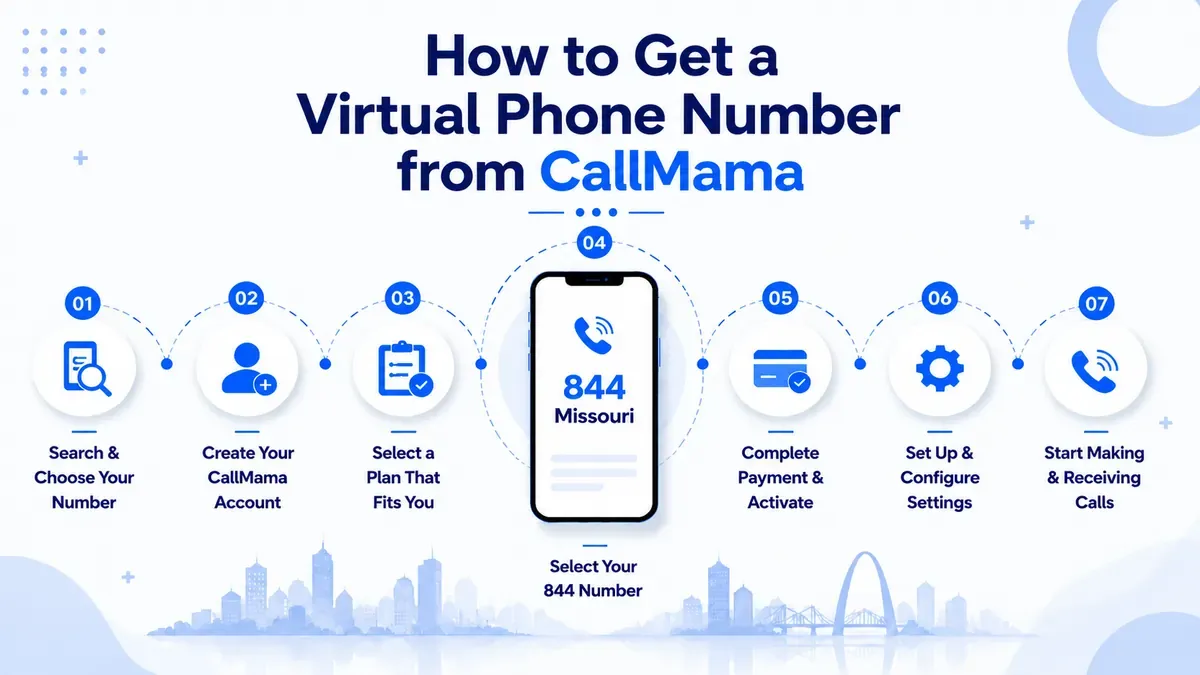
CallMama makes it fast and simple to claim an 844 area code number for any business. The platform provides toll-free virtual numbers with advanced features — call forwarding, SMS, voicemail, and call recording — all managed from one app with no technical setup required.
Is the 844 Area Code a Scam? How to Stay Safe
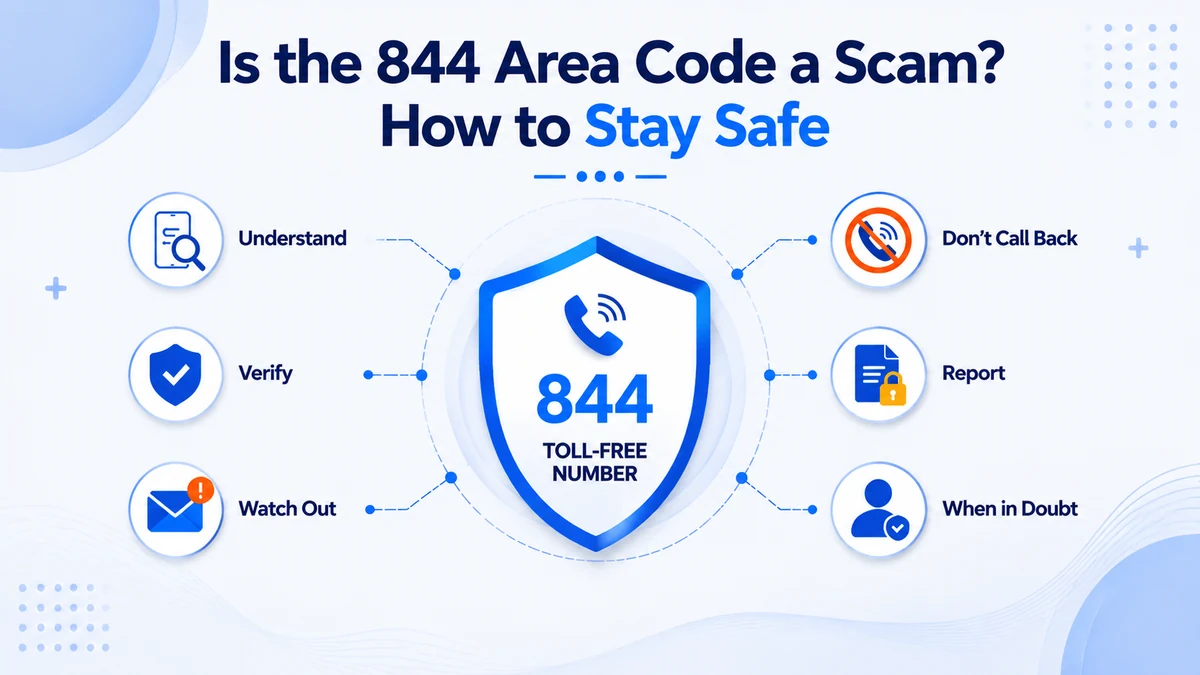
The 844 area code is not a scam. It is a legitimate, FCC-designated toll-free prefix used daily by thousands of reputable companies, government agencies, and nonprofits. However, because toll-free numbers project authority, fraudsters deliberately use them to impersonate banks, tech companies, and government bodies.
The most common schemes involve IRS impersonation, tech support fraud, Medicare and Social Security benefit scams, and bank calls requesting account verification. No legitimate organization will call from an 844 number and pressure you to pay immediately with gift cards, wire transfers, or cryptocurrency. For guidance on stopping unwanted calls, the FCC guidelines remain the definitive resource.
Common 844 Scam Types
Fraudulent 844 phone number calls typically follow one of four scripts: urgent threats such as arrest or account suspension, prize or benefit notifications, extended warranty pitches, or account verification requests. All rely on panic so you act before you think — hanging up and calling back through a verified number is always the right move.
How to Block Unwanted 844 Calls
Add problem numbers to your phone's built-in block list, register at DoNotCall.gov, and enable your carrier's free spam-call filtering service. Use apps like Hiya or Nomorobo for an extra layer of protection, and report persistent scam numbers to the FTC at ReportFraud.ftc.gov so regulators can act.
Conclusion
The 844 area code is one of the most practical tools a business can add to its communication stack today. It removes every cost barrier for callers, delivers a credible nationwide image, and works on any device without hardware investment.
The 844 prefix is mature, widely recognized, and still carries a healthy inventory of numbers for businesses that want a memorable vanity sequence. With the right provider, a new 844 toll-free number can be active and taking calls within minutes of sign-up.
If your business is ready to connect with customers across North America, an 844 area code line is the first upgrade worth making. Start by identifying the number or vanity phrase that fits your brand, then compare plan options to match your call volume.
CallMama delivers a full-featured 844 phone number with no long-term contracts and no complicated hardware setup. Take action today — your customers call more when the call is free.
Your 844 number is waiting — claim it before someone else does.
CallMama's toll-free virtual numbers include call forwarding, SMS, and voicemail, all in one easy app.