Introduction
The 888 area code is the second-oldest toll-free prefix in North America, carrying free customer calls for businesses since March 1996. Because the 888 area code shows up on everything from bank fraud alerts to phishing texts, understanding it helps you answer with confidence and hang up with certainty.
This guide explains what makes 888 numbers free, which organizations use them, why the triple eight is telecom's luckiest sequence, and how to claim an 888 phone number of your own. Stay to the end and the next 888 call you receive — or publish — will work in your favor.
Key Takeaways
- The 888 area code is toll-free — callers across the US and Canada pay nothing, and the number's owner covers every inbound charge.
- 888 launched on March 1, 1996, ending the 800 prefix's thirty-year run as the only toll-free code in North America.
- The digit 8 signals prosperity in Chinese culture, making triple-8 numbers some of the most sought-after lines in telecom.
- Scammers exploit 888's credibility with fake fraud alerts and spam texts — verifying through official channels defeats them every time.
888 Numbers Are Toll-Free — Here's What That Actually Means
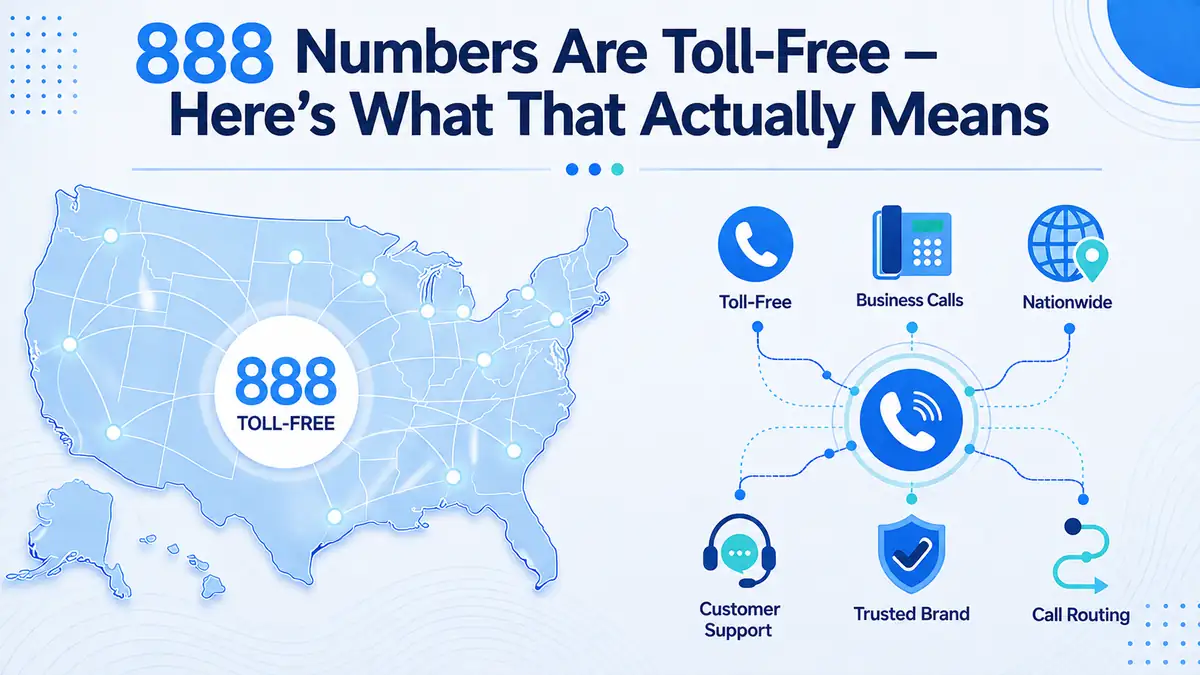
An area code usually answers the question "where?" The 888 area code answers "who pays?" instead. It belongs to the family of seven toll-free prefixes — 800, 833, 844, 855, 866, 877, and 888 — where the person dialing pays nothing and the organization receiving the call absorbs the full cost.
Since no city or state owns the prefix, an 888 number works identically across the whole North American Numbering Plan: every US state, Canada, Bermuda, and much of the Caribbean. One line serves a customer in Seattle and a customer in Halifax the same way, with zero long-distance charges on either end.
Watch for one common mix-up: 888 is toll-free, but similar-looking codes are not. The 876 code belongs to Jamaica and bills international rates — a favorite trick in callback scams — so glance twice at the exact 888 code before dialing back.
The Companies Behind 888 Calls, From Banks to Booking Lines
Nearly three decades of service have filled the 888 pool with household names. Banks send fraud alerts from it, credit card companies run activation lines on it, and airlines, hotels, insurers, and utilities use the 888 area code for reservations, claims, and account support. Callers recognize the prefix instantly, which is precisely why large organizations keep it front and center.
Debt collectors, political campaigns, and market researchers use toll-free lines too, so not every 888 call is one you will enjoy. Treat any unexpected request for money or personal data as unverified: hang up, find the organization's official number on its website or your statement, and call that instead.
Many 888 lines also send texts — delivery updates, appointment reminders, and login codes. US carriers require toll-free senders to complete verification before any SMS goes out, so a texting 888 number has cleared an identity check that ordinary local numbers never face.
1996: The Year 888 Ended the 800 Monopoly
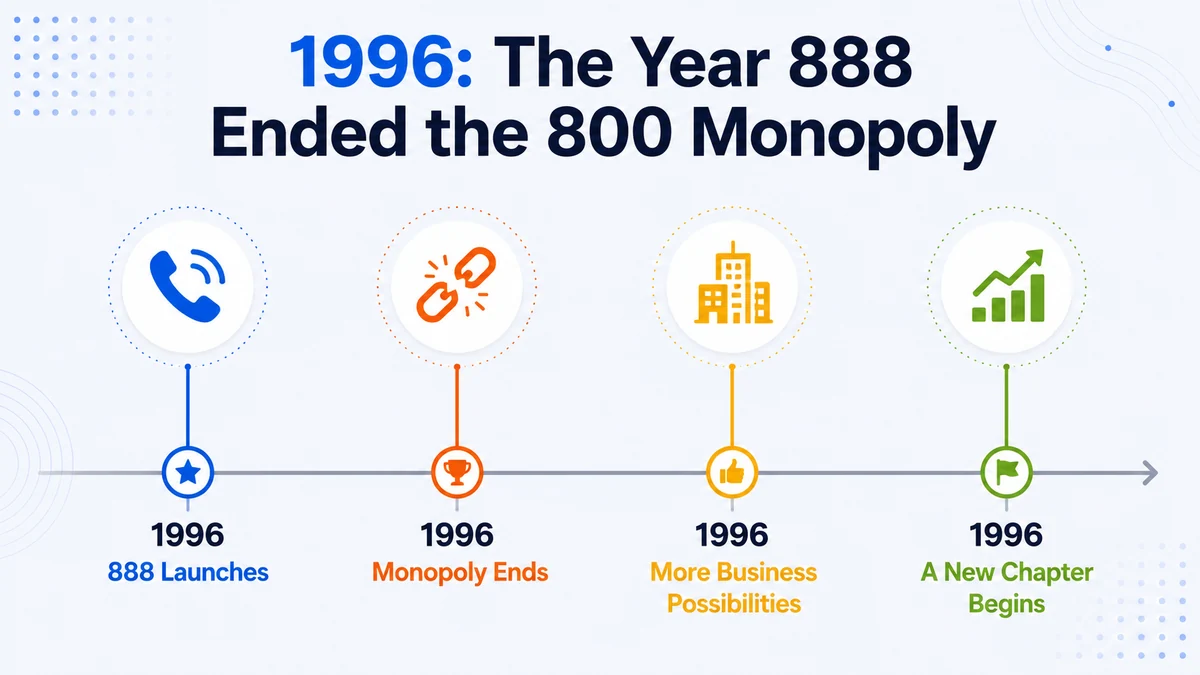
For thirty years, "toll-free" meant one thing: 800. AT&T launched that original prefix in 1966, and by the mid-1990s its 7.8 million usable numbers were nearly gone. On March 1, 1996, regulators opened the 888 area code — the first expansion of toll-free service in history.
Businesses raced to protect their brands, and regulators even set aside hundreds of thousands of 888 numbers matching existing 800 vanity lines so companies could claim their twins before squatters did.
- 800 — 1966: The original toll-free code, now essentially exhausted.
- 888 — March 1, 1996: The first relief code, snapped up at record pace.
- 877 — 1998: Released just two years later as demand kept surging.
- 866 — 2000: The dot-com-era addition — full story in our 866 guide.
- 855 — 2010: The smartphone-era code with strong modern inventory.
- 844 — 2013: A modern option with healthy inventory.
- 833 — 2017: The newest prefix with the widest selection.
That 1996 launch made 888 the second-most-recognized toll-free code on the planet — and after nearly thirty years of steady demand, its pool of desirable numbers has grown genuinely scarce.
Three decades of caller trust is built into every 888 line.
Good 888 inventory is scarce and shrinking — secure yours in minutes with forwarding, voicemail, and SMS included.
Triple Eights: The Luckiest Digits in Telecom
No other prefix carries the cultural weight of 888. In Chinese tradition, the digit 8 (ba) sounds like the word for wealth (fa), so tripling it signals fortune multiplied — the same reason license plates and phone numbers rich in eights sell at auction for extraordinary sums across Asia. A Beijing Olympics opening ceremony scheduled for 8:08 PM on 8/8/2008 says everything about the number's pull.
For businesses serving Chinese, Vietnamese, and wider Asian-diaspora communities, an 888 phone number is a genuine marketing asset — a prefix customers actively prefer to dial. Even outside any cultural context, a repeating triple digit is simply easier to remember from a radio spot or roadside billboard than a mixed sequence, which keeps demand for the 888 code permanently high.
Where 888 Stands Among the Seven Toll-Free Codes
All seven prefixes cost the caller nothing, so the real comparison is recognition against availability — and 888 sits right behind 800 on both counts.
| Prefix | Launched | Availability | Standout Trait |
|---|---|---|---|
| 800 | 1966 | Very scarce | The original, priced at a premium |
| 888 | 1996 | Limited | Lucky triple digit, deep trust |
| 877 | 1998 | Moderate | Established professional feel |
| 866 | 2000 | Moderate | Dot-com era workhorse |
| 855 | 2010 | Good | Solid modern inventory |
| 844 | 2013 | Very good | Wide choice of digits |
| 833 | 2017 | Best | Newest, most availability |
The practical takeaway: if you find an 888 number whose digits fit your brand, take it. Its combination of instant recognition, lucky-number appeal, and shrinking supply will not get easier to secure next year. If 888 inventory feels too tight, our 855 breakdown covers a code with more room to choose from.
What an 888 Phone Number Signals to Your Customers
Publishing a toll-free line tells customers three things at once: calling costs you nothing, the company is established enough to pay for your call, and one number reaches it from anywhere. That is why an 888 area code line consistently pulls more inbound calls than a local-only listing.
A virtual 888 line adds the operational muscle: forwarding to any phone, auto-attendant menus, transcribed voicemail, and verified SMS. Route the line to your cell during the day and to voicemail after hours, and a one-person operation answers like a national support desk.
How to Get a Virtual Phone Number from CallMama
CallMama offers virtual toll-free and local numbers with forwarding, voicemail, and SMS managed from a single app — no hardware, contracts, or technical setup. Your 888 phone number activates in minutes and is ready for calls immediately.
Visit the Website or Download the App
Go to callmama.com or get the app from the App Store or Google Play.
Create Your Free Account
Register with your email address to open the number dashboard.
Choose Your Plan
Pick monthly or pay-as-you-go pricing that matches your call volume.
Select Your 888 Number
Browse live inventory and hunt for the digit pattern you want.
Activate Instantly
Complete payment and your number goes live immediately, with no waiting period.
Configure Your Settings
Set up call forwarding, voicemail, and SMS to fit your schedule.
Start Calling Right Away
Make and receive calls on any smartphone, tablet, or computer.
Spotting Fake 888 Calls and Texts Before They Cost You
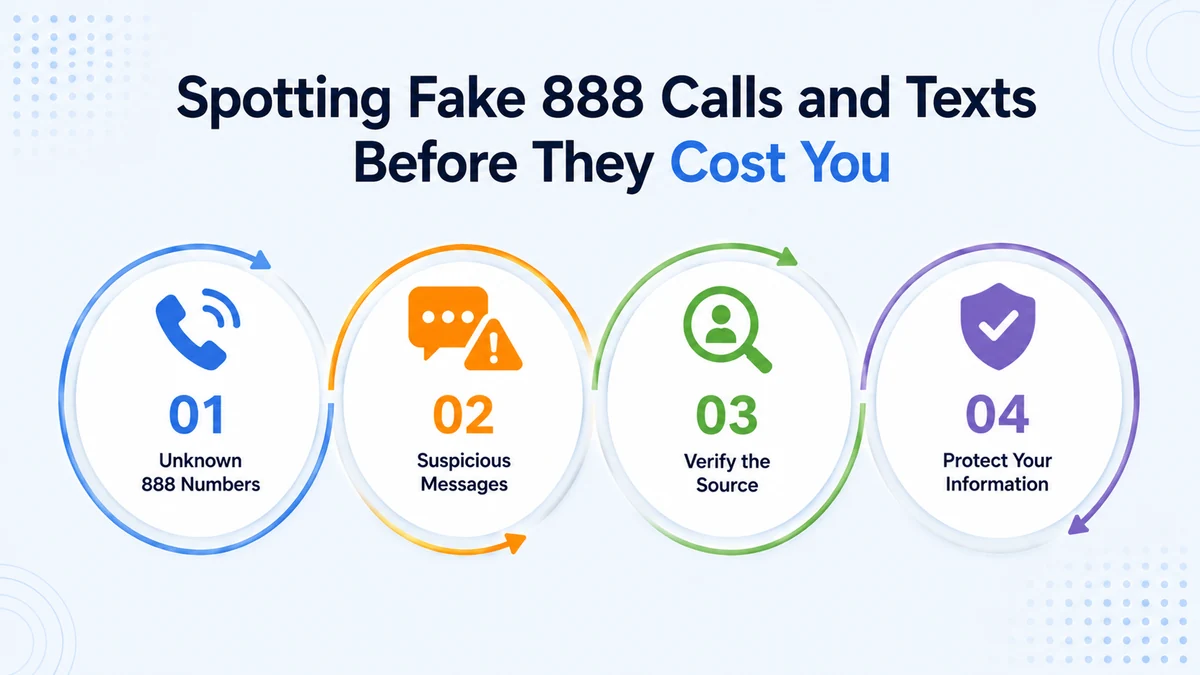
The 888 area code is completely legitimate, and that reputation is exactly what fraudsters hijack. Because real banks genuinely text and call from 888 lines, a fake "suspicious transaction" alert from a lookalike number feels believable — and one tapped link later, the scammer holds your login.
Per FCC guidelines, toll-free numbers are assigned only through registered providers, so anyone can hold one — legitimacy lives in the caller's behavior, never in the prefix.
The Fake Bank Alert Playbook
The most common 888 fraud opens with urgency: "Your account is locked — call now" or "Confirm this $900 charge." Real institutions never demand passwords, full card numbers, or gift-card payments over the phone. When any alert lands, skip the number in the message entirely and contact your bank through the app or the number printed on your card.
Blocking the Repeat Offenders
Block nuisance numbers directly on your phone, turn on your carrier's free spam filter, and add your line to DoNotCall.gov to cut unsolicited volume. Persistent scam callers belong at ReportFraud.ftc.gov, where complaints feed real enforcement actions.
Conclusion
The 888 area code earned its place as the second pillar of toll-free calling, from its record-setting 1996 launch to the lucky-number status that keeps demand high today.
You now know why the prefix has no location, why banks and airlines rely on it, and how its triple eights carry real cultural and marketing weight. Just as important, you can separate a genuine 888 fraud alert from a fake one in seconds. That puts you ahead of most people who see these ten digits on a screen.
As the older toll-free pools shrink, a memorable 888 phone number only becomes harder to find. Claiming one today means locking in three decades of built-in caller trust at a small monthly cost. The whole process — account, number, activation — fits inside a coffee break. Grab the triple eights while they are still on the shelf, and let every customer reach you for free.
Your lucky number is waiting — make the triple eight yours.
Download the CallMama app, pick an 888 line from live inventory, and take your first free customer call today.